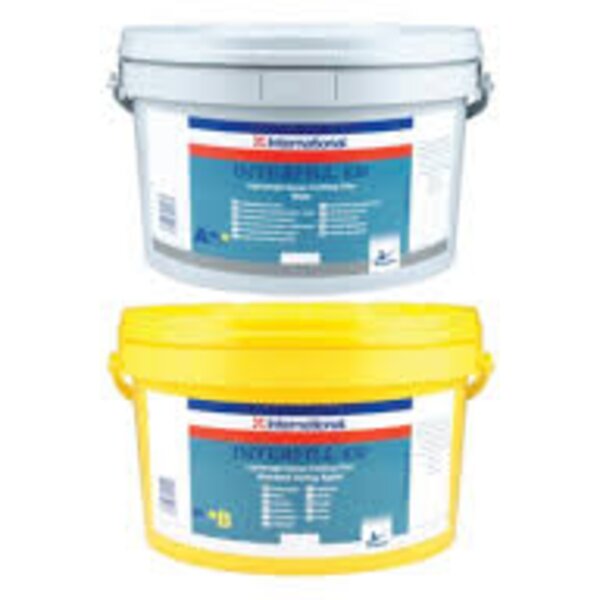
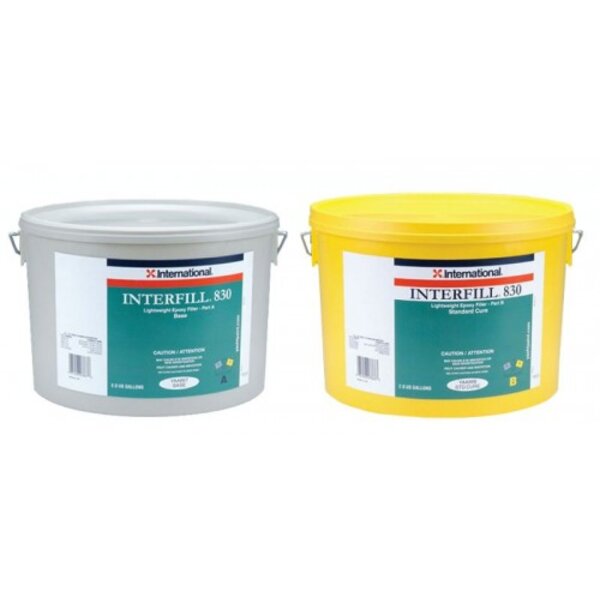
What is Interfill 830 Part A and why choose it?
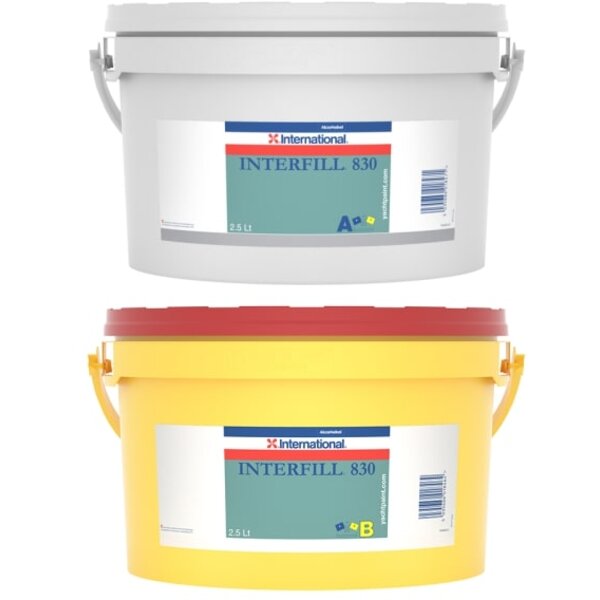
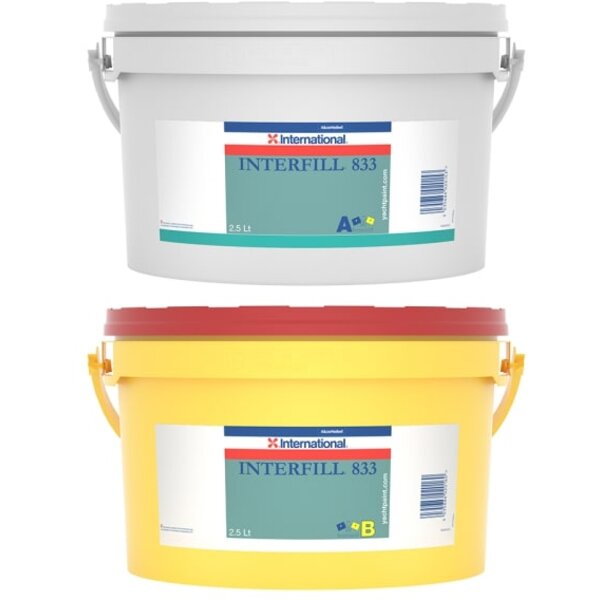
INTERFILL 830 PART A by International Náutica is the grey epoxy base component of the Interfill 830 fairing system. Designed for professional use, it is an interior and exterior profiling filler for steel, aluminium and composite hulls, above and below the waterline. Combined 1:1 by volume with its dedicated curing agent (YAA868), it produces a lightweight, high-build epoxy filler that can be applied up to 20,000 microns (2 cm) in a single coat at 23°C without sagging, then sands to a smooth, waterproof surface ready for high-build epoxy primers.
Main features
- High-build epoxy filler system: two-component, light grey epoxy designed specifically for profiling and fairing large hull areas.
- Very thick application in one pass: can be applied up to 2 cm (20,000 microns) in a single coat at 23°C without the risk of sagging or slumping.
- Low-density composition: helps minimise added hull weight while still delivering high strength.
- High strength and impact resistance: robust cured film suitable for demanding marine environments.
- Easy sanding: once cured, it sands to a fair, smooth surface with 80–180 grit wet or dry abrasive.
- Waterproof: provides an impermeable epoxy layer, ideal as part of osmosis prevention or repair schemes.
- Direct overcoating: when sanded, can be overcoated directly with Interprime 820 high-build epoxy primer, Interprime 880, Epoxy GP Coating or Interprotect Professional.
- Professional-grade quality control: manufactured under strict quality and laboratory testing standards for consistent performance.
Key technical characteristics
- Product type: Epoxy profiling filler, Part A (base).
- Colour: YAA867 – light grey.
- Finish: Matt.
- Specific gravity: approx. 0.75–0.80 g/cm³.
- Volume solids: 100%.
- Mix ratio (with Part B YAA868): 1:1 by volume (as supplied); approx. 1.15:1 by weight (YAA867:YAA868).
- Recommended maximum wet/dry film thickness per coat: up to 20,000 microns (2 cm) by trowel, knife or batten.
- Theoretical coverage: approx. 0.2 m²/L per coat at 5 mm (5000 microns) WFT.
- Pot life (mixed product): approx. 75 min at 10°C, 55 min at 15°C, 45 min at 23°C, 20 min at 35°C.
- Sandable time: approx. 48 h at 10°C, 28 h at 15°C, 19 h at 23°C, 13 h at 35°C.
- Typical shelf life: 2 years in unopened original containers.
- VOC (as supplied): approx. 77 g/L.
- Pack sizes: 5 L and 20 L units.
Overcoating and drying information
- Sandable:
- 10°C: 48 hours
- 15°C: 28 hours
- 23°C: 19 hours
- 35°C: 13 hours
- Recommended application temperature: use, mix and apply above 10°C/50°F. Substrate, product and ambient temperature should be between 10°C and 35°C.
- Overcoating (substrate 10–35°C): once within the specified intervals, Interfill 830 may be overcoated by:
- Epoxy GP Coating
- Interfill 833 (fairing/finishing filler)
- Interprime 820
- Interprime 880
- Interprotect (Professional)
- Important: once the sandable time has been exceeded, all filler surfaces must be sanded before overcoating to ensure adhesion. A sanded filler can normally be left up to 3 months before further epoxy filler or primer; after this, re-sanding is required.
Substrates and compatibility
- Suitable substrates:
- Steel and aluminium – over cured epoxy primers such as Intergard 269 or Interprime 820.
- Stable bare wood constructions – primed with Interprime 820.
- GRP/composites – cured GRP/composite, washed with Super Cleaner, rinsed, dried and sanded with 80–180 grit.
- Bare laminate for osmosis treatment – within Gelshield solvent-free epoxy primer systems, following Gelshield guidelines.
- Cured epoxy primers and epoxy fillers – abraded with 80–180 grit if maximum overcoating interval is exceeded.
- Not suitable for: traditional plank-on-frame or other wood constructions where the timber will significantly expand and contract with moisture content.
- Compatible overcoats: Interfill 833, Interprime 820, Interprime 880, Interprotect Professional, Epoxy GP Coating, Gelshield 200 or Gelshield Plus (within osmosis schemes).
Application and use
Surface preparation
- General: all substrates must be correctly primed, clean, dry and free from contaminants before application.
- Previously painted surfaces: Consultar ficha técnica del fabricante.
- Steel / aluminium: prime with Intergard 269 or Interprime 820 before applying Interfill 830.
- Bare wood: prime only stable constructions with Interprime 820.
- Bare GRP/composite: wash with Super Cleaner, rinse with fresh water and allow to dry; sand with 80–180 grit paper.
- Bare laminate for osmosis work: follow Gelshield solvent-free epoxy primer specification and guidelines.
- Epoxy primers: abrade with 80–180 grit paper if the maximum overcoating interval has been exceeded.
Mixing and application method
- Mix INTERFILL 830 PART A (YAA867) thoroughly with the specified curing agent YAA868 at 1:1 by volume until a uniform colour is obtained.
- Do not thin the product.
- Remove all dust from the prepared surface.
- Apply firmly using trowel, knife or batten in a spreading action.
- Spread mixed material out on a board to minimise heat build-up and extend working life.
- When cured hard enough, sand smooth with 80–180 grit wet or dry paper.
- Interfill 830 can then be overcoated with itself or with Interfill 833, ensuring it is not lifted during screeding.
Application conditions and limitations
- Do not use below 10°C/50°F.
- Do not exceed the recommended wet film thickness in a single application.
- Avoid low temperatures combined with high humidity, as a surface by‑product may form and must be removed by detergent wash and fresh water rinse or sanding before further coats.
- Do not wipe down cured filler with thinners or solvents.
- Substrate, product and ambient temperature should all be between 10°C and 35°C.
Typical applications and use cases
- Fairing new steel or aluminium yacht hulls: build fair, hydrodynamic surfaces over large areas with minimal risk of sagging in thick sections.
- Reprofiling composite hulls: create smooth, accurate profiles on GRP and composite structures before high-build epoxy primers and topcoats.
- Osmosis treatment schemes: used over Gelshield systems and under Gelshield 200 or Gelshield Plus as part of osmosis repair or prevention.
- Localised damage repair: filling dents, impact damage and surface irregularities where strength, waterproofing and high build are required.
- Professional refit work: ideal for yards and professional applicators needing a consistent, easy-sanding, low-density epoxy fairing filler.
FAQ – Interfill 830 Part A
-
Is INTERFILL 830 PART A a complete filler on its own?
No. It is the base component (Part A) and must be mixed 1:1 by volume with the specified curing agent YAA868 before use.
-
What substrates can Interfill 830 be applied to?
To cured epoxy primers or fillers, steel, aluminium, stable wood constructions primed with Interprime 820, and cured GRP/composites prepared as specified. It must not be used on traditional wood constructions that move significantly with moisture.
-
How thick can I apply Interfill 830 in one coat?
Up to 20,000 microns (2 cm) wet and dry film thickness in a single coat at 23°C, provided the recommended application guidelines are followed.
-
When can I sand the filler?
Approximate sandable times are 48 h at 10°C, 28 h at 15°C, 19 h at 23°C and 13 h at 35°C. Actual times may vary with film thickness and conditions.
-
Which primers can I use over Interfill 830?
After sanding, it can be overcoated with Interprime 820, Interprime 880, Epoxy GP Coating or Interprotect Professional, as well as Gelshield 200 or Gelshield Plus within osmosis schemes.
-
Do I need to sand before overcoating?
Yes. Once the sandable time is exceeded, all filler surfaces must be sanded to promote good adhesion before overcoating.
-
Can Interfill 830 be thinned?
No. Thinning is not recommended. International GTA220 may be used only for cleaning application equipment.
-
Is Interfill 830 suitable for DIY/consumer use?
The safety data sheet specifies that it is restricted to professional users. Appropriate training, equipment and safety measures are required.
-
What are the main health hazards of Interfill 830 Part A?
It can cause skin irritation, serious eye irritation, may cause an allergic skin reaction, may damage fertility and is toxic to aquatic life with long-lasting effects.
-
How should leftover product and empty containers be disposed of?
Do not pour into watercourses or drains. Allow paints to harden where possible and dispose of product and containers via authorised waste facilities, in accordance with local regulations.
Section 14 – Transport information
Based on the safety data for Interfill 830 Grey Part A (YAA867):
- UN number: UN3077.
- Proper shipping name: Environmentally hazardous substance, solid, n.o.s. (reaction product: bisphenol‑A‑(epichlorhydrin); epoxy resin, Reaction mass of 2,2'-[methylenebis(2,1‑phenyleneoxymethylene)]bis(oxirane) and 2,2'-[methylenebis(4,1‑phenyleneoxymethylene)]bis(oxirane) and 2‑({2‑[4‑(oxiran‑2‑ylmethoxy)benzyl]phenoxy}methyl)oxirane).
- Transport hazard class: Class 9 (miscellaneous dangerous substances and articles).
- Packing group: III.
- Environmental hazards: classified as environmentally hazardous; marine pollutant under IMDG.
- Small packages: not regulated as a dangerous good when transported in sizes ≤5 L or ≤5 kg, provided packaging meets the relevant ADR/RID, IMDG and IATA provisions.
- Transport within user’s premises: always transport in closed, upright and secure containers; ensure personnel know the procedures in case of accident or spillage.
Section 8 – Personal protective measures
The following information is derived from the Interfill 830 Grey Part A safety data sheet and applies to professional users handling and applying the mixed product.
Exposure controls and general hygiene
- Provide adequate local exhaust ventilation and/or general extraction where dust, vapour or mist may be generated.
- Wash hands, forearms and face thoroughly after handling, before eating, drinking or smoking and at the end of the work period.
- Contaminated work clothing should not leave the workplace; wash before reuse.
- Ensure eyewash stations and safety showers are available near work areas.
Individual protective equipment
- Eye/face protection: chemical splash goggles complying with an approved standard, where risk assessment indicates potential for eye contact.
- Skin and body protection: chemical-resistant protective clothing covering arms, legs and body, selected according to the task and risk assessment.
- Hand protection:
- Use chemical-resistant, impervious gloves compliant with EN374 or equivalent.
- For prolonged or frequently repeated contact, gloves with protection class 6 (breakthrough time > 480 min) are recommended – e.g. Viton or nitrile gloves with thickness ≥ 0.38 mm.
- For brief contact, gloves of protection class 2 or higher (breakthrough time > 30 min) are recommended – e.g. nitrile gloves with thickness ≥ 0.12 mm.
- Replace gloves regularly and immediately if damaged.
- Respiratory protection: where ventilation is insufficient or a respiratory hazard is identified, wear a respirator conforming to EN140 with A/P2 filter or better, within a formal respiratory protection programme.
- Other skin protection: use suitable protective footwear and any additional skin protection measures as indicated by the risk assessment.
Hazard summary (health and environment)
- Skin: causes skin irritation; may cause an allergic skin reaction (skin sensitiser).
- Eyes: causes serious eye irritation.
- Reproductive toxicity: may damage fertility.
- Environment: toxic to aquatic life with long-lasting effects; avoid release to the environment.
*Contenido generado por IA