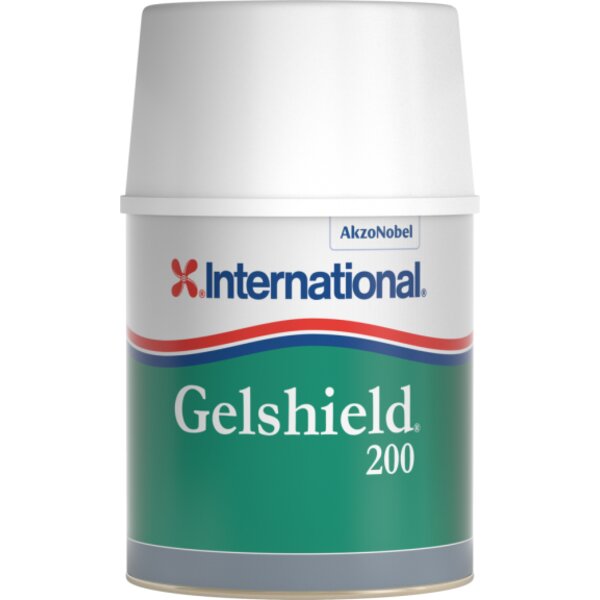
What is GELSHIELD 200 and why choose it?
GELSHIELD 200 from International Náutica is a two-component epoxy primer specifically designed to protect GRP/gelcoat (fibreglass) hulls against osmosis. It creates a dense, waterproof barrier in a defined film thickness of 250 µm (five coats), is quick drying and can be applied from temperatures as low as 5°C, allowing multiple coats in a single day. This makes it a practical solution both for new builds (after post-curing) and for refit projects where reliable, long-term osmosis protection is required.
Main features
- Epoxy osmosis protection for GRP: formulated to protect GRP gelcoats and cured laminates against water ingress and osmosis.
- Defined barrier system: full osmosis protection achieved in five coats, giving a total minimum dry film thickness of 250 µm.
- Quick drying: touch dry from 30 minutes at 35°C to 4 hours at 5°C, allowing multiple coats in one working day.
- Wide application temperature range: can be used from 5°C to 35°C; for optimum performance, product temperature should be above 10°C.
- Two colours for control: available in Green (YPA212) and Grey (YPA213), so coats can be alternated to visually control coverage and thickness.
- Matt finish: ideal as a bonding and barrier layer under antifoulings and tie coats.
- High-solids epoxy: approx. 45% volume solids with a specific gravity of about 1.4.
- Two-component system: mixed at 3:1 by volume with curing agent YPA214.
- Good coverage: theoretical coverage around 9.1 m²/L per coat by brush (approx. 8.1 m²/L practical).
- Compatible system: can be overcoated with a wide range of International antifoulings and tie coats within clearly defined overcoating intervals.
Technical characteristics
Product data
- Type: two-component epoxy primer for GRP osmosis protection
- Colours: YPA212 Green, YPA213 Grey
- Finish: matt
- Specific gravity: approx. 1.4
- Volume solids: approx. 45%
- Mix ratio: 3:1 by volume (base:curing agent, as supplied)
- Curing agent: YPA214 (GELSHIELD 200 Curing Agent)
- Typical shelf life: 2 years
- VOC (as supplied): approx. 464 g/L
- Available pack sizes: 750 ml and 2.5 L units
Drying and immersion times
- Touch dry (approx.):
- 5°C: 4 h
- 15°C: 2 h
- 25°C: 60 min
- 35°C: 30 min
- Minimum time before immersion (approx.):
- 5°C: 24 h
- 15°C: 18 h
- 25°C: 12 h
- 35°C: 8 h
- Pot life after mixing (approx.):
- 5°C: 10 h
- 15°C: 5 h
- 25°C: 3 h
- 35°C: 2 h
Overcoating intervals
Substrate temperature and overcoating windows (min./max.)
- Overcoated with GELSHIELD 200:
- 5°C: 10 h – 6 months
- 15°C: 5 h – 6 months
- 25°C: 3 h – 6 months
- 35°C: 2 h – 6 months
- Overcoated with Micron 350:
- 5°C: 10 h – 24 h
- 15°C: 5 h – 9 h
- 25°C: 3 h – 7 h
- 35°C: 1 h – 5 h
- Overcoated with B-Free Tiecoat:
- 15°C: 5 h – 2 days
- 25°C: 3 h – 2 days
- 35°C: 2 h – 2 days
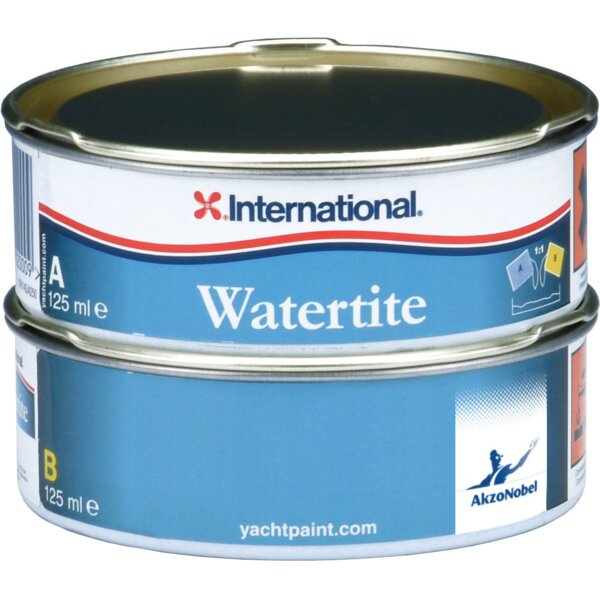
- Overcoated with Watertite filler (for small areas):
- 15°C: 36 h – 3 months
- 25°C: 24 h – 3 months
- 35°C: 24 h – 3 months
For other International antifoulings (including Cruiser Uno EU, Ultra EU, Cruiser Polishing Antifouling, Interspeed Extra, Micron Superior, Micron Extra EU, Micron LZ, Ultra 300, Boatguard 100, Cruiser 200/250, Trilux 200, Trilux Hard Antifouling and Uni-Pro 250) use the Micron 350 overcoating times. If the maximum overcoating interval is exceeded, sand with 180–220 grade wet-or-dry paper.
Film thickness and coverage
- Number of coats: minimum 5 coats by brush (total ≥ 250 µm DFT)
- Recommended DFT per coat: approx. 50 µm dry (brush)
- Recommended WFT per coat: approx. 111 µm wet (brush)
- Coverage (per coat, by brush):
- Theoretical: approx. 9.1 m²/L
- Practical: approx. 8.1 m²/L
- Application methods: brush, roller
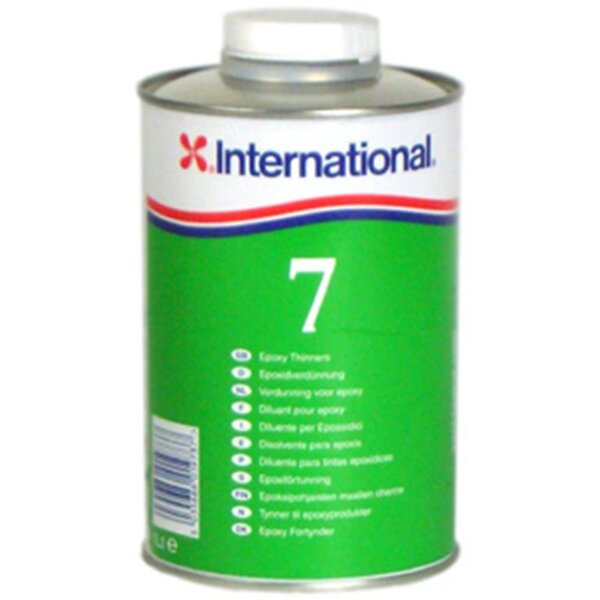
- Thinner / cleaner: YTA061 (Thinner No. 7)
Applications and use cases
Recommended substrates
- GRP gelcoats
- Cured GRP laminates
It should not be used over any one-pack (single-component) products.
Typical applications
- Osmosis prevention on new GRP hulls: new hulls must be post-cured for at least 4 weeks before applying GELSHIELD 200.
- Osmosis protection on existing boats: refurbishment of GRP hulls with existing antifoulings or previously treated surfaces.
- Barrier coat beneath antifouling systems: acts as an epoxy barrier and adhesion tie layer under compatible International antifoulings.
- Bilges: can be used in bilges with gelcoat on the inside of the hull (two coats only recommended in this area).
Surface preparation
- GRP (gelcoat):
- Degrease with solvent or suitable liquid detergent.
- Sand thoroughly with 180–220 grade abrasive paper.
- Clean thoroughly and allow to dry.
- Previously antifouled surfaces:
- Remove existing antifouling with Interstrip.
- Wash with Super Cleaner, rinse with fresh water and allow to dry.
- Sand with 180 grade paper.
- Exposed laminate:
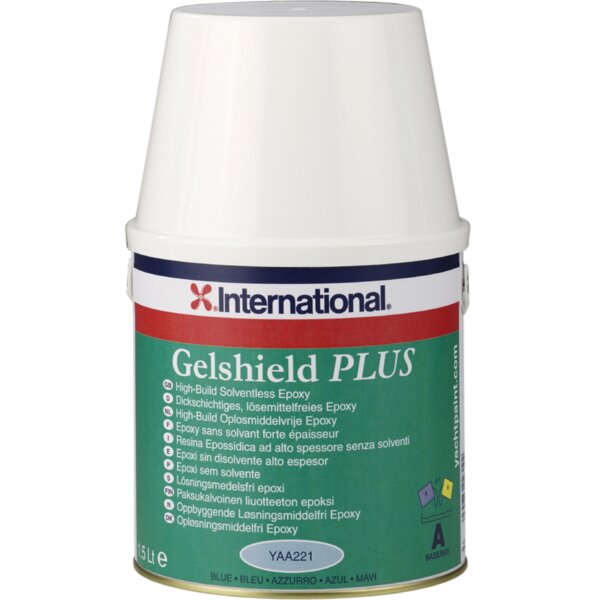
- Patch prime using Gelshield Plus (do not apply GELSHIELD 200 directly onto exposed laminate).
Application method
- Remove all dust from the prepared surface.
- Apply the required number of coats (minimum 5 coats / 250 µm total DFT).
- Alternate grey and green colours for easier visual control, starting and finishing with grey.
- Bilges: apply 2 coats only, provided there is a gelcoat on the inside of the hull. If there is no internal gelcoat, use Gelshield Plus instead.
Mixing and thinning
- Stir or shake each component thoroughly before mixing.
- Add the curing agent (YPA214) to the base in a 3:1 volume ratio.
- Stir well and leave for about 10 minutes to allow bubbles to disperse before application.
- If thinning is necessary, use YTA061 Thinner No. 7 as specified.
Application conditions and important points
- Ambient temperature: minimum 5°C / 41°F, maximum 35°C / 95°F.
- Product temperature: minimum 10°C, maximum 35°C.
- Substrate temperature: minimum 5°C / 41°F, maximum 35°C / 95°F.
- For maximum performance, temperature should be above 10°C.
- Do not apply directly to exposed laminate.
- Do not use below 5°C.
- If Watertite filler is needed on small areas, apply it after the first coat of GELSHIELD 200.
FAQ – GELSHIELD 200
-
Is GELSHIELD 200 suitable for substrates other than GRP?
No. GELSHIELD 200 is specified for GRP gelcoats and cured laminates only, and should not be used over any one-pack products.
-
How many coats are needed for full osmosis protection?
The system is designed for a minimum of five coats by brush, giving a total dry film thickness of at least 250 µm.
-
At what temperatures can I apply GELSHIELD 200?
Application is allowed between 5°C and 35°C ambient and substrate temperature. For best performance, the product itself should be between 10°C and 35°C.
-
How long do I have to wait before launching the boat after the last coat?
Minimum immersion time depends on temperature: approx. 24 h at 5°C, 18 h at 15°C, 12 h at 25°C and 8 h at 35°C, assuming correct film build and curing.
-
Can GELSHIELD 200 be overcoated with any antifouling?
It can be overcoated with several specified International antifoulings and tie coats, including Micron 350 and B-Free Tiecoat, within the published overcoating windows. For other International antifoulings listed in the technical sheet, use the Micron 350 overcoating times.
-
What should I do if I exceed the maximum overcoating interval?
Sand the surface with 180–220 grade wet-or-dry paper before applying the next coat or antifouling.
-
Can GELSHIELD 200 be used inside bilges?
Yes. Apply two coats only in bilges provided there is a gelcoat on the inside of the hull. If there is no internal gelcoat, use Gelshield Plus.
-
How should I prepare an exposed laminate area?
Exposed laminate should be patch-primed first using Gelshield Plus. GELSHIELD 200 should not be applied directly to exposed laminate.
-
What is the typical shelf life and how should I store the product?
Typical shelf life is around 2 years when stored in tightly closed containers between 5°C and 35°C, away from extremes of temperature and direct sunlight.
-
Where can I find performance or certification data not shown here?
Consultar ficha técnica del fabricante.
Section 14 – Transport information
According to the safety data for GELSHIELD 200 Part A (Green and Grey) the product is classified for transport as follows:
- UN number / ID number: UN1263
- Proper shipping name: PAINT
- Transport hazard class: 3 (flammable liquid)
- Packing group: III
- ADR/RID:
- UN1263, Paint, Class 3, Packing group III
- Tunnel code: (D/E)
- IMDG:
- UN1263, Paint, Class 3, Packing group III
- Emergency schedules: F-E, S-E
- Marine pollutant: No
- IATA:
- UN1263, Paint, Class 3, Packing group III
Special precautions for users:
- Transport within user’s premises only in closed, upright and secure containers.
- Ensure that persons transporting the product know what to do in case of accident or spillage.
- Avoid exposure to sources of ignition and high temperatures during transport and storage.
Section 8 – Individual protection measures
GELSHIELD 200 contains solvents and epoxy resins that can cause irritation to eyes, skin and respiratory tract and may cause skin sensitisation. The following personal protective equipment (PPE) and exposure controls are specified in the safety data sheets for the base components (Green Part A, Grey Part A and Curing Agent YPA214):
Engineering controls
- Use only with adequate ventilation.
- Employ local exhaust ventilation or process enclosures to keep solvent vapour concentrations below occupational exposure limits and below the lower explosive limit.
- Use explosion-proof ventilation and electrical equipment where required.
- Provide accessible eyewash stations and safety showers near the work area.
Hand protection
- Use chemical-resistant, impervious gloves complying with EN374 or equivalent.
- For prolonged or frequently repeated contact, gloves of protection class 6 are recommended (breakthrough time > 480 min):
- Recommended materials: Viton® or Nitrile, thickness ≥ 0.38 mm.
- For brief contact, gloves of protection class 2 or higher (breakthrough time > 30 min) are recommended:
- Recommended materials: Nitrile, thickness ≥ 0.12 mm.
- Replace gloves regularly and immediately if damaged. Performance can be reduced by physical or chemical damage or poor maintenance.
Eye and face protection
- Wear chemical splash goggles complying with an approved standard.
- Where there is risk of significant splashing or where spraying is used, complement goggles with a face shield or use a full-face respirator.
Skin and body protection
- Wear suitable protective clothing covering body, arms and legs (overalls, protective suits).
- Where ignition from static electricity is a risk, wear anti-static protective clothing, boots and gloves complying with EN 1149.
- Ensure no skin remains exposed during application.
Respiratory protection
- When ventilation is insufficient or exposure limits may be exceeded, use a respirator conforming to EN140 with type A/P2 filter or better.
- For spray application, or in confined spaces, a higher level of respiratory protection may be required; use suitable air-fed or self-contained breathing apparatus as indicated in the safety data sheet.
- During dry sanding, flame cutting or welding of the dry paint film, hazardous dust and fumes may be generated; wet sanding is preferable. If extraction cannot prevent exposure, use appropriate respiratory protection.
Hygiene measures
- Do not eat, drink or smoke in areas where the product is handled.
- Wash hands, forearms and face thoroughly after handling and before breaks.
- Remove contaminated clothing and protective equipment before entering eating areas.
- Wash contaminated clothing before reuse and clean footwear thoroughly.
Environmental exposure control
- Check emissions from ventilation and process equipment to ensure compliance with environmental legislation.
- Where necessary, use fume scrubbers, filters or process modifications to reduce emissions to acceptable levels.
- Prevent product and washings from entering drains or watercourses.
*Contenido generado por IA