What it is and why choose it
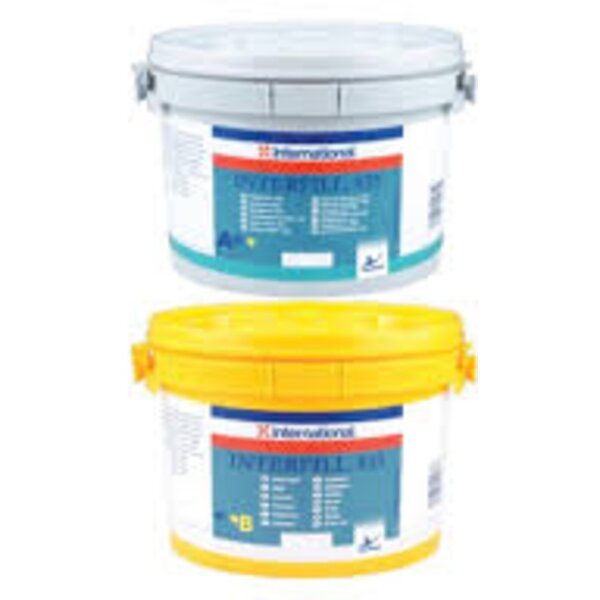
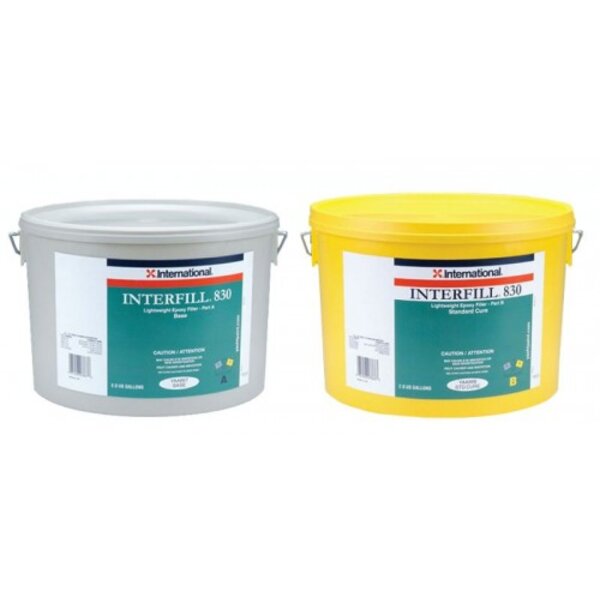
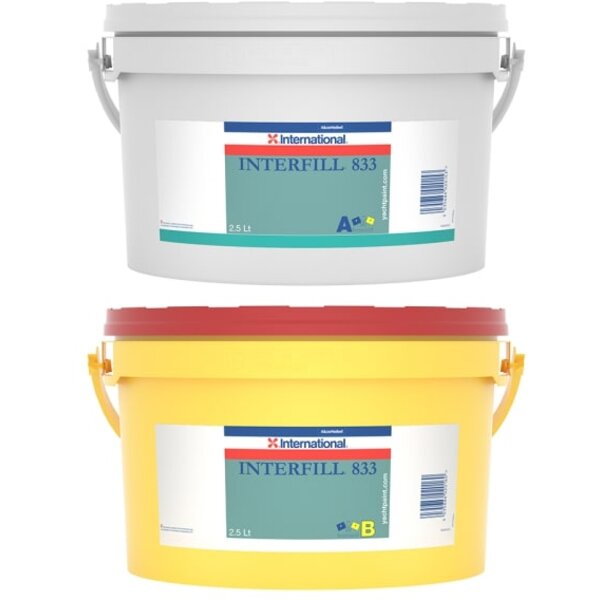
INTERFILL 833 STANDARD PART B is the off-white curing agent for the professional two-component epoxy finishing filler system Interfill 833 from International Náutica. When mixed 1:1 by volume with Interfill 833 Base (YAA813), it produces an easily sandable, high-build finishing filler designed to correct minor surface defects before application of finishing coats, both above and below the waterline.
This Part B hardener is formulated for interior and exterior use and is part of a system widely used in professional yacht and composite work where an exceptionally smooth, fair surface is required prior to priming and topcoating.
Main features
- Curing agent for Interfill 833 epoxy finishing filler (two-component system).
- For professional and industrial use, above and below the waterline.
- Enables an extra smooth, easy-to-sand finish when used with Interfill 833 Base.
- Designed for use over cured and sanded epoxy fillers such as Interfill 830 or over cured GRP/composite substrates.
- Suitable for interior and exterior applications on yachts and composites.
- Classified as corrosive and sensitising; requires appropriate personal protective equipment and careful handling.
Technical specifications
- Product type: Curing agent (Part B) for two-component epoxy filler system
- System: Interfill 833 finishing filler
- Brand: International Náutica
- Product code / SDS code: YAA814
- Colour (Part B): Off white
- Appearance: Solid
- Density: 0.769 g/cm³ (DIN EN ISO 2811-1)
- Flash point: 101°C (closed cup, Pensky-Martens)
- Boiling point: 201°C
- Solubility: Not soluble in cold water (OECD TG 105)
- VOC for ready-for-use mixture: Not available
- Mix ratio with Interfill 833 Base: 1:1 by volume (as supplied); mix ratio by weight 1.14:1 (Base YAA813 : Curing agent YAA814)
- Intended use: Two-component filler for interior and exterior applications
- Classification (Regulation (EC) 1272/2008): Skin Corr. 1B; Eye Dam. 1; Skin Sens. 1; Aquatic Acute 1; Aquatic Chronic 1
- Key hazard statements:
- Causes severe skin burns and eye damage (H314).
- May cause an allergic skin reaction (H317).
- Very toxic to aquatic life with long lasting effects (H410).
Applications and use cases
- Yacht and boat finishing: When combined with Interfill 833 Base, used to fair and refine surfaces over Interfill 830 or other cured epoxy fillers, above and below the waterline.
- GRP and composite structures: Part of an epoxy filler system applied over cured, sanded GRP/composites to remove minor surface defects before epoxy primers and topcoats.
- Professional repair yards: Suitable for professional and industrial users working under controlled conditions where accurate mixing and PPE are standard practice.
FAQ – INTERFILL 833 STANDARD PART B
-
What is INTERFILL 833 STANDARD PART B used for?
It is the curing agent (hardener) for the Interfill 833 two-component epoxy finishing filler, used to repair minor surface defects before priming and topcoating.
-
How should it be mixed with Interfill 833 Base?
It is mixed 1:1 by volume with Interfill 833 Base (YAA813). By weight, the typical mix ratio is 1.14:1 (Base : Part B).
-
On which substrates can the Interfill 833 system be used?
Over cured and sanded epoxy fillers such as Interfill 830, or over cured GRP/composite substrates, before application of epoxy primers and finishing coats.
-
Is INTERFILL 833 STANDARD PART B suitable for underwater areas?
Yes. The Interfill 833 system is indicated for use above and below the waterline when applied and overcoated according to the manufacturer’s recommendations.
-
Is this product for DIY users?
No. It is specified for professional and industrial use. It is corrosive, sensitising and very toxic to aquatic life, and must be handled only by trained personnel with appropriate PPE.
-
What colour is Part B?
INTERFILL 833 STANDARD PART B is off white. When mixed with the green Interfill 833 Base, it forms the working filler colour specified by the system.
-
Does Part B alone provide filling or fairing properties?
No. Part B is only the curing agent. It must be mixed with Interfill 833 Base to form the epoxy filler with fairing and filling properties.
-
Can unused mixed product be stored?
No. Once Base and Part B are mixed, the material will react and cure. Only mix quantities that can be applied within the stated pot life for the Interfill 833 system.
-
How should waste and empty containers be disposed of?
Waste product and contaminated containers should be treated as hazardous waste and disposed of via authorised waste contractors, in line with local and national regulations (EWC 08 01 11*).
-
Where can I find full safety information?
All detailed health, safety and environmental information is contained in the Safety Data Sheet for Interfill 833 Standard Part B (YAA814).
Section 14 – Transport information
- UN number / ID number: UN1759
- UN proper shipping name: CORROSIVE SOLID, N.O.S. (Fatty acids, tall-oil, reaction products with tetraethylenepentamine, 3,6,9-triazaundecamethylenediamine)
- Transport hazard class: 8 (corrosive)
- Packing group: II
- Environmental hazards: Environmentally hazardous; marine pollutant under IMDG. The environmentally hazardous / marine pollutant mark is not required when transported in packages of ≤5 L or ≤5 kg.
- ADR/RID tunnel code: (E)
- Special precautions for user:
- Transport only in securely closed, upright containers.
- Store and transport in the original container to avoid misidentification and leakage.
- Ensure personnel involved in transport know what to do in the event of an accident or spillage.
- Prevent contamination of drains, soil and waterways with spilled material or fire-fighting water.
- Transport in bulk according to IMO instruments: Not applicable.
Section 8 – Personal protective measures
INTERFILL 833 STANDARD PART B is classified as corrosive and sensitising. The following personal protection and exposure controls are specified in the Safety Data Sheet:
Engineering controls
- Use process enclosures, local exhaust ventilation or other engineering controls to keep airborne concentrations below any recommended or statutory limits.
- Where dust, fumes, gas, vapour or mist may be generated, provide effective extraction and ventilation.
General hygiene measures
- Wash hands, forearms and face thoroughly after handling and before eating, drinking or smoking.
- Do not eat, drink or smoke in areas where the product is handled or stored.
- Remove contaminated clothing and protective equipment before entering eating areas.
- Wash contaminated clothing before reuse; contaminated work clothing should not leave the workplace.
- Ensure eyewash stations and safety showers are available close to the work area.
Eye and face protection
- Wear chemical splash goggles and/or face shield meeting an approved standard whenever there is a risk of splashes, mists, gases or dust.
- If inhalation hazards exist, a full-face respirator may be required instead of goggles alone.
Hand protection
- Wear chemical-resistant, impervious gloves complying with EN374 or equivalent.
- For prolonged or frequently repeated contact, gloves with protection class 6 (breakthrough time > 480 minutes) are recommended. Recommended materials: Viton or nitrile, thickness ≥ 0.38 mm.
- For brief contact, gloves with protection class ≥ 2 (breakthrough time > 30 minutes) are recommended. Recommended material: nitrile, thickness ≥ 0.12 mm.
- Replace gloves regularly and immediately if damaged. Glove performance can be reduced by physical or chemical damage or poor maintenance.
Skin and body protection
- Wear suitable protective clothing covering body, arms and legs, selected according to the task and risk assessment.
- Use appropriate protective footwear and any additional skin protection measures as required.
Respiratory protection
- Where ventilation is insufficient or exposure limits may be exceeded, wear a respirator conforming to EN140 with a type A/P2 filter or better.
- Dry sanding, flame cutting and welding of cured films may generate hazardous dust and fumes; wet sanding/flatting is preferred. If exposure cannot be avoided by local exhaust ventilation, use suitable respiratory protection.
- Respirators must be used within a structured respiratory protection programme to ensure correct selection, fit and training.
Environmental exposure controls
- Check emissions from ventilation and process equipment to ensure compliance with environmental legislation.
- Where necessary, use fume scrubbers, filters or engineering modifications to reduce emissions.
*Contenido generado por IA