What Epifanes CLEAR VARNISH is and why choose it
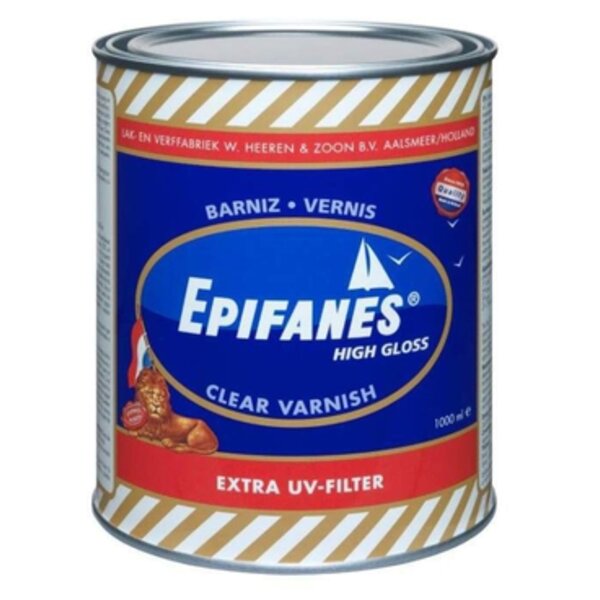
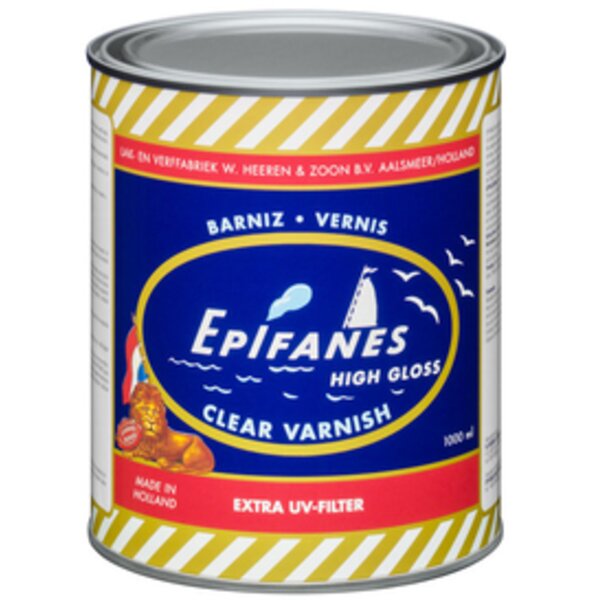
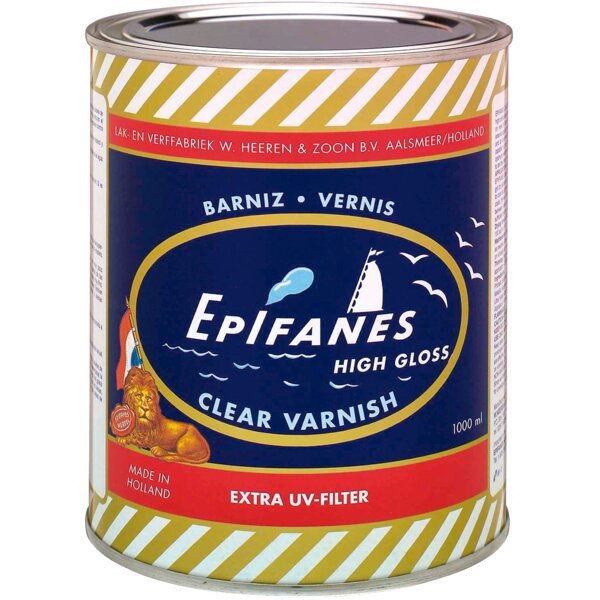
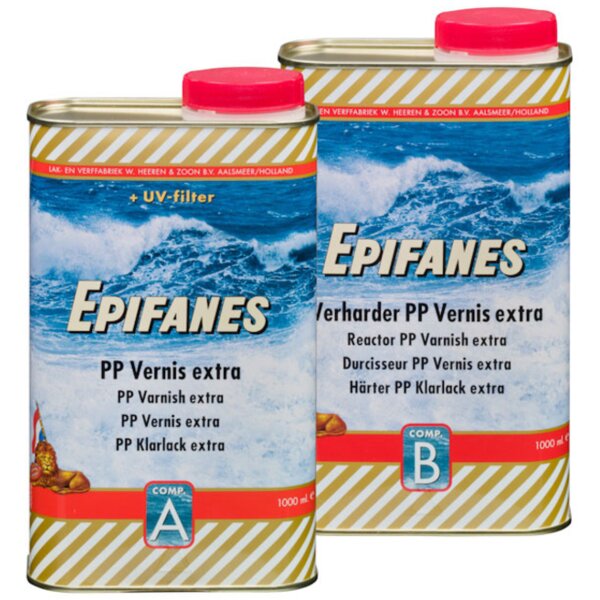
Epifanes CLEAR VARNISH is a one-component, classic high gloss yacht varnish with an extra UV filter. It is based on phenolic and alkyd resins combined with tung oil, providing extreme high gloss, excellent flow, high build capacity and long-lasting protection. The integrated UV filter protects wood against discolouration, while the flexible film helps prevent cracking on working wood, even in demanding climates.
This varnish is suitable for new work on bare solid wood and plywood above the waterline, as well as for maintenance of intact existing one- and two-component varnish systems, regardless of brand.
Main features
- One-component high gloss system: classic yacht varnish with very high gloss and excellent gloss retention.
- Extra UV protection: built-in UV filter helps protect wood against discolouration and degradation.
- Flexible, crack-resistant film: reduces risk of cracking on working or moving wood.
- High build capacity: allows multiple full-bodied coats for durable protection, including tropical climates.
- Wide wood compatibility: for bare solid woods such as mahogany, meranti and Oregon pine, as well as plywood, used inside and outside above the waterline.
- Maintenance coating: suitable on intact existing one- and two-component varnishes (any brand) after proper preparation.
- Clear amber appearance: transparent amber colour that enhances the natural warmth of wood.
- Brush or spray application: optimised for longhaired soft brushes or air spray; roller application is not advised.
Technical specifications
Product data
- Type: Oxidative drying
- Base: Phenolic resin / Alkyd resin / Tung Oil
- Gloss level: High gloss
- Colour: Transparent amber
- Density at 20 °C: 0.9138 g/cm³
- Viscosity: 50 seconds ISO-cup 4 mm
- Solids content: 52 ± 2 vol.%
- VOC level: 370 g/l
- Recommended wet film thickness: 60–70 µm
- Recommended dry film thickness: 30–35 µm
- Theoretical coverage: 15 m²/L at 35 µm dry film thickness
- Packaging: 250 ml, 500 ml, 1000 ml, 5000 ml
- Shelf life: 3 years in closed original container at 5–30 °C
Substrates and surface preparation
- Bare wood (general): wood degreased and sanded to P220 (or 180G in some instructions). For maximum impregnation, thin the first coat 40–50%.
- Maintenance on existing varnish: varnish must be intact, degreased and sanded to P240 (or 220–320G). For good grip, thin the first maintenance coat 10%.
- Field of use: bare solid wood (mahogany, meranti, Oregon pine) and plywood, inside and outside above the waterline. Maintenance of intact existing one- and two-component varnishes.
- Not suitable for: direct use on epoxy resin.
Drying times (approximate, 65% relative humidity)
- At 10 °C: dust dry 5 h; sandable 40 h; recoatable 40 h
- At 15 °C: dust dry 4 h; sandable 30 h; recoatable 30 h
- At 20 °C: dust dry 3 h; sandable 24 h; recoatable 24 h
- At 25 °C: dust dry 2 h; sandable 20 h; recoatable 20 h
Drying depends on temperature, ventilation and applied wet film thickness. Higher wet film thickness and/or poor ventilation significantly increase drying times. Especially horizontal parts may take longer to dry. Do not apply wet-on-wet.
Application conditions and thinning
- Application temperature (product, surface, ambient): 8–30 °C
- Relative air humidity: 50–85%
- Recommended tools: longhaired soft brush or air spray. Application by roller is not advised due to required wet film thickness.
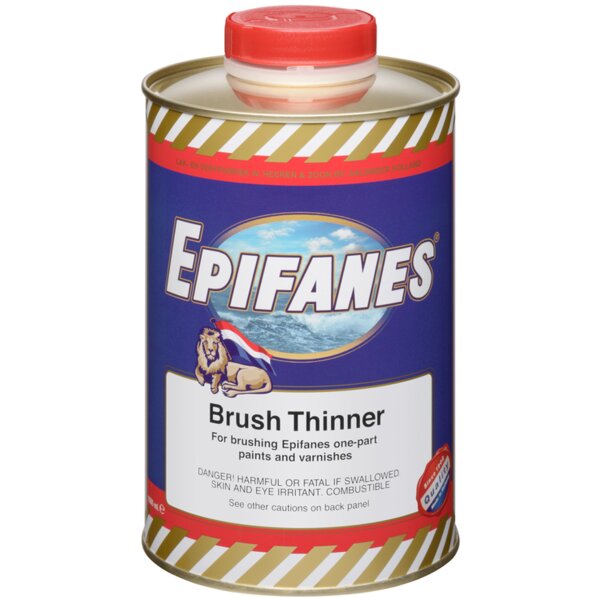
- Brush thinner: Epifanes Brushthinner for Paint & Varnish or a good quality white spirit / mineral spirits (not low VOC in some documents).
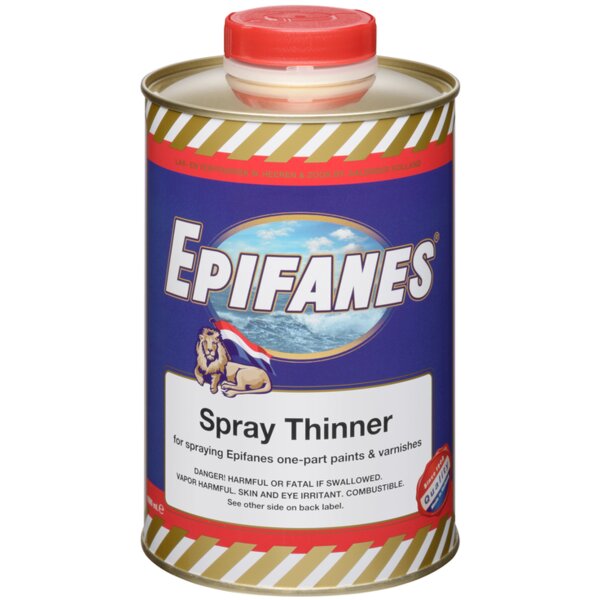
- Spray thinner: Epifanes Spraythinner for Paint & Varnish or denatured alcohol.
- General thinning: the thinning ratio depends on product temperature and working area. Overthinning should be avoided.
Recommended system build-up (brushing, bare wood)
- Step 1 – First penetrating coat
- Product: Epifanes Clear Varnish
- Number of coats: 1
- Thinning: 50% with Epifanes Brushthinner PV
- Drying time at 20 °C: 24 h
- Sanding: dry P220/P280 by hand along the grain
- Remarks: first penetrating coat; apply heavily thinned for full penetration into the wood fibres.
- Step 2 – Second penetration coat
- Product: Epifanes Clear Varnish
- Number of coats: 1
- Thinning: approx. 25% with Epifanes Brushthinner PV
- Drying time at 20 °C: 24 h
- Sanding: dry P220 by hand along the grain
- Step 3 – Third penetration / build-up coat
- Product: Epifanes Clear Varnish
- Number of coats: 1
- Thinning: approx. 15% with Epifanes Brushthinner PV
- Drying time at 20 °C: 24 h
- Sanding: dry P280 or 220G by hand along the grain
- Step 4 – Finishing coats
- Product: Epifanes Clear Varnish
- Number of coats: at least 4 finishing coats (more coats recommended for longer gloss retention)
- Thinning: 0–5% with Epifanes Brushthinner PV
- Drying time at 20 °C: 24 h between coats
- Sanding: wet P400 or dry 320G / Scotch Brite between coats, by hand along the grain
- Remarks: in warmer climates with high UV levels, a minimum of 6 or more full-bodied finishing coats is required for sufficient protection.
Spray application guidelines
- Thinning volume: 15–20%
- Nozzle size: 1.2–1.5 mm
- Pressure: 2–3 bar (approx. 30–45 psi depending on sheet)
- Viscosity (DIN cup 4 mm): 20–24 seconds
Applications and use cases
- New wooden yachts and boats: exterior and interior woodwork above the waterline, including hull, transom, superstructure and brightwork on suitable timber species.
- Refurbishment of existing varnish systems: overcoating intact one- and two-component varnishes after proper cleaning, degreasing and sanding.
- Interior joinery and trim: high gloss finish on furniture-grade wood surfaces where UV resistance and long gloss retention are required.
- Use on hardwoods: suitable for mahogany, meranti, Oregon pine and plywood. For tropical oily hardwoods such as teak and iroco, a dedicated one-component breathing UV varnish system with Epifanes Woodfinish Gloss is described separately in the technical information.
FAQ
How many coats of Epifanes CLEAR VARNISH are recommended on bare wood?
The brushing system described consists of 1 heavily thinned penetrating coat, followed by 2 further thinned penetration coats and at least 4 full-bodied finishing coats. In warmer climates with high UV levels, at least 6 or more full-bodied finishing coats are required for sufficient protection.
Can I use this varnish over existing coatings?
Yes, it can be used for maintenance of intact existing one- and two-component varnishes (any brand), provided the surface is properly degreased and sanded (typically around P240–P320) and the first maintenance coat is thinned about 10% for good grip.
Is Epifanes CLEAR VARNISH suitable for use below the waterline?
The field of use specified is bare solid wood and plywood for inside and outside above the waterline.
Can I apply this varnish directly on epoxy?
The technical datasheet states that the product is not suited for direct use on epoxy resin.
Which application tools are recommended?
Best results are achieved with a longhaired soft brush or by air spray. Because of the required wet film thickness, application by roller is not advised.
Which thinners should I use for brushing and spraying?
For brushing, use Epifanes Brushthinner for Paint & Varnish or a good quality white spirit / mineral spirits (not low VOC in some instructions). For spray application, use Epifanes Spraythinner for Paint & Varnish or denatured alcohol.
What environmental and safety classifications apply to this varnish?
According to the safety data sheet, the product is classified as a flammable liquid (Flam. Liq. 3, H226), may cause an allergic skin reaction (Skin Sens. 1, H317), may cause drowsiness or dizziness (STOT SE 3, H336), and is harmful to aquatic life with long lasting effects (Aquatic Chronic 3, H412). Repeated exposure may cause skin dryness or cracking (EUH066).
How should I prepare tropical hardwoods like teak and iroco?
For tropical oily hardwoods, the technical information advises a one-component breathing UV varnish system using Epifanes Woodfinish Gloss. Surface preparation includes thorough degreasing, sanding from P60–80 up to P220 along the grain, removing all dust and degreasing again before applying varnish.
Section 14 – Transport information
- UN number / ID number: UN1263
- UN proper shipping name: PAINT
- Transport hazard class: Class 3 – Flammable liquids (ADR, IMDG, IATA)
- Labels: 3
- Packing group: III
- Marine pollutant: No
- Hazard identification number (Kemler code): 30
- EMS code: F-E, S-E
- Stowage category: A
- ADR limited quantities (LQ): 5 L
- ADR excepted quantities (EQ): Code E1 – max. 30 ml per inner packaging, 1000 ml per outer packaging
- Transport category: 3
- Tunnel restriction code: D/E
Packaging under 450 L may fall under an exemption for viscous substances according to ADR 2.2.3.1.5, as indicated in the safety data sheet.
Section 8 – Personal protective measures
Exposure controls and personal protection
- General hygiene: immediately remove soiled or contaminated clothing. Wash hands before breaks and at the end of work.
- Respiratory protection: for short or low exposure, use an appropriate breathing filter device. For intensive or prolonged exposure, use breathing apparatus independent of the surrounding air. A half-face mask for organic vapours and solvents according to EN140 type A1 or A2 is recommended.
- Hand protection: use protective gloves of stable, chemical-resistant material, e.g. nitrile. The glove material must be impermeable and resistant to the product.
- Suitable glove materials for up to 15 minutes permanent contact: butyl rubber (BR).
- Suitable glove materials for splash protection: chloroprene gloves (thickness > 0.7 mm, penetration time > 60 min, EN 374) or nitrile rubber gloves (thickness > 0.3 mm, penetration time > 60 min, EN 374).
- Eye/face protection: tightly sealed safety goggles.
The safety data sheet emphasises that glove selection must consider penetration times, diffusion rates and degradation, and that exact break-through times must be obtained from the glove manufacturer.
Contenido generado por IA