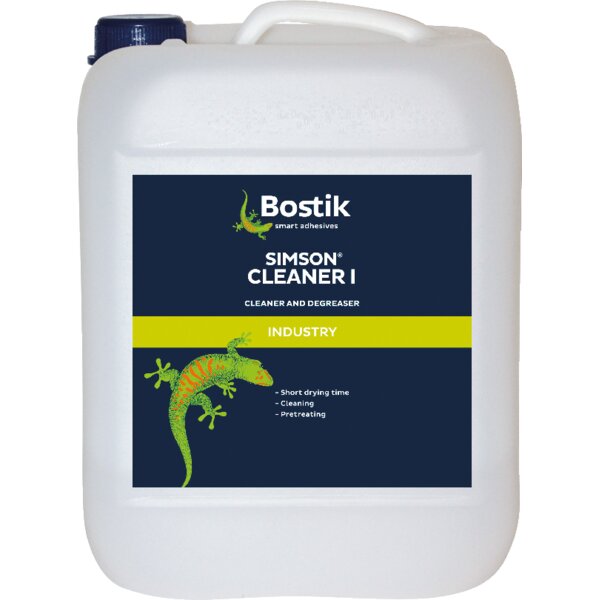
What Bostik CLEANER I is and why choose it
Bostik CLEANER I is a transparent, fast-evaporating preparation agent based on isopropyl alcohol, specially developed for cleaning and degreasing substrates before bonding or sealing with specific Bostik SMP products. Its high evaporation rate, excellent degreasing efficiency and compatibility with many plastic and glass substrates make it an effective pre-treatment step for professional sealing and bonding work.
Main features
- Special preparation agent for substrates to be bonded or sealed with Bostik SMP products.
- High evaporation rate for quick processing.
- No stress-crack formation on plastics, such as polycarbonate (PC) and PMMA.
- High degreasing efficiency and easy dissolution of contaminants.
- Suitable for the removal of uncured SMP-based sealants and adhesives from substrates and tools.
- Colourless, transparent liquid with characteristic alcohol odour.
Technical specifications
- Chemical base: Isopropyl alcohol (IPA)
- Physical state: Liquid
- Colour: Colourless / transparent
- Odour: Alcohol
- Dry content: 0 %
- Relative density: 0.79 g/ml (density 0.785 g/ml)
- Flash point: 12 °C (DIN 51755 Part 1)
- Melting / freezing point: -89 °C
- Initial boiling point: 82 °C (DIN 53171)
- Autoignition temperature: 425 °C
- Drying time: > 5 minutes
- Water solubility: Miscible in water at 20 °C
- Dynamic viscosity: 2.5 mPa·s at 20 °C
- Refractive index: 1.376–1.378 at 20 °C
- VOC content: Consultar ficha técnica del fabricante.
- Packaging: 2.5 litre can
- Storage stability: 12 months in unopened container
- Recommended storage temperature: between +5 °C and +30 °C (5–25 °C in SDS)
Applications and use cases
Recommended applications
- Cleaning and degreasing of glass with ceramic coating.
- Cleaning and degreasing of glass substrates, including polycarbonate (PC) and PMMA.
- Cleaning and degreasing of non-porous (closed) substrates. For more detailed substrate information, Bostik should be consulted.
- Removal of uncured SMP-based sealants and adhesives from substrates and application tools.
Method of use
- Impregnate a clean, lint-free and colourfast cloth with CLEANER I.
- Rub the substrate firmly with the cloth to remove contamination and degrease the surface.
- If the substrate is heavily contaminated, repeat the operation.
- Important: Before full application, test on a small, inconspicuous area to confirm that the substrate is not adversely affected.
FAQ – Bostik CLEANER I
1. What is Bostik CLEANER I used for?
It is used as a preparation agent for cleaning and degreasing substrates before bonding or sealing with specific Bostik SMP products, and for removing uncured SMP sealants and adhesives from substrates and tools.
2. On which substrates can I use CLEANER I?
It is suitable for glass with ceramic coating, glass substrates such as PC and PMMA, and other closed (non-porous) substrates. For additional substrate types, Consultar ficha técnica del fabricante.
3. How should I apply CLEANER I?
Apply with a clean, lint-free cloth soaked in CLEANER I and rub the surface thoroughly. For heavily soiled substrates, repeat the cleaning step.
4. Does CLEANER I attack plastics?
According to the technical information, it does not cause stress-crack formation in plastics. Nevertheless, a preliminary test on a small area is recommended before large-scale use.
5. How long does CLEANER I take to dry?
The drying time is greater than 5 minutes, depending on conditions such as temperature and ventilation.
6. How should CLEANER I be stored?
Store in a tightly closed, unopened container in a dry, cool and well-ventilated place, between +5 °C and +30 °C, away from heat, sparks, open flames and other ignition sources.
7. What is the shelf life of CLEANER I?
When stored correctly in unopened packaging, the shelf life is 12 months.
8. Is CLEANER I flammable?
Yes. It is a highly flammable liquid and vapour, with a flash point of 12 °C. Keep away from ignition sources and handle with appropriate precautions.
9. What are the main hazards to health?
It causes serious eye irritation and may cause drowsiness or dizziness. High vapour concentrations may lead to headache, dizziness, tiredness, nausea and vomiting.
10. What should I do if CLEANER I gets into my eyes?
Rinse immediately with plenty of water for at least 15 minutes, keeping the eyelids open. Remove contact lenses if present and easy to do, and continue rinsing. Seek medical advice if irritation persists.
Section 14 – Transport information
CLEANER I is classified as a dangerous good for transport under the name isopropanol.
Road and rail transport (ADR/RID)
- UN number: UN1219
- Proper shipping name: Isopropanol
- Transport hazard class: 3
- Packing group: II
- Description: UN1219, Isopropanol, 3, II, (D/E)
- Environmental hazards: Not applicable
- Limited quantity (LQ): 1 L
- Special provisions: 601
- Classification code: F1
- Tunnel restriction code: (D/E)
- ADR Hazard Identification Number (Kemmler): 33
Sea transport (IMDG)
- UN number: UN1219
- Proper shipping name: Isopropanol
- Transport hazard class: 3
- Packing group: II
- Description: UN1219, Isopropanol, 3, II, (12 °C c.c.)
- Marine pollutant: No (NP)
- Limited quantity (LQ): 1 L
- EmS code: F-E, S-D
- Bulk transport according to IMO instruments: Not applicable
Air transport (ICAO-TI / IATA-DGR)
- UN number: UN1219
- Proper shipping name: Isopropanol
- Transport hazard class: 3
- Packing group: II
- Description: UN1219, Isopropanol, 3, II
- Environmental hazards: Not applicable
- Limited quantity (LQ): 1 L
- Special provisions: A180
- ERG code: 3L
Section 8 – Personal protective measures
Exposure controls
- Ensure adequate ventilation, especially in confined areas.
- Vapours and aerosols should be extracted directly at the point of origin.
- Prevent release into sewers, soil or bodies of water.
Individual protection equipment (PPE)
- Eye/face protection: Tight-sealing safety goggles and face shield.
- Hand protection: Protective gloves complying with EN 374. Breakthrough time depends on glove material, thickness and temperature.
- Skin and body protection: Antistatic footwear and fire/flame resistant or retardant protective clothing such as suitable protective garments or an apron.
- Respiratory protection: If ventilation is inadequate or in case of mist, spray or aerosol exposure, wear suitable respiratory protection. Recommended filter type: organic gases and vapours filter conforming to EN 14387.
General hygiene measures
- Do not eat, drink or smoke while using the product.
- Wash hands before breaks and after handling.
- Contaminated work clothing should not leave the workplace and should be cleaned regularly.
*Contenido generado por IA