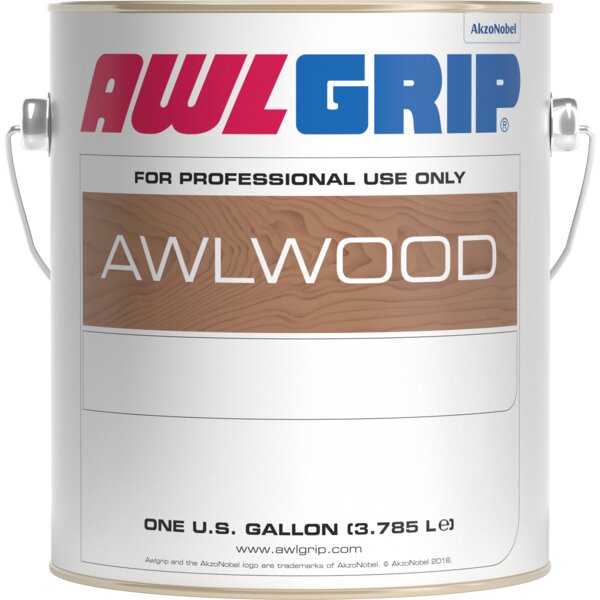
What is Awlwood Clear Gloss and why choose it?
Awlwood Clear Gloss is a 1-pack, solvent-based clear varnish designed for exterior timber above the waterline. Used in combination with Awlwood Primers, it forms a fast-curing, moisture-cured system that offers excellent flow, high abrasion resistance and long-lasting gloss retention. It is formulated for demanding marine and exterior woodwork where a durable, repairable high-gloss finish is required.
Main features
- High-gloss, long-lasting appearance – described as best-in-class gloss retention when used over Awlwood Primer.
- Fast curing – touch dry from 1.5 to 3 hours depending on temperature, allowing multiple applications per day.
- High abrasion resistance – suitable for capping rails, deck furniture and other high-wear exterior timber surfaces.
- Buffable and repairable system – designed to be sanded and overcoated for maintenance or local repairs.
- Moisture-cured – cures using humidity in the air, providing reliable hard drying in a wide humidity range.
- Compatible application methods – can be applied by brush, foam/mohair roller or air-atomized spray.
- Clear or tinted finish – clear gloss can be subtly tinted by adding up to 10% Awlwood coloured primers in early coats.
- Exterior durability – recommended minimum total film build of 10 mils (250 microns) in at least 8 coats for exterior timber.
Technical specifications
- Product type: 1-pack clear varnish for exterior use above the waterline
- System: Used over Awlwood Primers (Red, Yellow or Clear)
- Base / Code: OJ3890 (Awlwood Clear Gloss)
- Volume solids: 45%
- Specific gravity: 1.01
- Available pack sizes: 1 US gallon, 1 US quart
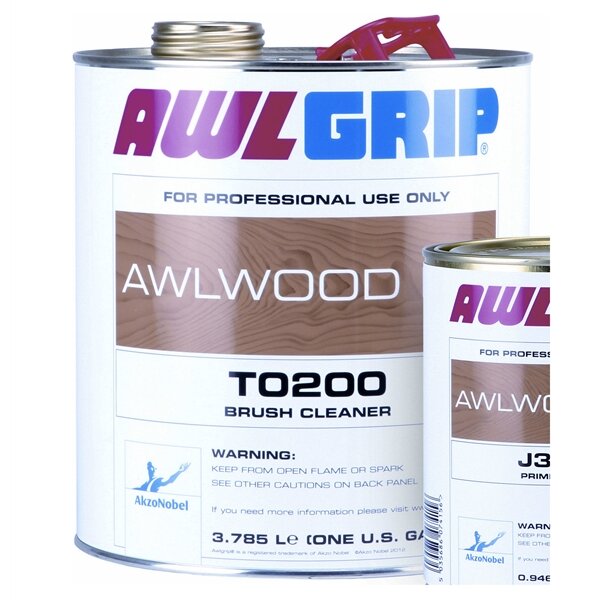
- Equipment cleaning: Awlwood OT0200 Brush Cleaner
- Typical shelf life: 2 years
Theoretical coverage and film thickness
- Application methods: Brush, roller, air-atomized spray
- Number of coats: Minimum 8
- Recommended wet film thickness (WFT) per coat: 80 µm (3.1 mil)
- Recommended dry film thickness (DFT) per coat: 36 µm (1.4 mil)
- Maximum DFT per coat: 45 µm (1.8 mil)
- Theoretical coverage at recommended DFT: 12 m²/L (approx. 488.9 ft²/gal)
- Final recommended total film build (exterior timber): ≥ 10 mils (250 microns), attainable in a minimum of 8 coats
VOC information (product as supplied, without reducer)
- VOC (g/L): 487
- VOC (lb/gal): 4.07
- VOC (g/kg): 482
- VOC (lb/lb): 0.48
Application conditions and curing
- Application temperature range: 4°C (39°F) to 30°C (86°F)
- Relative humidity range: 30% to 95%
- Not suitable for: Temperatures below 4°C/39°F or above 30°C/86°F, or very low humidity atmospheres
- Touch dry:
- 3 hours at 15°C (59°F)
- 2 hours at 25°C (77°F)
- 1.5 hours at 30°C (86°F)
- Sandable:
- 8 hours at 15°C (59°F)
- 4 hours at 25°C (77°F)
- 3 hours at 30°C (86°F)
- Hard dry:
- 24 hours at 15°C (59°F)
- 24 hours at 25°C (77°F)
- 18 hours at 30°C (86°F)
- Recoat times with Awlwood Clear Gloss:
- 15°C (59°F): 4–24 hours (without sanding if not exposed to direct sunlight)
- 25°C (77°F): 2–24 hours (without sanding if not exposed to direct sunlight)
- 30°C (86°F): 1.5–18 hours
Applications and use cases
Awlwood Clear Gloss is intended for professional and demanding exterior timber applications above the waterline, particularly in marine and outdoor environments.
Typical substrates
- Exterior timber primed with Awlwood Red, Yellow or Clear Primer
- Epoxy-primed surfaces
- Fibreglass or carbon fibre (after appropriate sanding and ensuring no epoxy blush is present)
Recommended use areas
- Capping rails
- Deck furniture
- Other exposed exterior woodwork above the waterline where a durable, high-gloss finish is required
Surface preparation overview
- Over Awlwood Red / Yellow / Clear Primer:
- Primers must be applied over clean, dry, P120-sanded, vacuumed and degreased timber.
- Primer should be touch dry and fully absorbed by the timber before first gloss coat.
- Do not sand the primer before the first gloss coat.
- If the overcoating window is missed, hard block sand the primer with P120 grit along the grain back to bare wood and re-apply primer.
- For best adhesion, apply the first coat of gloss on the same day as the primer.
- Over epoxy primer or fibreglass/carbon fibre:
- Machine or hand sand to remove defects, finishing with P180 grit paper.
- Ensure that no epoxy blush is present.
Application guidance
Mixing and reduction
- By brush: Thinning is not usually required. If necessary, thin up to 10% by volume with T0201 Brushing Reducer.
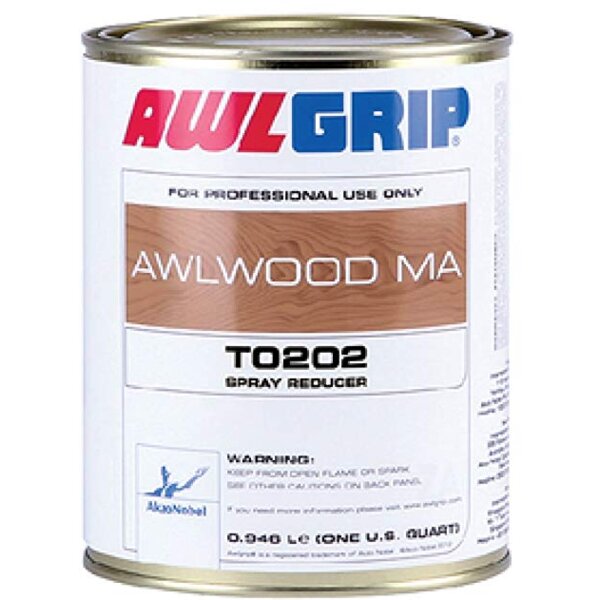
- By air-atomized spray: Thin 0–10% with T0202 Spray Reducer if needed, or safely warm the can. Do not use universal thinners.
- Important: Do not thin the first and second brush/roller coats of Awlwood Gloss.
Brush / roller application
- Apply using a brush or foam/mohair roller.
- Aim to minimise wet edge times and avoid overworking the surface; the product will defoam and level by itself but tacks up relatively quickly.
- Tipping with a brush after rolling helps achieve the best finish.
- Synthetic bristled brushes with tapered bristles and without flagged or split ends are recommended.
- In hot or windy conditions, thin up to 10% with Awlwood Brushing Reducer to extend wet edge and improve workability.
Spray application
- Apply with an air-atomized spray gun onto suitably prepared substrates.
- Reduce up to 10% with Awlwood Spray Reducer if necessary or safely warm the can.
- Do not leave Awlwood Clear Gloss in spray pots between coating applications.
- Typical spray setup: fluid tip 1.40–2.00 mm (55–79 thou). Heavier coats are recommended as the product will flow out and pull flat on curing.
Application process and film build
- Coats 1–3 (grain filling):
- Coats 1 and 2 must be applied by brush or roller with 1 day overcoating intervals.
- On deeper grain hardwoods, apply one coat per day until the grain is filled (typically 2–3 coats).
- Lightly sand each gloss coat with P220–P280 grit paper to flatten grain texture without sanding through to the primer.
- Do not flood the first coat and do not thin the first 2–3 coats.
- Multicoating (coats 3+):
- Can be applied by brush, roller or spray.
- Multiple coats may be applied in one day, provided the previous coat is sufficiently cured (finger press without leaving an indented fingerprint).
- Avoid rapidly applying heavy coats to build film; trapped solvent will inhibit performance.
- Allow each coat to become touch dry before applying the next.
- Lightly sand or scuff at the start of each day with P220–P280 grit to remove texture, especially on vertical surfaces.
- Final coat:
- Apply a single final coat after good quality finish sanding with at least P400 grit.
- For best results, allow a few days after multicoating for solvent evaporation before the final coat.
- Apply in optimal conditions: out of direct sunlight, minimal wind, preferably early in the day.
- Reduce the final coat 10% by volume.
- When spraying the final coat, reduce 10%, apply a mist coat if needed to aid vertical hold-up, then a full wet cross coat or a single cross-sprayed coat.
Sanding between coats and maintenance
- Between coats:
- Sanding generally not necessary if overcoating on the same day, unless in extreme drying conditions (full sun or high temperatures).
- In such conditions, rubbing with P280 grit paper ensures intercoat adhesion.
- Start-of-day sanding: lightly sand with P220–P280 grit to remove defects, taking care not to oversand edges or radii.
- Before the final coat, hand block sand through to P600 grit working with the grain.
- Recoating / maintenance:
- Clean and degrease existing Awlwood Gloss.
- Sand very well using P220 grit paper and apply at least 2 additional coats.
- Up to 10% coloured primer may be added to counter timber fading if required.
- Touch up damaged areas by sanding, re-priming and rebuilding full coating thickness.
FAQ – Awlwood Clear Gloss
-
Is Awlwood Clear Gloss a single-pack or two-pack product?
Awlwood Clear Gloss is a 1-pack clear varnish used over Awlwood Primers.
-
Where can it be used?
It is designed for exterior timber above the waterline, especially marine capping rails, deck furniture and other exposed woodwork.
-
How many coats are recommended?
A minimum of 8 coats is recommended to achieve at least 10 mils (250 microns) total dry film thickness on exterior timber.
-
Can it be thinned?
Yes. Brushing reduction up to 10% with T0201 Brushing Reducer or spray reduction up to 10% with T0202 Spray Reducer is allowed. Do not thin the first 2–3 brush/roller coats, and do not use universal or alcohol-based thinners.
-
What are the ideal application conditions?
Apply between 4°C and 30°C with relative humidity between 30% and 95%. Do not apply in very low humidity or when condensation may form on the uncured coating.
-
How long should I wait before sanding?
Sandable times are approximately 8 hours at 15°C, 4 hours at 25°C and 3 hours at 30°C, using P220–P280 for build coats and up to P600 for the final coat.
-
Can I tint Awlwood Clear Gloss?
Yes. For a richer, more traditional appearance, up to 10% of Awlwood coloured primers can be added during the early multicoating coats, then overcoated with clear topcoats.
-
How should tools be cleaned?
Use Awlwood OT0200 Brush Cleaner for equipment cleaning. Brushes washed with this cleaner should then be well rinsed with Acetone, Awlwood Brushing Reducer or Awlwood Spray Reducer before reuse with Awlwood Clear Gloss.
-
Are there any special considerations regarding sunscreens?
Yes. Some sunscreens contain nano grades of titanium dioxide or zinc oxide which, when transferred from hands onto varnished exterior surfaces, can significantly accelerate UV degradation of the coating.
-
Are there VOC-related restrictions?
The product has a theoretical VOC content of 487 g/L as supplied. Users should check with local authorities to determine VOC restrictions in their area.
Transport information (Section 14 reference)
The following transport data is taken from the Awlwood Primer Clear safety documentation and applies to shipments classified under UN1263 PAINT. Consult current transport documents for the specific product being shipped.
- UN number: UN1263
- UN proper shipping name: PAINT
- Transport hazard class: Class 3 (flammable liquid)
- Packing group: III
- Mode-specific notes:
- DOS / ADR / RID: UN1263, Class 3, Packing Group III.
- IMDG: UN1263, PAINT, Class 3, Packing Group III; emergency schedules F-E, S-E.
- IATA: UN1263, PAINT, Class 3, Packing Group III.
- Environmental hazards:
- Some safety data indicate no environmental mark is required; other regional documents specify that the environmentally hazardous substance mark may appear if required by applicable transport regulations.
- Special precautions for users: Within user premises, always transport in closed, upright and secure containers. Ensure that personnel transporting the product know what to do in case of accident or spillage.
Individual protection measures (Section 8 reference)
The following personal protection guidance is based on Section 8 of the Awlwood Primer Clear Safety Data Sheet. A task-specific risk assessment should always be carried out to determine the exact level of PPE required when using Awlwood products.
Engineering controls and hygiene
- Use only with adequate ventilation; apply local exhaust ventilation or process enclosures where necessary.
- Engineering controls must keep vapour concentrations below recommended exposure limits and below the lower explosive limit.
- Use explosion-proof ventilation equipment.
- Wash hands, forearms and face thoroughly after handling chemical products and before eating, smoking or using the lavatory.
- Remove contaminated clothing and protective equipment before entering eating areas; wash contaminated clothing before reuse.
Eye and face protection
- Wear safety eyewear complying with an approved standard whenever a risk assessment indicates the possibility of liquid splashes, mists, gases or dusts.
- Where contact is possible, use safety glasses with side shields, unless a higher level of protection is indicated.
Hand protection
- Wear chemical-resistant, impervious gloves compliant with an approved standard whenever handling the product, if indicated by the risk assessment.
- Glove selection and breakthrough time depend on the specific glove material and manufacturer; performance should be checked regularly during use.
Body and skin protection
- Select protective clothing based on the specific task and associated risks, and have it approved by a specialist before use.
- Where there is a risk of ignition from static electricity, wear anti-static protective clothing, including anti-static overalls, boots and gloves.
- Choose appropriate footwear and any additional skin protection measures according to the work being performed.
Respiratory protection
- Select a respirator that meets appropriate standards or certifications based on hazard and potential exposure.
- Respirators must be used under a formal respiratory protection program that ensures correct fit, training and proper use.
- A respirator conforming to EN140 with a type A/P2 filter or better is recommended where required by the risk assessment.
- Dry sanding, flame cutting or welding of dry paint film generates dust and/or hazardous fumes; wet sanding or flatting is preferred. If exposure cannot be controlled by ventilation, suitable respiratory protective equipment must be used.
Contenido generado por IA