What INTERPRIME 450 BASE is and why choose it
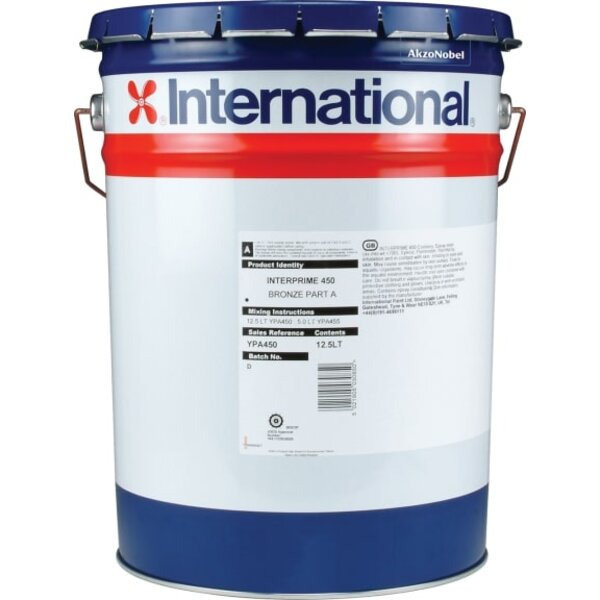
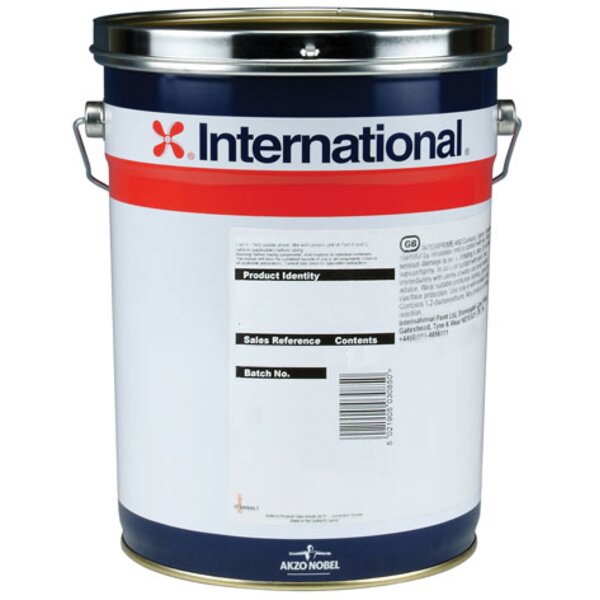
INTERPRIME 450 BASE by International Náutica is a pure epoxy, high performance anti-corrosive primer designed to deliver long-term protection in demanding marine and industrial environments. Its excellent water barrier properties provide durable anticorrosive performance on suitably prepared and primed steel and aluminium, and it is suitable for use in systems with controlled cathodic protection.
Supplied as part of a two-component system (mixed at 2.5:1 with curing agent YPA455), this matt epoxy primer is formulated for professional applications where reliable adhesion, high film build and controlled drying and overcoating characteristics are essential.
Main features
- Pure epoxy anticorrosive primer providing excellent long-term corrosion protection.
- Outstanding water barrier performance thanks to 60% volume solids and high build application (recommended 150 microns dry film per coat).
- Versatile substrate compatibility: can be applied directly over suitably prepared and primed steel, aluminium and GRP/FRP within International coating systems.
- High performance within yacht specifications: to be used in accordance with standard Global Yacht specifications.
- Wide application temperature window: can be applied on substrates down to -5°C / 23°F (consider subsequent coats for full cure at low temperatures).
- Controlled drying and overcoating times from 5°C to 35°C, optimised for professional scheduling and multi-coat systems.
- Multiple application methods: airless spray, brush or roller, with guidance for film thickness and coverage.
- Available colours: YPA450 Bronze and YPA451 Aluminium, both with a matt finish.
Technical characteristics
Product information
- Type: Epoxy anticorrosive primer (pure epoxy coating).
- Brand: International Náutica.
- Product name: INTERPRIME 450 BASE (Interprime 450).
- Colour: YPA450 Bronze, YPA451 Aluminium.
- Finish: Matt.
- Specific gravity: 1.23.
- Volume solids: 60%.
- Mix ratio: 2.5 volumes Part A to 1 volume Part B (converter/curing agent YPA455).
- Typical shelf life: 2 years.
- VOC (as supplied): 386 g/l.
- VOC (EU Solvent Emissions Directive): 318 g/kg (Council Directive 1999/13/EC).
- Unit size: 17.5 litre unit.
Drying and pot life
Substrate temperature and corresponding drying data:
- 5°C (41°F)
- Touch dry: 5 hours
- Hard dry: 8 hours
- Pot life: 6 hours
- 15°C (59°F)
- Touch dry: 4 hours
- Hard dry: 7.5 hours
- Pot life: 4.5 hours
- 25°C (77°F)
- Touch dry: 3 hours
- Hard dry: 6 hours
- Pot life: 2.5 hours
- 35°C (95°F)
- Touch dry: 2 hours
- Hard dry: 3 hours
- Pot life: 60 minutes
Overcoating intervals
Recommended minimum and maximum overcoating times by substrate temperature:
- 5°C (41°F)
- Epoxy Tiecoat: 9 hours min, 14 days max
- Interfill 550: not specified
- Interior Primer 860: 9 hours min, 14 days max
- Interprime 450: 9 hours min, 14 days max
- Interprime 450 Non Immersed Areas: 9 hours min, 6 months max
- 15°C (59°F)
- Epoxy Tiecoat: 7 hours min, 14 days max
- Interfill 550: 2 days min, 14 days max
- Interior Primer 860: 7 hours min, 14 days max
- Interprime 450: 8 hours min, 14 days max
- Interprime 450 Non Immersed Areas: 8 hours min, 6 months max
- 25°C (77°F)
- Epoxy Tiecoat: 7 hours min, 14 days max
- Interfill 550: 24 hours min, 14 days max
- Interior Primer 860: 7 hours min, 14 days max
- Interprime 450: 7 hours min, 14 days max
- Interprime 450 Non Immersed Areas: 7 hours min, 6 months max
- 35°C (95°F)
- Epoxy Tiecoat: 4 hours min, 14 days max
- Interfill 550: 24 hours min, 14 days max
- Interior Primer 860: 4 hours min, 14 days max
- Interprime 450: 4 hours min, 14 days max
- Interprime 450 Non Immersed Areas: 4 hours min, 3 months max
Application data
- Number of coats: 2.
- Theoretical coverage: 4 m²/litre per coat.
- Recommended dry film thickness (DFT) per coat: 150 microns dry.
- Recommended wet film thickness (WFT) per coat: 250 microns wet.
- Application methods: Airless spray, brush, roller.
- Airless spray settings: Pressure 211 bar; tip size 0.66–0.79 mm (26–31 thou).
- Thinner: International GTA220, only in exceptional circumstances, max 5% by volume.
- Cleaner: GTA822 for equipment cleaning.
Applications and use cases
Typical substrates and systems
- Steel: Thoroughly degreased and grit blasted to Sa 2½ (near white metal). Where blasting is not possible, ground with 24–36 grit discs to a uniform, clean bright metal surface with 50–75 microns anchor profile. All residues must be removed before painting.
- Aluminium: Degreased with Super Cleaner, then blasted with aluminium oxide or copper-free equivalent. If blasting is not possible, prepared by discing with 24–36 grade aluminium oxide paper to a bright, uniform surface with 50–75 microns (2–3 mils) anchor profile. Filler at the waterline must first be overcoated with a thin coat of Epoxy GP Coating and allowed to dry 24 hours at 20°C before applying INTERPRIME 450.
- GRP/FRP: Degreased with solvent, Super Cleaner or suitable liquid detergent, then sanded with 120–180 grade paper to remove all gloss. Rinse with water ensuring the water film “sheets out” with no breaks or holes. After thorough drying, prime with an International primer as specified for the coating system.
Professional marine and industrial use
- Yacht and marine structures: Use in line with the standard Global Yacht specifications where a robust epoxy anticorrosive base is required.
- Cathodic protection systems: Compatible for use in schemes with controlled cathodic protection, as indicated in the product description.
- High build primer in multi-coat systems: Serves as the epoxy base for tiecoats, fillers and subsequent primers such as Epoxy Tiecoat, Interfill 550, Interior Primer 860 and additional Interprime 450 coats, including non-immersed areas with extended overcoating windows.
- Spot repair and small areas: Brush or roller application may be suitable for small localised repairs, bearing in mind that multiple coats may be necessary to achieve the specified DFT.
FAQ – INTERPRIME 450 BASE
-
What type of product is INTERPRIME 450 BASE?
It is a pure epoxy, high performance anti-corrosive primer designed as a water-barrier coating for long-term protection of suitably prepared and primed steel and aluminium, within International coating systems.
-
On which substrates can it be applied?
It can be applied over suitably prepared and primed steel and aluminium, and is also used over prepared GRP/FRP surfaces within specified International systems.
-
What is the mixing ratio and which curing agent should be used?
The mix ratio is 2.5 volumes Part A to 1 volume Part B, using converter/curing agent YPA455.
-
How many coats are recommended and what film thickness should I aim for?
The system specifies 2 coats, each with a recommended dry film thickness of 150 microns (approximately 250 microns wet film per coat).
-
Can INTERPRIME 450 BASE be applied at low temperatures?
Yes. It may be applied at substrate temperatures down to -5°C / 23°F. However, when overcoating at low temperatures, subsequent coats may require higher temperatures to achieve full cure.
-
What thinner and cleaner should be used?
Use International GTA220 thinner only in exceptional circumstances, at a maximum of 5% by volume. For equipment cleaning, use GTA822.
-
How should the surface be prepared before application?
All surfaces must be clean, dry and free from contamination. High pressure fresh water wash or fresh water wash should be used to remove oil, grease, soluble contaminants and other detrimental matter. Steel, aluminium and GRP/FRP require the specific mechanical preparation steps detailed in the technical information.
-
How is the product best mixed and applied?
A power agitator should be used to mix both the individual components and the blended paint. Recommended application methods are airless spray (211 bar, 0.66–0.79 mm tip), brush or roller. Brush or roller may require multiple coats to reach the specified dry film thickness.
-
What is the typical shelf life?
The typical shelf life is 2 years when stored in unopened containers under the recommended conditions.
-
How should surfaces be treated before overcoating?
Prior to overcoating, INTERPRIME 450 should be high pressure fresh water washed and or solvent washed where necessary to remove any accumulated surface contamination.
Section 14 – Transport information
- UN number (ADR/RID, IMDG, IATA): UN1263.
- UN proper shipping name: PAINT / PINTURAS.
- Transport hazard class: Class 3 (flammable liquids).
- Packing group: III.
- Marine pollutant / environmental hazards:
- Classified as environmentally hazardous for transport.
- Marine pollutant substances include 2,2'-[(1-methylethylidene)bis(4,1-phenyleneoxymethylene)]bisoxirane and solvent naphtha (petroleum), light aromatic.
- The environmentally hazardous substance mark is not required when transported in packages of 5 litres or 5 kg or less.
- ADR/RID additional information:
- Tunnel restriction code: D/E.
- IMDG additional information:
- Emergency schedules: F-E, S-E.
- Marine pollutant marking not required for packages of 5 litres or 5 kg or less.
- IATA information:
- The environmentally hazardous substance mark may appear if required by other transport regulations.
- User transport precautions:
- During internal transport on site, always carry the product in securely closed, upright containers.
- Ensure personnel handling the product know what to do in case of accident or spillage.
Section 8 – Personal protective measures
Exposure controls and engineering measures
- Use only with adequate ventilation.
- Employ local exhaust ventilation or other engineering controls to keep airborne concentrations below statutory limits and below the lower explosion limit for vapours.
- Use explosion-proof ventilation and electrical equipment where required.
- Ensure eye wash stations and safety showers are located close to work areas.
Personal protective equipment (PPE)
- Eye and face protection
- Wear chemical splash goggles and or a face shield that meet approved standards whenever there is a risk of splashes, mists or vapours.
- If there is a significant inhalation risk, a full-face respirator may be required instead of separate eye protection.
- Hand protection
- Use chemical resistant, impermeable gloves that comply with relevant standards.
- For prolonged or frequently repeated contact, gloves of protection class 6 (breakthrough time greater than 480 minutes according to EN374) are recommended. Suggested materials: Viton or nitrile, thickness at least 0.38 mm.
- For short contact, gloves of protection class 2 or higher (breakthrough time greater than 30 minutes according to EN374) are recommended. Suggested material: nitrile, thickness at least 0.12 mm.
- Gloves should be replaced regularly and whenever there is any sign of damage.
- Skin and body protection
- Wear suitable protective clothing such as coveralls to prevent skin contact.
- Where there is a risk of ignition due to electrostatic charges, anti-static protective clothing should be used, including coveralls, boots and gloves with antistatic properties.
- Choose additional protective footwear and garments according to the specific task and risk assessment.
- Respiratory protection
- Where ventilation is insufficient and exposure limits may be exceeded, wear a respirator complying with applicable standards.
- Recommended: respirator in accordance with EN140 fitted with an A/P2 or better filter.
- Dry sanding, flame cutting and or welding of dry paint films may generate hazardous dusts and fumes. Wet sanding or wet abrading is preferable. If extraction ventilation cannot prevent exposure, appropriate respiratory protection must be used.
Hygiene measures
- Wash hands, forearms and face thoroughly after handling and before eating, drinking, smoking or using the restroom, and at the end of the work shift.
- Contaminated clothing should not be taken out of the workplace and must be washed before reuse.
- Remove protective equipment and contaminated clothing before entering eating areas.
*Contenido generado por IA