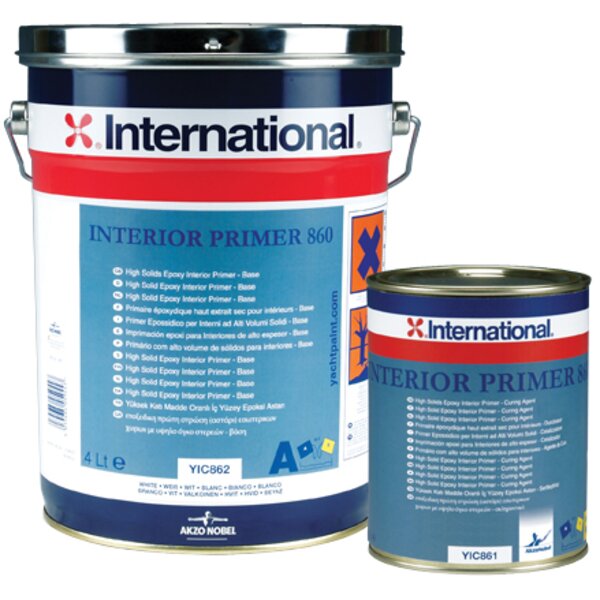
What is Interior Primer 860 Base and why choose it
Interior Primer 860 Base from International Náutica is a high build, multipurpose, low VOC epoxy primer specifically formulated for use on the interiors of all types of constructions. It is designed for steel, aluminium, GRP/laminate and wood interiors, delivering excellent anticorrosive protection and holding a certified Surface Spread of Flame (fire retardant) approval. Reduced surface preparation requirements, fast walk-on times and low odour help speed up the painting process and reduce disruption to other trades working inside the vessel or structure.
Main features
- High build epoxy primer with 70% volume solids for full coverage in a single coat (recommended 125 microns DFT).
- Multipurpose interior system suitable for steel, aluminium, stainless steel, GRP/laminate, gelcoat, bare wood and suitably prepared powder-coated surfaces.
- Low VOC, low odour formulation (340 g/l VOC as supplied; 234 g/kg VOC EU Solvent Directive) for reduced emissions and better working comfort.
- Fast drying and early walk-on: touch dry from 30–90 minutes and walk-on ready from 3–24 hours depending on temperature.
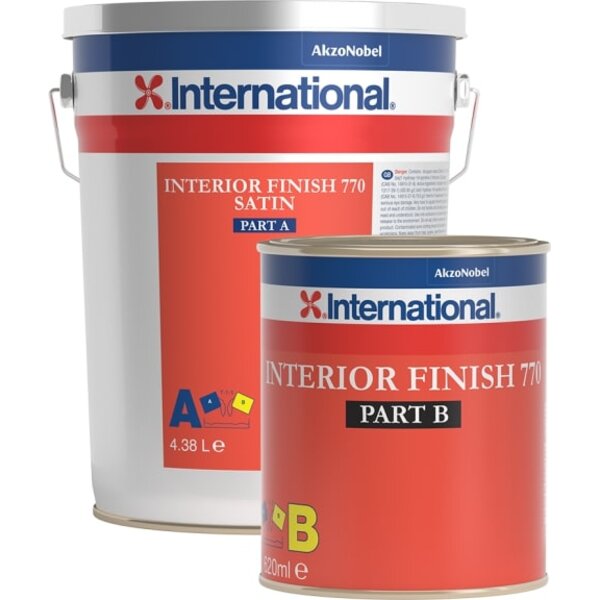
- Long overcoating interval: can be overcoated by itself, Awlgrip Topcoat (spray), Interior Finish 750 or Interior Finish 770 from 1–7 hours minimum up to 12 months maximum in dry environments.
- Excellent anticorrosive and chemical resistance for long-term protection of interior hull, bilges and machinery spaces.
- Fire performance: holds a Surface Spread of Flame Certificate / Lloyd’s Register fire-retardant certification when used in specified systems.
- Reduced surface preparation demand and easy sanding in visible areas when required.
- Available colours: white (YIC862) and grey (YIC866) with semi-gloss finish.
- Professional two-component system mixed 4:1 by volume with curing agent YIC861.
Technical specifications
- Product type: two-component epoxy primer for interiors.
- Colour: YIC862 White, YIC866 Grey.
- Finish: semi-gloss.
- Specific gravity: approximately 1.45 g/cm³.
- Volume solids: 70%.
- Mix ratio: 4:1 by volume (base:curing agent) as supplied.
- Curing agent: YIC861.
- Typical shelf life: 2 years.
- VOC (as supplied): 340 g/l.
- VOC (EU Solvent Directive): 234 g/kg (Council Directive 1999/13/EC).
- Unit sizes: 5 l and 20 l base; compatible curing agent 1 l and 5 l (según referencia YIC861).
- Recommended DFT per coat: 125 microns dry.
- Recommended WFT per coat: 179 microns wet (varies with thinner addition).
- Theoretical coverage: 4.8 m²/l per coat unthinned.
- Practical coverage by spray: 2.9 m²/l per coat (approximate).
- Maximum wet film thickness before sagging: 300 microns WFT (unthinned).
Drying and walk-on times
- Hard dry:
- 10°C: 7 hours
- 15°C: 5 hours
- 23°C: 2.5 hours
- 35°C: 1 hour
- Touch dry:
- 10°C: 90 minutes
- 15°C: 75 minutes
- 23°C: 60 minutes
- 35°C: 30 minutes
- Dry to walk on:
- 10°C: 24 hours
- 15°C: 16 hours
- 23°C: 7 hours
- 35°C: 3 hours
- Pot life after mixing:
- 10°C: 3 hours
- 15°C: 2 hours
- 23°C: 60 minutes
- 35°C: 45 minutes
Overcoating intervals (dry environments)
Substrate temperature and allowable overcoating times:
- 10°C: minimum 7 hours, maximum 12 months.
- 15°C: minimum 5 hours, maximum 12 months.
- 23°C: minimum 2.5 hours, maximum 12 months.
- 35°C: minimum 1 hour, maximum 12 months.
These intervals apply when overcoating with Awlgrip Topcoat (spray), Interior Finish 750, Interior Finish 770 or additional coats of Interior Primer 860 in dry environments. In wet areas such as bilges, the maximum overcoating time for Interior Finish 750 is reduced to 1 month. If the maximum overcoating interval is exceeded, scrub thoroughly with a maroon 3M Scotch-Brite pad 7447 before recoating.
Applications and use cases
Recommended substrates and typical uses
- Interior steel hull and structure: bulkheads, frames, stringers and other internal steel surfaces.
- Aluminium interiors: decks, superstructures and internal stiffeners in dry or wet areas.
- Stainless steel: internal tanks, handrails and machinery supports (after light blasting).
- GRP/laminate and gelcoat: closed, sound laminates impregnated with resin; interior surfaces where fibres are not exposed.
- Bare wood interiors: suitable for interior wooden structures and linings after correct preparation.
- Powder-coated surfaces and pipework: after appropriate cleaning and mechanical abrasion, in consultation with an International Paint technical representative.
- Bilges and wet compartments: protection of bilges and other damp interior areas when used in the specified scheme, including with Interior Finish 750.
- Engine and machinery spaces: as part of fire-retardant interior coating systems, providing durable, chemically resistant priming.
Surface preparation
- Steel: degrease with 600 Wipedown Solvent or Thinner 910. Gritblast to SSPC-SP10/NACE 2 (Sa 2½) near-white metal. If blasting is not possible, mechanically grind with 24–36 grit abrasive discs to a clean, bright, well roughened surface meeting SSPC-SP-3 / St3; use an angle grinder in difficult areas.
- Steel with shop primer: degrease with 600 Wipedown Solvent or Thinner 910. Ensure the surface is clean, free from rust, dust, oil, grease and dirt. Shop primer should have been applied to a substrate with the specified surface profile.
- Aluminium:
- Dry areas: degrease with 600 Wipedown Solvent or Thinner 910.
- Wet areas (e.g. bilges): degrease with 600 Wipedown Solvent or Thinner 910 then scrub thoroughly with a maroon 3M Scotch-Brite pad 7447.
- Stainless steel: degrease with 600 Wipedown Solvent or Thinner 910 and light gritblast to produce a 50 micron profile.
- Bare wood: sand with P120 grit. Remove oil from oily timbers such as teak using the recommended thinner (disolvente nº 9) and change cloths frequently.
- Laminate (GRP): only on closed, sound laminates impregnated with resin, never on exposed fibres. Degrease with 600 Wipedown Solvent or Thinner 910 and scrub using a maroon 3M Scotch-Brite pad 7447.
- Gelcoat: degrease with 600 Wipedown Solvent or Thinner 910, sand with 80 grit and carefully remove all sanding debris before coating.
- Powder-coated surfaces: degrease with 600 Wipedown Solvent or Thinner 910 and scrub with a maroon 3M Scotch-Brite pad 7447.
Application methods and parameters
- Mixing: use a power agitator to thoroughly mix each component separately, then add curing agent YIC861 to the base at 4:1 by volume and mix well.
- Recommended thinners:
- Preferred thinner: Thinner 910.
- Alternative slower thinners (when required): Thinner No.7 and Thinner 920.
- Equipment cleaning: International Equipment Cleaner GTA822, Thinner No.7, Thinner 910 or Thinner 920.
- Airless spray:
- Thinning: 0–5% with Thinner 910.
- Tip size: 1540–1750; recommended 1740.
- Pressure: approximately 200 bar.
- Conventional spray:
- Pressure pot: thin 10–15%.
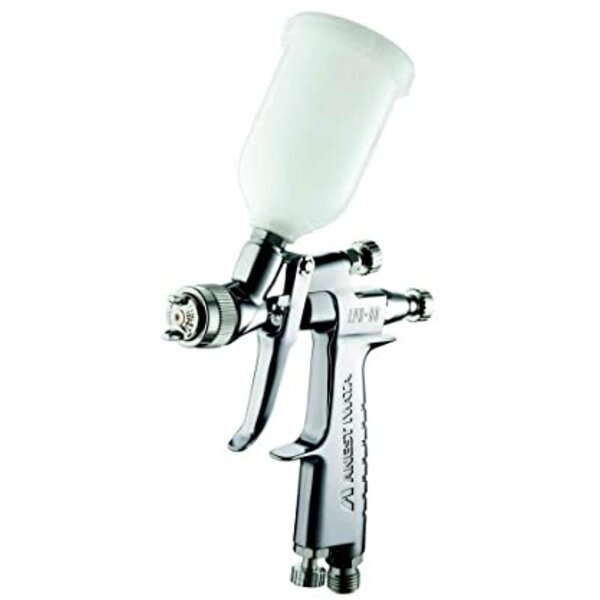
- Gravity feed gun: thin 20–25%.
- Tip size: 1.8 mm.
- Pressure: less than 1 bar (pot) and 3–4 bar (atomising).
- Two coats may be required to achieve recommended DFT.
- Brush: thin 0–5% using Thinner 920.
- Roller: thin 0–5% using Thinner 920.
- Application conditions:
- Do not use below 5°C.
- Ambient temperature: 5–35°C.
- Product temperature: 10–35°C.
- Substrate temperature: 5–35°C.
- For maximum performance, curing temperature should be above 10°C.
- Do not apply at film thicknesses greater than recommended to avoid solvent entrapment.
- Do not apply over conventional one-pack coatings.
- Do not apply when condensation may form on the substrate.
FAQ
-
On which substrates can Interior Primer 860 Base be used
It can be used on suitably prepared steel, shop-primed steel, aluminium, stainless steel, bare wood, GRP/laminate, gelcoat and powder-coated surfaces inside the vessel or structure.
-
What topcoats are compatible with Interior Primer 860
In dry environments it can be overcoated with Awlgrip Topcoat (spray), Interior Finish 750, Interior Finish 770 or further coats of Interior Primer 860 within the stated overcoating intervals.
-
Can it be used in bilges and other wet areas
Yes, it is suitable for wet areas such as bilges. When overcoated with Interior Finish 750 in such areas, the maximum overcoating interval for the finish is reduced to one month.
-
How much surface does one litre cover
The theoretical coverage is about 4.8 m² per litre at 125 microns DFT without thinning. Practical coverage by spray application is approximately 2.9 m² per litre per coat.
-
What is the mixing ratio with the curing agent
Interior Primer 860 Base must be mixed 4:1 by volume with curing agent YIC861.
-
How long can I wait before recoating
In dry conditions the minimum overcoating time is 1–7 hours depending on temperature, and the maximum is 12 months for compatible topcoats and for recoating with itself.
-
Does the product have fire-retardant certification
Yes, Interior Primer 860 holds a Surface Spread of Flame Certificate and forms part of Lloyd’s Register fire-retardant interior systems when used as specified.
-
Can it be applied over one-pack (single-component) paints
No. Interior Primer 860 must not be applied over conventional one-pack coatings.
-
What is the recommended storage temperature
Store between 5°C and 35°C, in a cool, dry place away from direct sunlight, with containers tightly closed.
-
Is sanding always required between coats
No. Within the specified overcoating window sanding is not required. If the maximum interval is exceeded, the surface must be thoroughly abraded with a maroon 3M Scotch-Brite pad 7447 before recoating.
Section 14: transport information
- UN number: UN1263.
- Proper shipping name: PAINT.
- Transport hazard class: Class 3 (flammable liquid).
- Packing group: III.
- ADR/RID: Class 3, Packing Group III; environmentally hazardous; tunnel code D/E.
- IMDG: Class 3, Packing Group III; marine pollutant (reaction product: bisphenol-A-epichlorhydrin epoxy resin; trizinc bis(orthophosphate)); emergency schedules F-E, S-E. Marine pollutant mark is not required when transported in packages ≤5 l or ≤5 kg.
- IATA: Class 3, Packing Group III; the environmentally hazardous substance mark may appear if required by regulations.
- General transport advice: transport only in securely closed original containers, upright and secured. Ensure personnel know what to do in case of accident or spillage. Avoid release to drains and watercourses.
Section 8: individual protective measures
The following personal protective measures are derived from the Safety Data Sheet for Interior Primer 860 components and apply during professional use, especially during spraying and surface preparation.
Personal protective equipment (PPE)
- Respiratory protection:
- Use only with adequate ventilation and local extraction.
- When spraying or if exposure limits may be exceeded, wear a respirator conforming to EN140 with type A/P2 filter or better (combination organic vapour and particulate filter).
- In confined spaces, use air-fed or compressed-air breathing equipment.
- During dry sanding, flame cutting or welding of the dry film, use suitable respiratory protection, and wet sanding should be used wherever possible.
- Hand protection:
- Chemical-resistant, impervious gloves complying with EN374.
- For prolonged or frequently repeated contact: gloves with protection class 6 (breakthrough time >480 minutes), recommended materials Viton or nitrile, thickness ≥ 0.38 mm.
- For brief contact: nitrile gloves, thickness ≥ 0.12 mm, protection class ≥ 2 (breakthrough time >30 minutes).
- Replace gloves regularly and immediately if damaged.
- Eye and face protection:
- Wear chemical splash goggles complying with an approved standard.
- When there is a risk of splashes or spray, use goggles plus a face shield, or a full-face respirator if inhalation hazards exist.
- Body protection:
- Wear protective clothing covering body, arms and legs. No skin should remain exposed.
- Use anti-static protective clothing, overalls, boots and gloves when there is a risk of ignition from static electricity, in accordance with EN 1149.
- Other skin protection:
- Use appropriate chemical-resistant footwear.
- Avoid petroleum-based barrier creams; wash all exposed skin thoroughly after contact.
Hygiene and handling measures
- Do not breathe vapour, spray or mist. Avoid contact with eyes, skin and clothing.
- Do not eat, drink or smoke in application areas. Wash hands, forearms and face after handling and before breaks.
- Remove contaminated clothing and protective equipment before entering eating areas; wash contaminated garments before reuse.
- Ensure eyewash stations and safety showers are available near the work area.
Contenido generado por IA