What is Interfill 833 Fast Part B and why choose it?
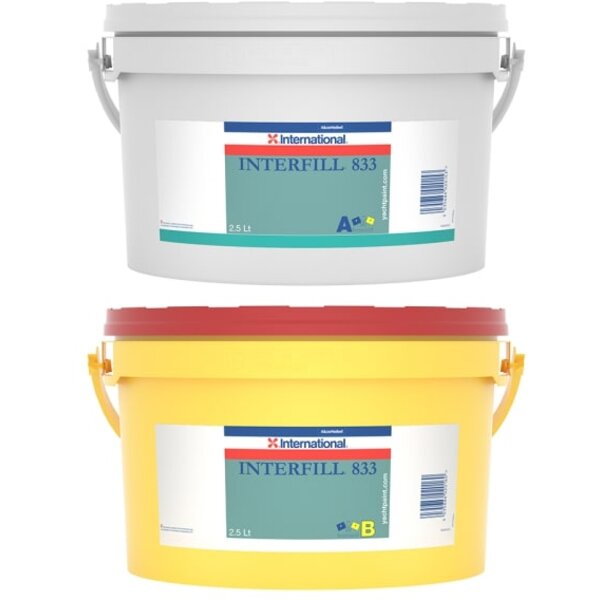
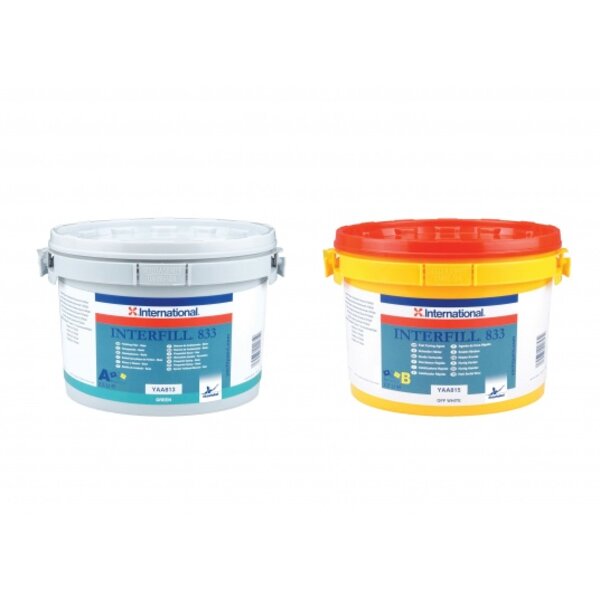
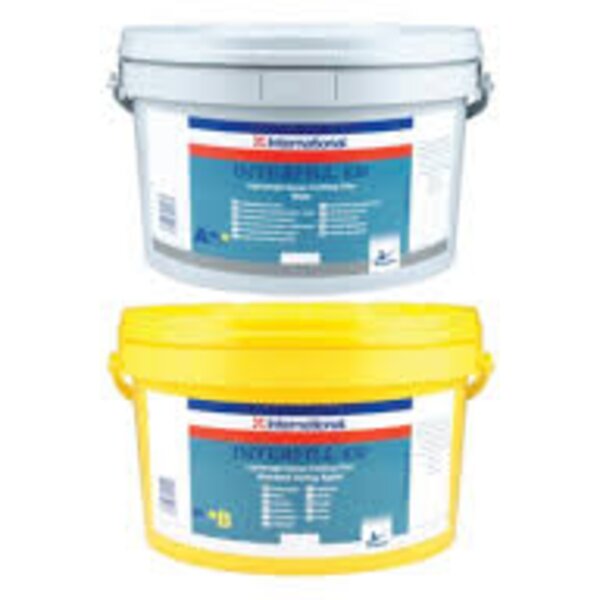
Interfill 833 Fast Part B is the fast hardener (converter YAA815) for the professional epoxy finishing filler system Interfill 833 Fast Cure from International Náutica. When mixed 1:1 by volume with Interfill 833 base (YAA813), it creates a high-build epoxy finishing filler designed to correct minor surface defects over Interfill 830 or cured GRP/composites before applying epoxy primers and finishing coats.
The Fast Cure hardener allows the filled surface to be sanded and recoated much earlier than with standard curing systems, providing excellent productivity in professional refit and new-build projects.
Main features
- Fast cure hardener for the Interfill 833 Fast Cure epoxy finishing filler system.
- Very easy to sand when mixed and cured as Interfill 833 Fast Cure.
- Allows sanding and overcoating after only 6 hours at 23ºC when used with the Fast Cure system.
- Designed for application over cured and sanded epoxy fillers such as Interfill 830 or over cured GRP/composites.
- Can be applied up to 0.3 cm thickness per coat (as Interfill 833 Fast Cure) by trowel or fairing batten.
- Simple 1:1 mix ratio by volume with Interfill 833 Fast Cure base (YAA813).
- Suitable for areas above and below the waterline when used within the specified epoxy system.
Technical specifications
- Product type: Epoxy finishing filler hardener (converter YAA815) for Interfill 833 Fast Cure
- Use: Professional, two-component epoxy filler system
- Application area: Above and below the waterline when used as Interfill 833 Fast Cure system
- Mix ratio (with base YAA813): 1:1 by volume (as supplied); mix until uniform colour
- Maximum recommended wet film thickness (system): 3000 microns (3 mm) per coat
- Recommended dry film thickness per coat (system): 3000 microns dry
- Theoretical coverage (system): 0.33 m²/l at 3 mm / 3000 µm WFT
- Pot life (system, Interfill 833 Fast Cure): approx. 30 minutes at 23ºC; 20–50 minutes depending on temperature
- Sanding time (system, Interfill 833 Fast Cure): approx. 6 hours at 23ºC; 3–16 hours depending on temperature
- Substrate temperature for use: between 10ºC and 35ºC
- Typical shelf life: 2 years
- Pack size (system data): 2.5 L base + 2.5 L converter = 5 L mixed; also available in 60 L. Specific details for this pack: Consultar ficha técnica del fabricante.
- Colour of base: YAA813 – Green; colour of Part B: Consultar ficha técnica del fabricante.
- Finish (system): Matt
- Volume solids (system): 100 %
Applications and use cases
Typical substrates
- Cured and sanded epoxy fillers, especially Interfill 830.
- Cured GRP (fibreglass) and composite substrates.
Recommended use
- Fairing and finishing: Creating an exceptionally smooth surface before epoxy primers such as Interprime 820 or Interprime 880, or epoxy barrier systems like Interprotect.
- Minor defect correction: Filling and levelling small surface defects over Interfill 830 prior to application of high-performance coatings.
- Professional repair work: Fast turnaround jobs where reduced waiting time before sanding and recoating is critical.
Surface preparation (system)
- Previously painted surfaces in good condition: Wash with Yacht Line Super Cleaner, rinse with fresh water and allow to dry. Abrade with 180–280 grit abrasive.
- Previously painted surfaces in poor condition/repairs: Remove all previous coatings back to sound material and fill with Interfill 830 before applying Interfill 833 Fast Cure.
- Interfill 830: Sand with 80–180 grit paper.
- Bare GRP/composites: Sand smooth with 120–180 grit paper. Remove sanding residue with clean compressed air and brushing; vacuum for best results.
Application method (system)
- Mix Interfill 833 base (YAA813) and Interfill 833 Fast Part B (YAA815) thoroughly at 1:1 by volume until an even colour is obtained.
- Do not thin. Do not mix with other hardeners such as YAA814.
- Apply firmly using a trowel, spreader or fairing batten, up to a maximum of 3 mm per coat.
- Allow to cure; once hardened, sand smooth with 80–180 grit wet or dry paper.
- Interfill 833 Fast Cure can be overcoated with itself as soon as it is sufficiently cured not to be lifted during screeding.
FAQ
-
What is Interfill 833 Fast Part B used for?
It is the fast curing converter (YAA815) that must be mixed 1:1 by volume with Interfill 833 base (YAA813) to create the Interfill 833 Fast Cure epoxy finishing filler.
-
Can I use Part B on its own without the base?
No. It must never be used without thoroughly mixing with the specified base in the correct ratio.
-
How thick can I apply the filler when using Fast Part B?
When mixed as Interfill 833 Fast Cure, the system can be applied up to 3 mm (0.3 cm) per coat using a trowel or fairing batten.
-
When can I sand and overcoat?
At 23ºC, Interfill 833 Fast Cure is typically sandable and recoatable after about 6 hours. At higher or lower temperatures the times range from approximately 3 to 16 hours.
-
Which primers can I apply after Interfill 833 Fast Cure?
According to the technical data, compatible epoxies include Interprime 820, Interprime 880 and Interprotect systems, observing the specified minimum overcoating intervals.
-
Can I thin Interfill 833 Fast Cure or adjust the cure speed by mixing with other hardeners?
No. Do not thin the product and do not mix Fast Part B with other hardeners such as YAA814 to change cure speed.
-
What is the recommended temperature range for use?
Product, substrate and ambient temperatures should all be between 10ºC and 35ºC during mixing and application.
-
How should I clean tools after use?
Use International GTA220 thinner for equipment cleaning only.
-
What happens if the sandable time is exceeded before overcoating?
All fillers must be re-sanded before overcoating to ensure good adhesion. A sanded filler can generally be left up to 3 months before recoating; after this period it must be re-sanded again.
-
What is the pot life when using Fast Part B?
When mixed as Interfill 833 Fast Cure, pot life is approximately 30 minutes at 23ºC (20–50 minutes depending on temperature).
Section 14 – Transportation information
For Interfill 833 Fast Cure, including Fast Part B, the following transport guidance is provided in the product documentation:
- Exposure to air and extremes of temperature should be avoided during transport and storage.
- Keep the product in securely closed containers during transport.
- Maintain the container in its original, closed packaging as supplied until use.
- Store and transport between approximately 5ºC and 35ºC, out of direct sunlight.
- Specific UN number, transport class and packing group for this particular component: Consultar ficha técnica del fabricante.
Section 8 – Individual protection measures
Interfill 833 Fast Part B is an amine-based epoxy curing agent and can cause serious skin and eye damage and sensitisation. Follow the safety and PPE recommendations from the safety data sheets for Interfill 833 curing agents:
- General measures: Avoid contact with skin and eyes and avoid breathing vapours or sanding dust. Do not eat, drink or smoke in application areas. Wash hands, forearms and face thoroughly after handling.
- Hand protection: Use chemical-resistant gloves during mixing and application. Nitrile gloves are recommended; for frequent or prolonged contact, use gloves compliant with EN374 with a high breakthrough time (for example, class 6).
- Eye and face protection: Wear approved chemical splash goggles; use a face shield where splashing is likely.
- Skin and body protection: Wear protective clothing covering body, arms and legs so that no skin remains exposed. Avoid petroleum-based barrier creams.
- Respiratory protection: Ensure adequate ventilation. If airborne concentrations may exceed occupational limits, use suitable respiratory protection. For sanding or spraying operations, use a respirator with combined organic vapour and particulate filters (for example A2-P2) or air-fed equipment in confined spaces.
- Hygiene measures: Remove contaminated clothing immediately and wash before reuse. Clean footwear thoroughly before reuse.
- Environmental precautions: Prevent spills from entering drains or watercourses. Waste and empty containers must be disposed of in accordance with local regulations; residues should not be discharged to municipal waste or landfills without proper authorisation.
*Contenido generado por IA