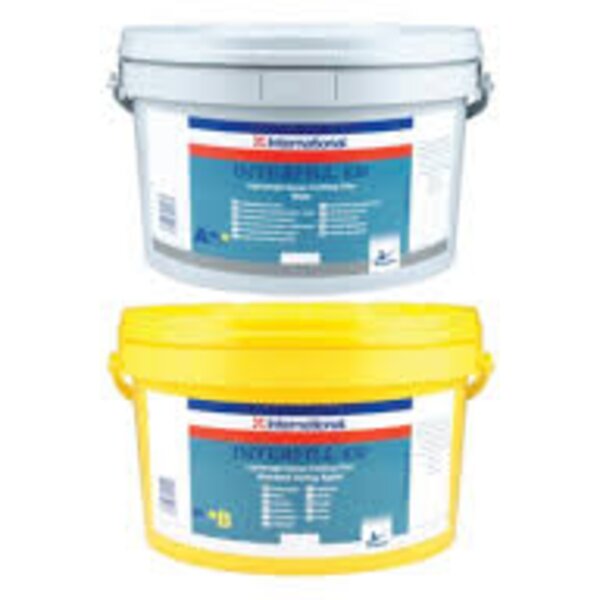
What is Interfill 833 Part A and why choose it?
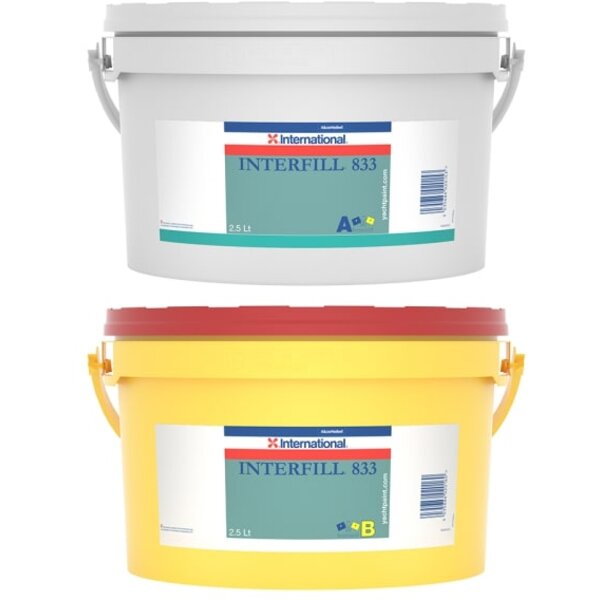
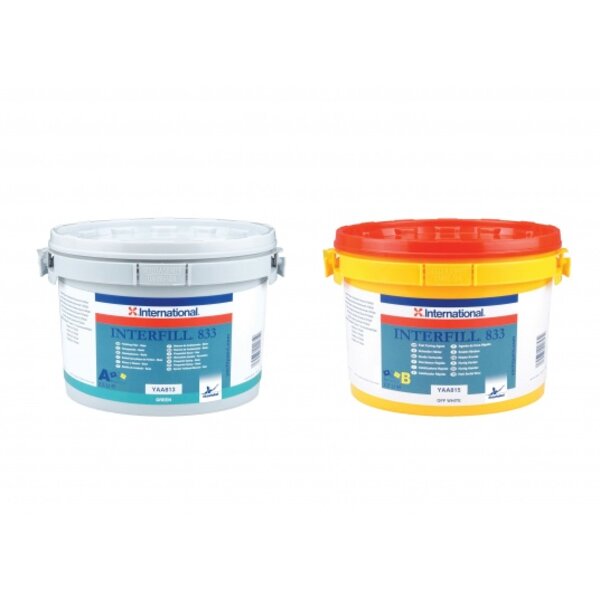
INTERFILL 833 PART A by International Náutica is the green base component of a professional two-component epoxy finishing filler. Designed for use over Interfill 830 and other cured epoxy fillers, it allows you to correct minor surface defects and achieve an exceptionally smooth, fair surface before applying high-performance primers and topcoats. With 100% solids by volume, easy sanding and excellent application properties, it is ideal for demanding yacht and boatbuilding projects both above and below the waterline.
Main features
- Professional epoxy finishing filler specifically formulated for minor surface correction prior to final priming and painting.
- Two-component system: INTERFILL 833 Part A (green base) to be mixed 1:1 by volume with the corresponding curing agent.
- Very easy to sand, enabling precise fairing and fast preparation for subsequent coatings.
- Excellent finishing qualities: levelling additives provide an extraordinarily smooth surface.
- Colour contrast (green) against Interfill 830 (grey) to clearly show high and low spots during fairing.
- Versatile application: can be applied by trowel, spreader or fairing batten.
- Above and below the waterline use on suitably prepared substrates.
- Flexible curing options when used with standard or fast cure hardeners, helping to optimise turnaround in various temperatures.
Technical specifications
- Product type: Epoxy finishing filler base (Part A of a two-component system).
- Colour: Green (code YAA813).
- Finish: Matt.
- Density (Part A): approx. 0.825–0.879 g/cm³.
- Solids by volume: 100%.
- Mix ratio (by volume): 1:1 with the designated curing agent.
- Typical pack size: 5 L (combined when mixed with curing agent).
- Recommended dry film thickness (DFT): approx. 3000 µm per application when applied by palette or batten.
- Theoretical coverage: about 0.33 m²/L at 3 mm (3000 µm) wet film thickness.
- Substrates: cured and sanded epoxy fillers such as Interfill 830, or cured GRP/FRP and composite substrates.
- Areas of use: above and below the waterline on yachts and composite structures.
- Typical storage life: up to 2 years in unopened original containers, stored between 5°C and 35°C, away from direct sunlight and extremes of temperature.
Drying and overcoating information (typical system)
Interfill 833 – Standard Cure (with standard curing agent)
- Sanding time:
- 10°C: approx. 38 hours
- 15°C: approx. 28 hours
- 23°C: approx. 17 hours
- 35°C: approx. 12 hours
- Typical pot life:
- 10°C: approx. 80 minutes
- 15°C: approx. 70 minutes
- 23°C: approx. 50 minutes
- 35°C: approx. 30 minutes
- Minimum overcoating intervals with epoxy primers/fillers (standard cure hardener):
- Interfill 835, Interprime 820, Interprime 850, Interprime 880, Interprotect, Interprotect Professional
- 10°C: minimum 5 days
- 15°C: minimum 3 days
- 23°C: minimum 2 days
- 35°C: minimum 1 day
Interfill 833 Fast Cure (with fast curing agent)
- Sanding time:
- 10°C: approx. 16 hours
- 15°C: approx. 16 hours
- 23°C: approx. 6 hours
- 35°C: approx. 3 hours
- Typical pot life:
- 10°C: approx. 50 minutes
- 15°C: approx. 45 minutes
- 23°C: approx. 30 minutes
- 35°C: approx. 20 minutes
- Minimum overcoating intervals with epoxy primers (fast cure hardener):
- Interprime 820, Interprime 880, Interprotect, Interprotect Professional
- 10°C: minimum 24 hours
- 15°C: minimum 24 hours
- 23°C: minimum 6 hours
- 35°C: minimum 6 hours
Once the sanding window is exceeded, all filler surfaces must be abraded again before overcoating to ensure adhesion. Sanded Interfill 833 can typically remain exposed for up to three months before recoating, after which it should be re-abraded.
Surface preparation and application
Suitable substrates and preparation
- Previously painted surfaces in good condition: wash with Super Cleaner, rinse with fresh water and allow to dry. Abrasive blast lightly or sand with 180–280 grit paper.
- Previously painted surfaces in poor condition / repairs: remove all existing coatings to clean, sound substrate and refair with Interfill 830 before applying Interfill 833.
- Existing Interfill 830: sand with 60–120 or 80–180 grit paper, depending on document, until smooth.
- Untreated GRP / composites: sand to a smooth, matt finish with 120–180 grit paper. Remove sanding residue using clean, dry air and a clean brush or broom; vacuuming is recommended for best results.
Mixing and application
- Thoroughly mix INTERFILL 833 PART A with the corresponding curing agent in a 1:1 volume ratio until a uniform colour is obtained.
- Do not thin the product.
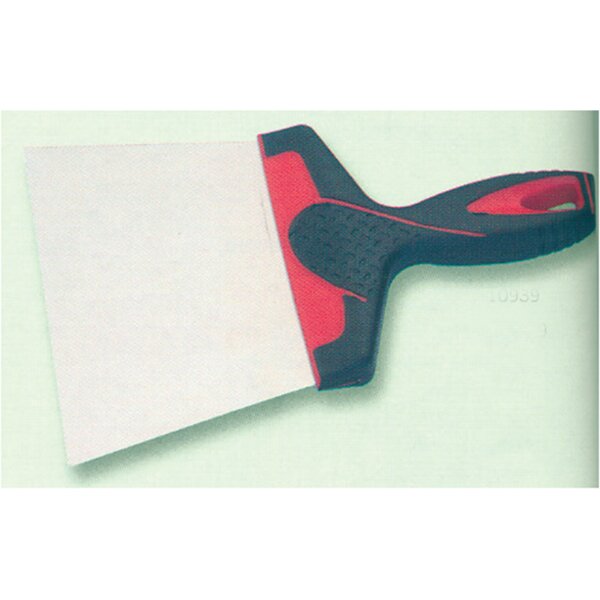
- Spread the mixed filler firmly onto the prepared surface using a trowel, palette knife or fairing batten.
- For small pinholes and defects in Interfill 830, work the filler back and forth with the spatula across the area to ensure complete filling.
- Maximum recommended wet/dry film per coat: approx. 3 mm (3000 µm) when applied by palette or batten.
- Once cured, sand fair with 80–180 grit dry or wet abrasive until smooth.
- After adequate cure, a further levelling coat of Interfill 833 may be applied if required; this protective layer will not be removed during final fairing.
Environmental and handling considerations
- Do not use below 10°C substrate, product or ambient temperature.
- Product, substrate and air temperature should be between 10°C and 35°C.
- Avoid high humidity and low temperatures, which can cause surface by-products that must be removed by detergent wash and fresh-water rinse or sanding before overcoating.
- Spread mixed filler out on a board to avoid excessive heat build-up and extend pot life.
Applications and use cases
- Yacht hull fairing: final skim over Interfill 830 to eliminate minor unfairness, pinholes and surface defects before high-build and finish primers.
- Superstructure and deck finishing: smooth finishing on GRP or composite decks, coachroofs and superstructures above the waterline.
- Professional refit and repair: ideal for fairing local repairs or modifications on composite hulls and structures.
- Commercial and high-performance craft: where consistent, smooth surfaces are required prior to specialist coatings.
FAQ – INTERFILL 833 PART A
-
Is Interfill 833 Part A suitable for use below the waterline?
Yes. When applied over suitably prepared epoxy filler or GRP/composite and correctly overcoated with compatible epoxy primers, it can be used above and below the waterline.
-
What curing agents can be used with Interfill 833 Part A?
It is designed to be mixed 1:1 by volume with the specific Interfill 833 curing agents in standard or fast-cure versions supplied by the manufacturer.
-
How thick can I apply Interfill 833 in one coat?
The typical recommended application is around 3 mm (3000 µm) wet/dry film thickness per coat when applied with a palette or fairing batten.
-
When can I sand the filler after application?
With the standard curing agent, sanding is generally possible from around 17 hours at 23°C, while the fast-cure version can be sanded from about 6 hours at 23°C. Always check that the filler is fully cured before sanding.
-
Which primers are compatible after Interfill 833?
Typical compatible epoxies include Interfill 835, Interprime 820, Interprime 850, Interprime 880, Interprotect and Interprotect Professional, respecting the stated overcoating intervals.
-
Can I thin Interfill 833 or clean cured filler with solvent?
No. The filler must not be thinned, and cured filler should not be cleaned with solvents. Use GTA220 only for equipment cleaning.
-
How should I store unused Interfill 833 Part A?
Store in tightly closed original containers between 5°C and 35°C, in a dry, well-ventilated place away from direct sunlight and temperature extremes.
-
What should I do if sanding or overcoating is delayed more than three months?
If the sanded filler has been left for more than three months, it must be re-sanded before applying additional epoxy filler or primers.
Section 14 – Transport information
INTERFILL 833 PART A (Interfill 833 Green Part A) is classified for transport as follows:
- UN number: UN3077
- Proper shipping name: Environmentally hazardous substance, solid, n.o.s. (epoxy resin components as specified by the manufacturer).
- Transport hazard class: Class 9
- Packing group: III
- Environmentally hazardous / Marine pollutant: Yes.
- ADR/RID, IMDG, IATA: Classified as UN3077, Class 9, PG III.
- Limited quantity exemption: According to the SDS, packages of ≤5 L or ≤5 kg that meet the general packaging provisions are not regulated as dangerous goods for transport.
- Special precautions for users: always transport in closed, upright and secure containers and ensure personnel know the emergency procedures in case of an accident or spillage.
Section 8 – Individual protection measures
When handling INTERFILL 833 PART A, especially during mixing, application and sanding, the following personal protective measures are indicated in the safety data sheet:
- General hygiene: wash hands, forearms and face thoroughly after handling and before eating, drinking or smoking. Remove contaminated clothing and protective equipment before entering eating areas. Wash contaminated clothing before reuse.
- Eye/face protection: wear chemical splash goggles that comply with approved standards whenever there is a risk of splashes, mists or dust.
- Hand protection:
- Use chemical-resistant, impervious gloves meeting EN374 or equivalent.
- For prolonged or frequent contact, gloves with protection class 6 are recommended (breakthrough time > 480 minutes), such as Viton or nitrile, thickness ≥ 0.38 mm.
- For brief contact, use gloves with protection class ≥ 2 (breakthrough time > 30 minutes), typically nitrile, thickness ≥ 0.12 mm.
- Replace gloves regularly and immediately if damaged.
- Skin and body protection: wear suitable protective clothing covering arms and legs, selected according to the task and approved by a safety specialist.
- Respiratory protection: if ventilation is insufficient or during operations that generate dust, mist or vapours, wear a respirator conforming to EN140 with type A/P2 filter or better. During dry sanding, flame cutting or welding of dried films, use suitable respiratory protection; wet sanding is preferred where possible.
- Foot protection and other skin protection: use appropriate protective footwear and any additional skin protection required by the specific job and risk assessment.
- Engineering controls: when user operations generate dust, fumes, gas, vapour or mist, use process enclosures, local exhaust ventilation or other engineering controls to keep exposure below occupational exposure limits.
*Contenido generado por IA