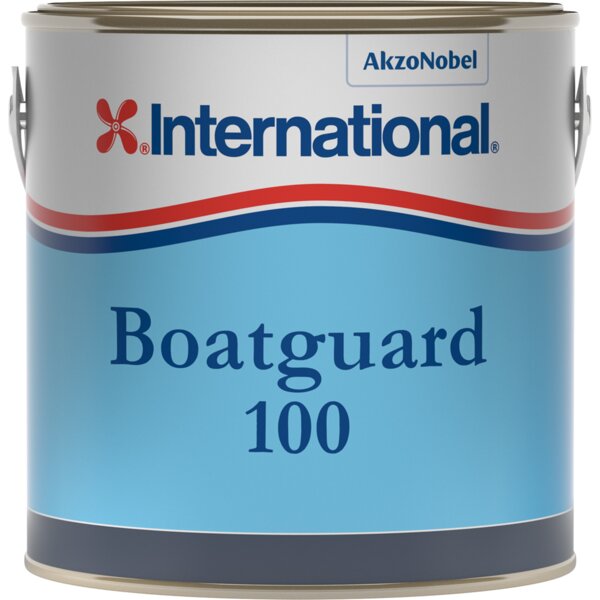
BOATGUARD 100

FROM:

Regular price 38,62€

*VAT not included

BOATGUARD 100 by International Náutica is a solvent-based polishing antifouling paint for boat hulls used in fresh or salt water. It helps prevent fouling by slime, aquatic plants and animals, providing protection for up to one year and can be applied up to six months before launching.

  *Contenido generado por IA

    Presentation: Container
    Colours:
    Antifoulings: Self-polishing
    Solvent:: SOLVENT N.3

Features

    Presentation: Container
    Colours:
    Antifoulings: Self-polishing
    Solvent:: SOLVENT N.3

description

What is Boatguard 100 and why choose it?

Boatguard 100 from International Náutica is a polishing antifouling coating designed to protect boat hulls against fouling organisms such as slime, aquatic plants and animals. It is suitable for professional and consumer application on vessels operating in both fresh and salt water. The product provides protection for up to one year and can be applied up to six months before launch, offering flexible yard planning and reliable seasonal performance.

Main features

  • Effective antifouling protection: Formulated to combat fouling organisms, slime and aquatic flora and fauna.
  • Polishing antifouling: Self-polishing film helps maintain performance over the service period.
  • Fresh and salt water use: Suitable for a wide range of cruising environments.
  • Professional and amateur application: Can be applied by trained professionals or experienced boat owners.
  • Flexible application window: May be applied up to 6 months before launch (5–35°C).
  • Multiple colours: Dover White (YBP000), Red (YBP001), Blue (YBP002), Navy (YBP003) and Black (YBP004).
  • Matt finish: Non-gloss surface appearance.
  • Secure performance when applied at correct film thickness: Thinning is not recommended; correct DFT is essential.

Technical characteristics

  • Product type: Antifouling, polishing type; solvent-borne coating for exterior use.
  • Colours: YBP000 Dover White, YBP001 Red, YBP002 Blue, YBP003 Navy, YBP004 Black.
  • Finish: Matt.
  • Specific gravity: 1.5 (average).
  • Volume solids: 51% (average).
  • Typical shelf life: 2 years.
  • VOC (as supplied): 427 g/L (average).
  • VOC (EU solvent, Council Directive 1999/13/EC): 286 g/kg (average).
  • Available pack sizes: 750 mL, 2.5 L, 5 L, 20 L.

Drying and immersion times

  • Immersion time before launch:
    • 5°C: 8 hours
    • 15°C: 6 hours
    • 23°C: 4 hours
    • 35°C: 4 hours
  • Touch dry:
    • 5°C: 1 hour
    • 15°C: 45 minutes
    • 23°C: 30 minutes
    • 35°C: 20 minutes
  • Maximum immersion time: 6 months between 5°C and 35°C.

Overcoating intervals with Boatguard 100

  • Substrate temperature 5°C: minimum 16 hours, no maximum (ext).
  • Substrate temperature 15°C: minimum 10 hours, no maximum (ext).
  • Substrate temperature 23°C: minimum 6 hours, no maximum (ext).
  • Substrate temperature 35°C: minimum 4 hours, no maximum (ext).

Substrate compatibility

  • Suitable for GRP (fiberglass), wood, steel/iron and lead.
  • Not suitable for aluminium/alloy substrates or zinc-sprayed surfaces.
  • Can be applied directly over most existing antifoulings in sound condition, except VC17m/PTFE antifoulings.

Application and use

Surface preparation

Previously antifouled surfaces

  • In good condition:
    • Remove all fouling and contamination, including the leached layer.
    • Wash with high-pressure fresh water (3000 psi / 207 bar).
    • Scrape and wet sand with 80–120 grade paper. Do not dry sand.
    • If the existing antifouling is incompatible or unknown, seal with a suitable International Paint barrier/sealer coat.
  • In poor condition:
    • Use Interstrip to remove all traces of existing antifouling.

Priming bare substrates

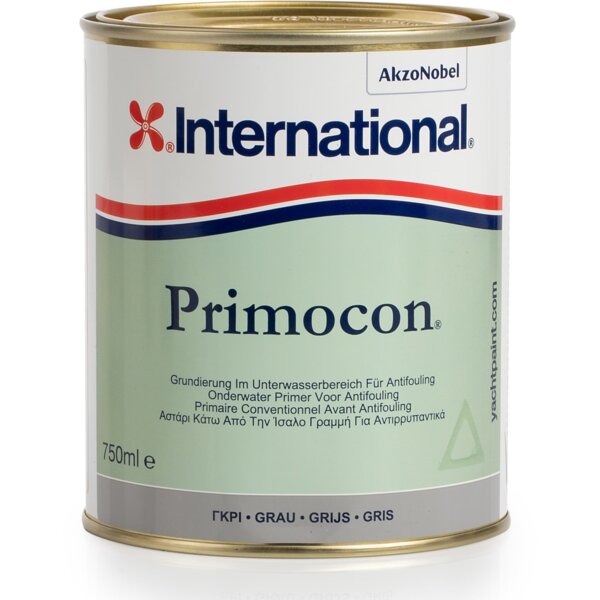
  • Bare GRP: Prime with Gelshield 200 for osmosis protection, or Primocon or Interprotect.
  • Steel, iron, lead or wood: Prime with Interprotect or Primocon.

Application conditions and methods

  • Application methods: Airless spray (professional use only), brush, roller.
  • Mixing: Stir thoroughly until a uniform consistency is obtained before use.
  • Thinning: Not recommended. Antifouling performance can be compromised if the correct dry film thickness is not applied.
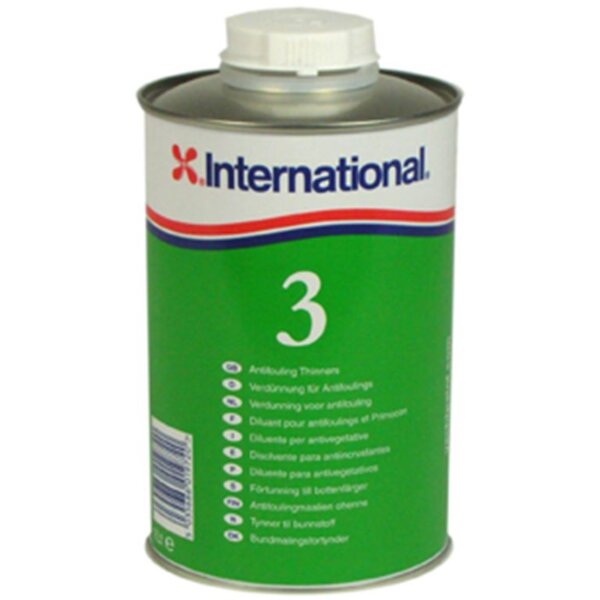
  • Cleaner: YTA085 International Antifouling Thinners No. 3.
  • Airless spray parameters (professional only): 176–210 bar (2500–3050 psi), tip size 517–521.
  • Ventilation: Ensure adequate ventilation during use.
  • Sanding: Antifoulings should only be wet sanded. Never dry sand or burn off old antifoulings. True colour will develop after immersion.

Film thickness and coverage

  • Number of coats by brush/roller: 2 coats at 50 microns dry film thickness (DFT) each (total DFT 100 microns).
  • Number of coats by spray: 1 coat at 100 microns DFT (total DFT 100 microns).
  • Reinforcement areas: Apply an extra stripe coat on high-wear areas such as chines, rudders, sterngear and leading edges.
  • Recommended DFT per coat:
    • Brush/roller: 50 microns dry (98 microns wet).
    • Spray: 100 microns dry (196 microns wet).
  • Coverage by brush/roller:
    • Theoretical: 10 m²/L per coat.
    • Practical: 9 m²/L per coat.
  • Coverage by spray (professional only):
    • Theoretical: 5 m²/L per coat.
    • Practical: 3 m²/L per coat.

Important application points

  • Use the stated coverage figures to ensure the correct amount of paint is applied and to help prevent premature failure.
  • Ambient temperature should be between 5°C and 35°C.
  • Substrate temperature should be at least 3°C (5°F) above the dew point and not more than 35°C.
  • Regular operation at high speeds (around 30 knots) may result in earlier wear-through of the coating.

Applications and typical use cases

  • Leisure and cruising yachts: Protection for GRP and wooden hulls sailing in fresh or salt water.
  • Motorboats and powerboats: Suitable for vessels on GRP, steel/iron or lead substrates, with consideration of possible increased wear at sustained high speeds.
  • Seasonal lay-up: Can be applied up to 6 months before launching within 5–35°C, aiding winter or pre-season maintenance schedules.
  • Refit over existing antifouling: Can be applied over most sound antifoulings (excluding VC17m/PTFE types) following the specified preparation.

FAQ

  1. How long does Boatguard 100 protect my hull?

    The product description states that Boatguard 100 provides antifouling protection for up to one year when applied correctly.

  2. Can I apply Boatguard 100 myself?

    Yes. It is described as suitable for both professional and consumer application, using brush, roller or (for professionals) airless spray.

  3. On which substrates can I use Boatguard 100?

    It is suitable for GRP, wood, steel/iron and lead, after appropriate priming where required. It is not suitable over aluminium/alloy substrates or zinc-sprayed surfaces.

  4. Can it be applied over my current antifouling?

    Boatguard 100 can be applied directly over most types of existing antifoulings that are in sound condition, except VC17m/PTFE antifoulings. Surfaces must be properly cleaned and prepared.

  5. When should I launch after painting?

    Minimum immersion times range from 8 hours at 5°C to 4 hours at 23–35°C. The maximum immersion time is 6 months between 5°C and 35°C.

  6. Do I need to sand between coats?

    Only wet sanding is permitted. Antifoulings should not be dry sanded or burned off. Surface preparation instructions must be followed carefully.

  7. What cleaner should I use for tools and equipment?

    The recommended cleaner for application equipment is YTA085 International Antifouling Thinners No. 3.

  8. Can Boatguard 100 be used in any climate?

    Application should take place only when ambient temperature is between 5°C and 35°C and substrate temperature is between 5°C and 35°C and at least 3°C above the dew point.

  9. Is the product suitable for high-speed boats?

    The datasheet notes that boats regularly travelling at high speeds (around 30 knots) may experience early wear-through of the coating.

  10. How should leftover paint and empty tins be disposed of?

    Tins or paint must not be poured into watercourses or drains. It is best to allow paints to harden before disposal. Remainders cannot be disposed of through municipal waste or dumped without permit; disposal must be arranged in consultation with the relevant authorities.

Section 14 – Transport information

  • UN number (ADR/RID, IMDG, IATA): UN1263.
  • UN proper shipping name: PAINT.
  • Transport hazard class: Class 3 (flammable liquid).
  • Packing group: III.
  • Environmental hazards: Classified as hazardous to the environment; marine pollutants include dicopper oxide and zinc oxide.
  • Special precautions for user: Transport within the user’s premises only in closed containers that are upright and secure. Ensure that persons transporting the product know what to do in case of accident or spillage.
  • Environmentally hazardous / marine pollutant marking: The environmentally hazardous substance or marine pollutant mark is not required when the product is transported in pack sizes of 5 L or less (or 5 kg or less), although other regulations may still require marking.
  • Tunnel restriction code (ADR): D/E.
  • Transport in bulk according to IMO instruments: Not applicable.

Section 8 – Personal protective measures

The following information on individual protection is taken from the safety data sheet for Boatguard 100 Dover White and applies when handling or applying the product. Selection of equipment must always form part of a full workplace risk assessment.

General hygiene measures

  • Eating, drinking and smoking are prohibited in areas where the product is handled, stored or processed.
  • Wash hands, forearms and face thoroughly after handling and before eating, smoking or using the lavatory, and at the end of the working period.
  • Contaminated work clothing should not be allowed out of the workplace and must be washed before reuse.
  • Ensure eyewash stations and safety showers are available near the work area.

Eye and face protection

  • Wear suitable eye or face protection when there is a risk of splashes, mists, gases or dust.
  • The SDS specifies chemical splash goggles and/or a face shield that comply with approved standards (for example, EN 166).

Hand protection

  • Use chemical-resistant, impervious gloves complying with an approved standard whenever handling the product, if indicated by risk assessment.
  • For prolonged or frequently repeated contact, gloves with protection class 6 (breakthrough time > 480 minutes according to EN374) are recommended. Suggested materials: Viton or nitrile, thickness ≥ 0.38 mm.
  • For brief contact, gloves with protection class 2 or higher (breakthrough time > 30 minutes according to EN374) are recommended. Suggested material: nitrile, thickness ≥ 0.12 mm.
  • Gloves should be replaced regularly and whenever signs of damage appear. Performance may be reduced by physical or chemical damage or poor maintenance.

Skin and body protection

  • Wear protective clothing covering body, arms and legs. No skin should be left exposed.
  • Where there is a risk of ignition from static electricity, use anti-static protective clothing (for example, overalls, boots and gloves meeting EN 1149 requirements).
  • Additional skin protection (including suitable footwear) should be selected by a specialist based on the tasks and risks.

Respiratory protection

  • If exposure levels may exceed occupational limits or ventilation is insufficient, wear appropriate respiratory protection.
  • The SDS recommends a respirator conforming to EN140 with an A/P2 filter or better.
  • During spray application, dry sanding, flame cutting or welding of the dry paint film, dusts and/or hazardous fumes may be generated; wet sanding/flatting is preferred, and suitable respiratory protection must be used if local exhaust ventilation cannot prevent exposure.

Engineering and environmental controls

  • Use only with adequate ventilation. Process enclosures, local exhaust or other engineering controls should keep airborne concentrations below recommended or statutory limits and below lower explosive limits.
  • Use explosion-proof ventilation equipment and non-sparking tools; take precautions against electrostatic discharge.
  • Emissions from ventilation or process equipment must be checked to ensure compliance with environmental protection legislation; scrubbers, filters or process modifications may be required to reduce emissions.
*Contenido generado por IA

TECHNICAL SHEET

TECHNICAL SHEET

link

SAFETY DATA SHEETS

SAFETY DATA SHEETS

link
Ref. Colour Capacity Amount*
YBP000/2.5IB White sand 2,5 l 112,20 €
YBP000/750IB White sand 750 ml 38,62 €
YBP001/2.5IB Red 2,5 l 112,20 €
YBP001/750IB Red 750 ml 38,62 €
YBP002/2.5IB Blue 2,5 l 112,20 €
YBP002/750IB Blue 750 ml 38,62 €
YBP003/2.5IB Navy blue 2,5 l 112,20 €
YBP003/750IB Navy blue 750 ml 38,62 €
YBP004/2.5IB Black 2,5 l 112,20 €
YBP004/750IB Black 750 ml 38,62 €
Page up

Product Quick View Popup

Vendor: Optimal

Product Type: Tops

SKU: 50-ABC

In stock Pre-order Now Sold out Order now, Only 10 left!
$400.00$300.00
Optimal Multipurpose Bootstrap 5 Html Template that will give you and your customers a smooth shopping experience which can be used for various kinds of stores such as fashion..
  • Black
  • Green
  • Orange
  • Blue
  • Red
  • XS
  • S
  • M
  • L
  • XL

Added to your shopping cart successfully.

Added to your shopping cart successfully.
Ditsy Floral Dress

Color: Gray

1 X $113.88

Total: $113.88