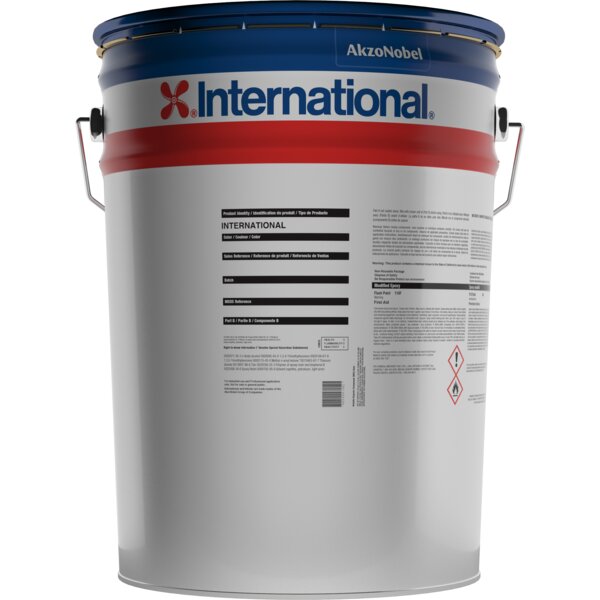
What Interprime 198 is and why choose it
Interprime 198 from International Marina is a one-component, fast drying, high performance alkyd primer designed for maintenance and new construction work. It is surface tolerant, compatible with most common substrates and can be overcoated with a wide range of finishes, including alkyds, epoxies and polyurethanes. Its quick-drying properties make it suitable for hand prepared steel, fabrication shop work and onboard or in-service maintenance, especially in above-water areas.
When used as part of an approved scheme, Interprime 198 also offers certified performance in areas such as fire resistance and grain carriage, providing a robust, versatile priming solution for marine and protective coating specifications.
Main features
- One-pack alkyd primer: no mixing ratio or curing agent required, simplifying preparation and reducing waste.
- Fast drying: touch dry in as little as 30–60 minutes at 25–35°C (77–95°F), with hard dry achieved in 2–4 hours at these temperatures.
- Surface tolerant: formulated for use on hand or power tool prepared steel (typically St2 preparation), and suitable for overlap onto many aged coating systems.
- Wide overcoating window: may be overcoated after short minimum intervals, with extended maximum intervals (often “extended” with no strict top limit under suitable conditions).
- Multiple application methods: can be applied by airless spray, conventional air spray (protective coatings data), brush or roller.
- Matte finish: provides a low-sheen primed surface for subsequent topcoats.
- Certified performance (when part of an approved system):
- Fire Resistance – Surface Spread of Flame (Exova Warringtonfire)
- Fire Resistance – Smoke and Toxicity (Exova Warringtonfire)
- Fire Resistance – Marine Equipment Directive compliant
- Food Contact – Carriage of Grain (NOHH)
- VOC data: 506 g/L (4.22 lb/US gal) as supplied (EPA Method 24); 416 g/kg according to EU Solvent Emissions Directive.
- Shelf life and storage: minimum 24 months at 25°C (77°F) in unopened containers, stored dry, shaded, and away from heat and ignition sources.
Technical characteristics
Product composition and type
- Type: Alkyd primer (universal / maintenance primer).
- Pack type: Single pack, one component.
- Finish: Matt.
- Colours (marine data sheet): CPA097 White, CPA098 Grey, CPA099 Red.
- Colours (protective coatings data sheet): Grey, Red Oxide.
Film build and coverage
- Volume solids: 41% ± 2% (ISO 3233:1998).
- Typical dry film thickness (marine): 75 microns (3 mils) dry, 183 microns wet.
- Typical dry film thickness (protective coatings): 50–75 microns (2–3 mils) dry, 122–183 microns (4.9–7.3 mils) wet.
- Theoretical coverage (marine): 5.47 m²/litre at 75 microns dft; 219 ft²/US gal at 3 mils dft.
- Theoretical coverage (protective coatings): 6.80 m²/litre at 60 microns dft; 274 ft²/US gal at 2.4 mils dft.
- Practical coverage: dependent on application method, surface profile and losses; appropriate loss factors must be allowed.
Drying and overcoating
Typical drying times (marine data, alkyd primer for above water areas):
- Touch dry:
- 8 hours at -5°C (23°F)
- 3 hours at 5°C (41°F)
- 60 minutes at 25°C (77°F)
- 30 minutes at 35°C (95°F)
- Hard dry:
- 48 hours at -5°C (23°F)
- 24 hours at 5°C (41°F)
- 4 hours at 25°C (77°F)
- 2 hours at 35°C (95°F)
Overcoating (selected data, substrate temperature dependent):
- Can be overcoated with a wide range of International finishes such as Interfine 5703, Interfine 599, Interlac 665, Intersheen 579, Interstores Alkyd, Interstores Polyurethane, Interthane 990 / 990E, Intertherm 891 and additional topcoats listed for the protective coatings version (e.g. Intercryl 530, Interfine 629HS, Intergard 740, Interplus 770, Interplus 880).
- Minimum intervals typically range from 2–24 hours depending on topcoat and temperature; maximum intervals are often several days or “extended”.
- When overcoating with epoxy or polyurethane topcoats in the protective coatings schemes, a minimum 16 hours at 25°C (77°F) is recommended.
Important: Overcoating times are guidance only and may vary according to climate and environmental conditions.
Application details
- Substrates: hand prepared steel (typically St2 / SSPC-SP2), power tool cleaned steel, brush blasted steel (Sa1 / SSPC-SP7) and suitably prepared blast cleaned steel (Sa2 or Sa2½ / SSPC-SP6). Also suitable for overlap onto many aged coating systems and specific primers such as Intergard 251 and Intergard 269.
- Recommended minimum system dft over hand prepared steel: 150 microns (6 mils) achieved by multiple coats.
- Application methods:
- Airless spray: recommended; tip range typically 0.43–0.66 mm (17–26 thou); minimum fluid pressure around 176 kg/cm² (approx. 2500 psi).
- Conventional air spray: recommended in the protective coatings data sheet (e.g. DeVilbiss MBC or JGA, air cap 704 or 765, fluid tip E).
- Brush: recommended; multiple coats may be required to achieve specified dft; typical single-coat dft 40–50 microns (1.6–2.0 mils).
- Roller: recommended; typical single-coat dft 40–50 microns (1.6–2.0 mils); avoid under-application.
- Thinner: International GTA007 only, and then only where allowed by local environmental legislation (marine data: thinning not generally recommended).
- Cleaner / flush solvent: International GTA007.
- Flash point: 35°C (95°F) closed cup (single pack).
Surface preparation (summary)
- General: all surfaces must be clean, dry and free from oil, grease, salts and other contaminants. High pressure fresh water wash and/or SSPC-SP1 solvent cleaning are recommended.
- Abrasive blast cleaning (protective coatings): Sa2½ (ISO 8501-1:2007) or SSPC-SP6. Suitable for application onto blast cleaned surfaces initially to this standard that have deteriorated to Sa2 under good shop conditions (within 7–10 days) provided they are free from loose powdery deposits.
- Maintenance and site touch-up: typically St2 (ISO 8501-1:2007) / SSPC-SP2; brush blasting to Sa1 / SSPC-SP7 is also acceptable. On poor surfaces, brush application improves wetting and performance.
- Overlap: primer should overlap onto sound existing coatings by approximately 2–3 cm.
- North American marine standards: SSPC-SP6 may be used in place of Sa2, and SSPC-SP2 in place of St2, where applicable.
Limitations and service conditions
- Coating systems incorporating Interprime 198 are not suitable for immersion service.
- The product is not intended for aggressive, highly corrosive environments or for heavily pitted/contaminated steel.
- Not suitable as a barrier coat for upgrading old chlorinated rubber or vinyl systems.
- Marine data sheet recommends that Interprime 198 is not overcoated with epoxy coatings, although protective coatings guidance includes certain epoxy and polyurethane systems when film builds and curing are carefully controlled.
- Apply only in good weather, with substrate temperature at least 3–5°C (5°F) above the dew point, and ideally with paint temperature brought to approximately 21–27°C (70–81°F) prior to mixing and application.
Typical applications and use cases
- Marine maintenance above water: maintenance primer for topsides, superstructures and other above-water ship areas, including onboard maintenance and repair.
- Fabrication shop and new construction: quick-drying shop primer on suitably prepared steel, allowing high throughput and rapid handling.
- Maintenance and repair of existing structures: touch-up primer for hand or power tool prepared areas, including overlap onto aged compatible coatings.
- Grain-handling structures: when part of an approved system, suitable for surfaces involved in the carriage or storage of grain.
- General industrial steelwork: frames, walkways, platforms and structural steel where a fast-drying, surface-tolerant alkyd primer is specified and immersion is not required.
FAQ
1. Is Interprime 198 a single-component or two-component primer?
Interprime 198 is a single-pack, one-component alkyd primer; no mixing ratio or separate curing agent is required.
2. On which substrates can Interprime 198 be used?
It is primarily intended for hand or power tool prepared steel and blast cleaned steel. It is also suitable for overlap onto many existing compatible coating systems and for use over specific primers such as Intergard 251 and Intergard 269.
3. Can Interprime 198 be immersed in water or used for tank linings?
No. Coating systems containing Interprime 198 are not suitable for immersion service and are intended for above-water or non-immersed environments.
4. Which application methods are recommended?
Recommended methods are airless spray, conventional air spray (in protective coatings specifications), brush and roller. Multiple coats may be required to reach the specified dry film thickness, especially when brushing or rolling.
5. How quickly does Interprime 198 dry?
At around 25°C (77°F) the coating is typically touch dry in about 1 hour and hard dry in about 2–4 hours, depending on which data sheet conditions apply. At lower temperatures drying times are longer.
6. What is the typical coverage of Interprime 198?
Theoretical coverage is approximately 6.80 m²/litre at 60 microns dft or around 219–274 ft²/US gal at about 2–3 mils dft, not including application losses.
7. Is thinning required?
Thinning is generally not recommended. Where necessary and permitted by local legislation, only International GTA007 thinner should be used, and not in excess of allowed limits.
8. What is the recommended storage condition and shelf life?
Store unopened containers in a dry, shaded, well-ventilated area away from heat and ignition sources. Shelf life is typically 24 months at 25°C (77°F), subject to reinspection thereafter.
9. Can Interprime 198 be applied without a cosmetic topcoat?
In some regions, and for specific customer requirements where cosmetic appearance is not critical, Interprime 198 may be used without a cosmetic finish. This is subject to regional technical guidance.
10. What health and environmental classifications apply to Interprime 198 White?
According to the safety data sheet, Interprime 198 White is classified as a flammable liquid (Category 3), may cause respiratory irritation and drowsiness or dizziness, and is toxic to aquatic life with long lasting effects.
Section 14 – Transport information
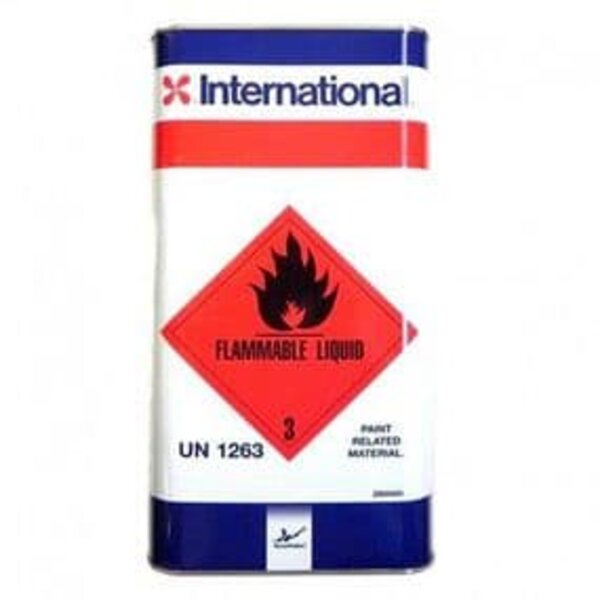
- UN number / ID number: UN1263
- UN proper shipping name: PAINT
- Transport hazard class: Class 3 (flammable liquid)
- Packing group: III
- Environmental hazards: classified as environmentally hazardous / marine pollutant (contains solvent naphtha (petroleum), light arom. and 1,2,4-trimethylbenzene). For small pack sizes ≤5 L or ≤5 kg, the environmentally hazardous or marine pollutant mark may not be required.
- ADR/RID additional data: tunnel code D/E.
- IMDG additional data: emergency schedules F-E, S-E; IMDG segregation group not applicable.
- IATA: environmentally hazardous substance mark may appear if required by applicable transport regulations.
- On-site transport advice: always move containers upright, securely closed, and ensure personnel know the emergency procedures in case of spills or accidents.
Section 8 – Personal protective measures
The following personal protective equipment (PPE) and exposure controls are summarised from the safety data sheet for Interprime 198 White:
Engineering and hygiene controls
- Use only with adequate ventilation; apply process enclosures or local exhaust ventilation to keep airborne concentrations below statutory limits and below the lower explosion limit.
- Use explosion-proof ventilation and electrical equipment in areas where the product is handled or sprayed.
- Wash hands, forearms and face thoroughly after handling, and before eating, drinking or smoking.
- Contaminated clothing should be removed and washed before reuse. Ensure eyewash stations and safety showers are close to work areas.
Eye and face protection
- Wear safety glasses with side shields or equivalent eye protection complying with approved standards whenever there is a risk of splashes, mists or aerosols.
Hand protection
- Use chemical-resistant, impervious gloves complying with an approved standard whenever handling the product.
- For prolonged or frequent contact, gloves with protection class 6 (breakthrough time > 480 minutes according to EN374) are recommended. Suggested materials: Viton® or nitrile, thickness ≥ 0.38 mm.
- For short, occasional contact, gloves with protection class 2 or higher (breakthrough time > 30 minutes according to EN374) are recommended. Suggested material: nitrile, thickness ≥ 0.12 mm.
- Gloves must be replaced regularly and whenever signs of damage, degradation or breakthrough appear.
Body and skin protection
- Select protective clothing based on the tasks and associated risks. Where there is a risk of ignition by static discharge, wear anti-static protective clothing (coveralls, boots, gloves) complying with EN 1149.
- Wear suitable protective footwear and any additional skin protection as required by the risk assessment.
Respiratory protection
- Where adequate ventilation cannot be ensured, or where exposure limits may be exceeded, use a suitable respirator that meets relevant standards or certifications.
- Respirators must be used within the framework of a formal respiratory protection programme to ensure correct selection, fit and user training.
Environmental exposure controls
- Emissions from ventilation or process equipment must be checked to ensure compliance with environmental regulations.
- Where necessary, use fume scrubbers, filters or engineering modifications to reduce emissions to acceptable levels. Avoid release of the product to drains or watercourses.
*Contenido generado por IA