What it is and why choose it
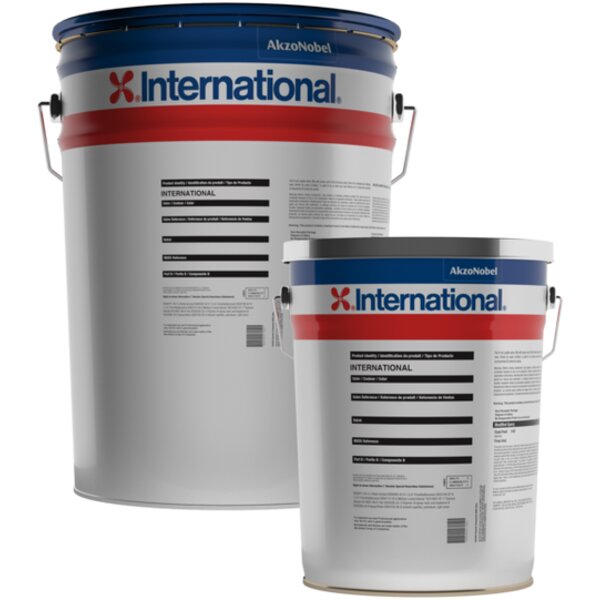
INTERSTORES EPOXY PRIMER PART A INDIVISIBLE KIT is the base component of a hard wearing, surface-tolerant, two-pack epoxy primer/finish designed for on board maintenance of marine structures. When mixed with its dedicated curing agent (Part B ISA426) it provides an anticorrosive matt epoxy coating suitable for decks, deck fittings and cargo holds. The formulation is optimized for brush and roller application over hand or power tool cleaned steel, making it suitable for maintenance situations where full abrasive blasting is not possible.
Main features
- Two-pack epoxy primer/finish: Part A base component to be mixed with Part B (ISA426) to form a durable epoxy coating.
- Surface-tolerant and hard wearing: Suitable for application over St2-prepared steel and many aged coating systems.
- Anticorrosive protection: Designed for decks, deck fittings and cargo holds in marine environments.
- On board maintenance use: Intended exclusively for on board maintenance schemes.
- Matt finish: Provides a low-sheen surface in red (ISA420), green (ISA430) or grey (ISA450).
- Brush and roller application: Airless and conventional spray are not recommended.
- No induction time: Can be applied immediately after mixing the full unit.
- Fire and food-contact related certifications (when in an approved scheme):
- Food Contact – Carriage of Grain (NOHH).
- Fire Resistance – Marine Equipment Directive compliant.
- Fire Resistance – Surface Spread of Flame (Exova Warringtonfire).
- Fire Resistance – Smoke and Toxicity (Exova Warringtonfire).
- Not suitable for immersion: The product must not be used in permanently immersed areas.
Technical characteristics
Product data (mixed system)
- Type: Epoxy primer/finish (two-component system; this item is Part A).
- Colours (system references): ISA420 Finish Red, ISA430 Finish Green, ISA450 Finish Grey.
- Finish: Matt.
- Volume solids: 65% ±2% (ISO 3233:1998).
- Typical dry film thickness (DFT): 75 microns (115 microns wet film thickness).
- Theoretical coverage: 8.67 m²/litre at 75 microns DFT (allow appropriate loss factors).
- Mixing ratio: 5 volumes Part A : 1 volume Part B (ISA426 curing agent). Material is supplied in 2 containers as a unit and a full unit should always be mixed.
- Method of application: Brush, Roller. Application by airless spray or conventional spray is not recommended.
- Flash point (typical): Part A 35°C; Part B 25°C; mixed 28°C.
- Induction period: Not required.
Drying and overcoating information (mixed coating)
Substrate temperature vs. typical times:
- 5°C:
- Touch dry: 6 h
- Hard dry: 8 h
- Pot life: 5 h
- Typical minimum overcoating times:
- Intergard 740: 12 h (max. 7 days)
- Intersheen 579: 12 h (max. 24 h)
- Interstores Epoxy Primer: 12 h (max. 28 days)
- Interstores Polyurethane: 12 h (max. 7 days)
- Interthane 990: 12 h (max. 7 days)
- 10°C:
- Touch dry: 4 h
- Hard dry: 6 h
- Pot life: 3 h
- 25°C:
- Touch dry: 2 h
- Hard dry: 4 h
- Pot life: 2 h
- 35°C:
- Touch dry: 30 min
- Hard dry: 90 min
- Pot life: 60 min
Optimum performance is achieved when applied over steel prepared to at least St2 (ISO 8501-1:2007). Temperature of the surface to be coated must be at least 3°C above the dew point. For optimum application properties the mixed material should be at 21–27°C before mixing and application.
VOC and regulatory data
- VOC (as supplied): 326 g/l (EPA Method 24).
- VOC (EU Solvent Emissions Directive 1999/13/EC): 225 g/kg of liquid paint as supplied.
- VOC (Chinese National Standard GB23985): 327 g/l.
- VOC values are typical and may vary with colour and normal manufacturing tolerances.
Unit sizes and storage
- Typical unit sizes (Part A + Part B system):
- 20 litre kit: Part A 16.67 l (pack 20 l), Part B 3.33 l (pack 5 l).
- 5 US gallon kit: Part A 4.17 US gal (pack 5 US gal), Part B 0.83 US gal (pack 1 US gal).
- Approximate unit shipping weight:
- 20 l kit: 30.35 kg.
- 5 US gal kit: 59.4 lb.
- Shelf life at 25°C:
- Part A: 18 months.
- Part B: 12 months.
- Storage conditions: Store in dry, shaded conditions, away from sources of heat and ignition. Keep containers tightly closed. Subject to reinspection after the stated shelf life.
Applications and use cases
- Marine decks: Anticorrosive primer/finish for working decks where maintenance is carried out with brush and roller over mechanically prepared steel.
- Deck fittings and equipment: Protection of fittings and associated steelwork requiring a hard wearing, surface-tolerant epoxy.
- Cargo holds: As part of approved schemes for cargo holds, including grain carriage, where appropriate certifications apply.
- Maintenance over aged coatings: Suitable for overlap onto most aged coating systems once loose or flaking material has been removed and edges feathered. Glossy epoxies and polyurethanes may require abrasion.
Use is restricted to on board maintenance. Interstores Epoxy Primer is not suitable for immersed areas and, like other epoxy coatings, will show chalking on prolonged UV exposure.
FAQ
1. What is INTERSTORES EPOXY PRIMER PART A used for?
It is the base component of a two-pack epoxy primer/finish used as an anticorrosive coating for decks, deck fittings and cargo holds in marine service, specifically for on board maintenance.
2. Can it be used below the waterline or in permanent immersion?
No. Interstores Epoxy Primer is not suitable for use on immersed areas.
3. How should the steel surface be prepared?
For exposed steel and corrosion, prepare by hand or power tools to at least St2 (ISO 8501-1:2007). All scale must be removed; areas that cannot be prepared adequately by chipping or needle gun should be spot blasted to at least Sa2.
4. What is the recommended mixing ratio with the curing agent?
The product must be mixed 5 volumes of Part A to 1 volume of Part B (ISA426). Always mix a complete supplied unit.
5. Which application methods are recommended?
Brush and roller are recommended. Application by airless spray or conventional spray is not recommended.
6. What is the theoretical coverage?
At 75 microns dry film thickness, the theoretical coverage is 8.67 m² per litre, not allowing for losses.
7. How long does it take to dry before overcoating?
At 25°C, the coating is typically touch dry in 2 hours and hard dry in 4 hours. Minimum overcoating times depend on the next product and temperature; as an example, overcoating with Intergard 740 at 25°C requires a minimum of 4 hours and a maximum of 7 days.
8. Is thinning required?
Thinning is not normally required. If used in extreme conditions, advice should be taken from the local representative, and any thinning must comply with local environmental legislation.
9. What cleaner should be used for equipment?
Application equipment should be cleaned with International GTA220 or GTA822 immediately after use.
10. Does the coating chalk under sunlight?
Yes. In common with all epoxy-based coatings, Interstores Epoxy Primer will exhibit film chalking on UV exposure.
Section 14 – Transport information
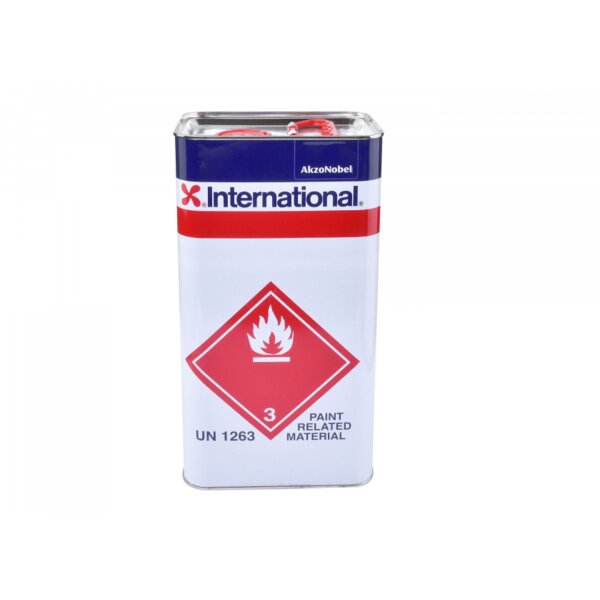
- UN number / ID number: UN1263.
- UN proper shipping name: PAINT.
- Transport hazard class: Class 3 (flammable liquid) for ADR/RID, IMDG and IATA.
- Packing group: III.
- Environmental hazards: Not classified as environmentally hazardous for transport under ADR/RID, IMDG or IATA.
- ADR/RID tunnel code: D/E.
- IMDG emergency schedules: F-E, S-E.
- Special precautions for user: Within the user’s premises, always transport in closed containers that are upright and secure. Ensure that personnel transporting the product know what to do in case of an accident or spillage.
- Transport in bulk according to IMO instruments: Not applicable.
Section 8 – Personal protection measures
Exposure and engineering controls
- Use only with adequate ventilation. Apply local exhaust ventilation or process enclosures to keep airborne concentrations below applicable limits and below the lower explosion limit.
- Use explosion-proof ventilation and electrical equipment.
- Keep away from heat, sparks, open flames and other ignition sources. Take precautions against electrostatic discharge.
Personal protective equipment (PPE)
- Eye/face protection: Chemical splash goggles and/or face shield complying with an approved standard. If inhalation hazards exist, a full-face respirator may be required instead of goggles.
- Hand protection:
- Chemical-resistant, impervious gloves meeting EN374 or equivalent.
- For prolonged or frequently repeated contact: gloves with protection class 6 (breakthrough time > 480 min). Recommended: Viton or nitrile, thickness ≥ 0.38 mm.
- For brief contact: gloves with protection class ≥ 2 (breakthrough time > 30 min). Recommended: nitrile, thickness ≥ 0.12 mm.
- Gloves should be replaced regularly and if any damage is observed. Suitability and breakthrough times must be confirmed with the glove supplier.
- Skin and body protection: Protective clothing selected according to the task and risks, approved by a specialist before handling the product. Where there is a risk of ignition from static electricity, use anti-static protective clothing including coveralls, boots and gloves that comply with EN 1149.
- Other skin protection: Suitable safety footwear and any additional skin protection as required by the work being performed.
- Respiratory protection: Where ventilation is insufficient or exposure limits may be exceeded, wear a respirator conforming to EN140 with type A/P2 filter or better. When dry sanding, flame cutting or welding of the dry paint film cannot be avoided, provide local exhaust ventilation or use suitable respiratory protection.
Hygiene measures
- Wash hands, forearms and face thoroughly after handling and before eating, drinking or smoking.
- Remove contaminated clothing and protective equipment before entering eating areas. Contaminated work clothing should not be taken out of the workplace and must be washed before reuse.
- Ensure that emergency eye-wash stations and safety showers are located close to work areas.
*Contenido generado por IA