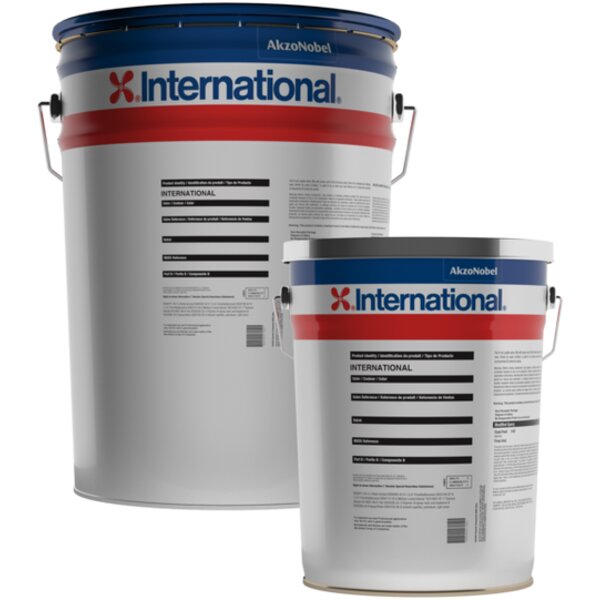
What is INTERSLEEK 731 PART A and why choose it?
INTERSLEEK 731 PART A is a two-pack, silicone elastomer tie coat designed to be used with INTERSLEEK 731 Part B. Together they form an elastomeric tie coat that promotes adhesion between the specified anticorrosive priming system and the Intersleek finish coats. It is suitable for both newbuilding projects and maintenance and repair work in marine environments, offering a low-gloss finish and reliable performance when correctly applied over a recommended primer scheme.
Main features
- Two-component silicone elastomer system – Part A is combined 1:1 by volume with curing agent Part B (BXA731) to create a durable elastomeric tie coat.
- Designed as a tie coat – specifically formulated to improve adhesion between anticorrosive primers and Intersleek finish coats such as Intersleek 1001, 1100SR, 757 and 970.
- Low-gloss appearance – provides a uniform, low-sheen surface ready for overcoating.
- Airless spray application – optimized for airless spray; brush can be used for stripe coating or small areas.
- Consistent film build – typical dry film thickness (DFT) of 100 microns from 159 microns wet film thickness.
- Predictable drying and overcoating times – touch-dry and hard-dry windows defined across a wide temperature range (15–35°C).
- Regulated VOC values – supplied VOC data according to EPA Method 24, EU Solvent Emissions Directive and Chinese GB23985.
- For professional use – intended for use by trained applicators in industrial and marine coating applications.
Technical characteristics
Product composition and appearance
- Type: Two-pack silicone elastomer tie coat.
- Component: INTERSLEEK 731 PART A (to be mixed with Part B BXA731).
- Finish/Sheen: Low-gloss.
- Available colours (system): BXA730 Light Pink, BXA732 Red.
- Physical state (Part A): Liquid.
- Colour (Part A SDS example): Red.
- Odour: Solvent.
Application and film build
- Recommended methods: Airless spray; brush for small areas or stripe coating.
- Typical dry film thickness (DFT): 100 microns.
- Typical wet film thickness: 159 microns.
- Theoretical coverage: 6.3 m²/litre at 100 microns DFT (allow appropriate loss factors).
- Mix ratio: 1 volume Part A to 1 volume Part B.
- Induction time: Not required.
Drying and overcoating (mixed product)
Equipment guidance
- Airless spray: Recommended.
- Tip range: 0.38–0.53 mm (15–21 thou).
- Total output fluid pressure at tip: not less than 211 kg/cm² (3000 psi).
- Brush: Recommended for small areas only; multiple coats may be required to achieve specified DFT.
- Roller: Not suitable.
- Thinner: Not recommended. International GTA007 only in exceptional circumstances and not beyond local environmental limits.
- Cleaner: International GTA007 for flushing and cleaning application equipment.
Physical and safety data (Part A)
- Volume solids (system): 63% ±2% (ISO 3233:1998).
- Flash point (Part A): 28°C (closed cup) [Pensky–Martens].
- Boiling point (Part A): 136°C (276.8°F).
- Density: 1.371 g/cm³ (DIN EN ISO 2811-1).
- Viscosity: 948 mm²/s at room temperature; 1300 mm²/s at 40°C (DIN EN ISO 3219).
VOC and regulatory data
- VOC as supplied (EPA Method 24): 325 g/litre.
- VOC (EU Solvent Emissions Directive 1999/13/EC): 247 g/kg of liquid paint as supplied.
- VOC (Chinese GB23985): 292 g/litre.
- VOC values are typical and may vary with colour and normal manufacturing tolerances.
Packaging, storage and shelf life
- Standard unit size (system): 10 litres total (Part A 5 L pack, Part B 5 L pack).
- Typical unit shipping weight (10 L system): 13.1 kg.
- Shelf life: 12 months at 25°C, subject to re-inspection thereafter.
- Storage conditions: Store in dry, shaded conditions, away from sources of heat and ignition. Keep containers tightly closed and in original packaging.
Applications and use cases
Intended uses
- Marine newbuilding – as an elastomeric tie coat between approved anticorrosive primer systems and Intersleek foul-release finish coats on new vessels.
- Maintenance and repair – for refurbishment of existing coated structures where Intersleek finishes are specified.
Substrate and system compatibility
- Use in accordance with standard Worldwide Marine Specifications.
- INTERSLEEK 731 should always be applied over a recommended primer coating scheme.
- The primer surface must be clean, dry and free from all contamination, and the tie coat applied within the specified overcoating intervals of the primer.
- Areas of breakdown or damage should be prepared to the specified standard (e.g. Sa2½, ISO 8501-1:2007, or SSPC-SP10 in North American marine applications) and re-primed before applying INTERSLEEK 731.
Surface preparation
- All surfaces to be coated should be clean, dry and free from oil, grease, salts, soluble contaminants and other foreign matter.
- High-pressure fresh water wash or fresh water wash, as appropriate.
- Degrease in accordance with SSPC-SP1 solvent cleaning where required.
Mixing and application notes
- Material is supplied in two containers as a unit; always mix a complete unit in the supplied proportions.
- Step 1: Agitate Base (Part A) with a power agitator.
- Step 2: Add entire contents of Curing Agent (Part B) to Part A and mix thoroughly with power agitator.
- Apply by airless spray at 160 microns wet to achieve 100 microns DFT.
- Brush application is suitable only for small areas or stripe coating and may require multiple coats.
- Do not allow mixed material to remain in hoses, guns or spray equipment; flush thoroughly with International GTA007 during work stoppages and at the end of the shift.
Environmental and climatic conditions during application
- Apply in good weather when air and surface temperatures are above 15°C.
- Surface temperature must be at least 3°C above the dew point.
- For optimum application properties, bring material to 21–27°C before mixing and application.
- Overcoating information is provided as guidance and may vary with local climate and environmental conditions.
FAQ
-
What is the main function of INTERSLEEK 731 PART A?
It is one component of a two-part elastomeric tie coat system that promotes adhesion between a specified anticorrosive primer system and Intersleek finish coats on marine structures.
-
Can INTERSLEEK 731 be applied directly to bare steel?
No. It must always be applied over a recommended primer coating scheme. Areas of damage must be prepared to the specified standard and re-primed before applying the tie coat.
-
Which application methods are recommended?
Airless spray is recommended for general application. Brush may be used for small areas and stripe coating but may require multiple coats to reach the specified dry film thickness. Conventional spray and roller application are not recommended.
-
Do I need to thin INTERSLEEK 731 before application?
Thinning is not recommended. International GTA007 may be used only in exceptional circumstances and must not be used beyond local environmental legislation limits.
-
What are the typical drying times?
At 20°C, the coating is touch dry in approximately 120 minutes and hard dry in about 4.5 hours. Pot life of the mixed product is about 3 hours across 15–35°C.
-
How soon can I overcoat with an Intersleek finish?
At 20°C, Intersleek 1001, 1100SR, 757 or 970 can typically be applied after a minimum of 4.5 hours and within a maximum of 5 days, provided environmental conditions are suitable.
-
What is the coverage rate at the recommended film thickness?
The theoretical coverage is 6.3 m² per litre at 100 microns dry film thickness, without allowance for losses.
-
Is INTERSLEEK 731 suitable for use in cold conditions below 15°C?
For applications below 15°C it is stated that International Paint should be consulted, as standard guidance is based on temperatures from 15°C upwards.
-
How should equipment be cleaned after use?
Flush and clean all spray and mixing equipment with International GTA007 immediately after use and during work stoppages to prevent curing inside the equipment.
-
What is the shelf life and how should the product be stored?
The shelf life is 12 months at 25°C, subject to re-inspection thereafter. Store in dry, shaded conditions away from heat and ignition sources, in tightly closed original containers.
Section 14 – Transport information
The following transport data applies to INTERSLEEK 731 RED PART A as supplied in the Safety Data Sheet:
- UN number (ADR/RID, IMDG, IATA): UN1263
- Proper shipping name: PAINT
- Transport hazard class: Class 3 (flammable liquid)
- Packing group: III
- Environmental hazards: Not classified as environmentally hazardous for transport.
- Special provisions:
- Viscous liquid exception: This Class 3 viscous liquid is not subject to regulation in packagings up to 450 L according to the relevant ADR/RID and IMDG clauses (2.2.3.1.5.1 and 2.3.2.5).
- Tunnel code (ADR/RID): D/E.
- Bulk transport according to IMO instruments: Not applicable.
- On-site transport precautions: Always transport in closed, upright and secure containers. Ensure personnel know what to do in case of accident or spillage.
Section 8 – Individual protection measures
According to the Safety Data Sheet for INTERSLEEK 731 RED PART A, the following personal protection and exposure control measures apply during handling and application:
General hygiene and engineering control
- Use only with adequate ventilation. Where necessary, use local exhaust ventilation or process enclosures to keep airborne concentrations below occupational exposure limits and below lower explosive limits.
- Ensure eyewash stations and safety showers are located close to the work area.
- Do not eat, drink or smoke in areas where the product is handled. Wash hands, forearms and face thoroughly after handling and before breaks.
Eye and face protection
- Wear chemical splash goggles complying with an approved standard when there is a risk of splashes or mists.
Hand protection
- Use chemical-resistant, impervious gloves complying with EN374 or equivalent.
- For prolonged or frequently repeated contact: gloves with protection class 6 (breakthrough time > 480 minutes) are recommended. Examples: Viton or Nitrile gloves with thickness ≥ 0.38 mm.
- For brief contact: gloves with protection class 2 or higher (breakthrough time > 30 minutes) are recommended. Example: Nitrile gloves with thickness ≥ 0.12 mm.
- Replace gloves regularly and immediately if damaged or showing signs of degradation.
Skin and body protection
- Wear protective clothing appropriate to the task and risk level.
- When there is a risk of ignition from static electricity, use anti-static protective clothing, including overalls, boots and gloves compliant with EN 1149.
- Use appropriate footwear and additional skin protection measures as required by the work situation.
Respiratory protection
- If ventilation is insufficient to control vapour or mist, wear a respirator conforming to EN140 with type A/P2 filter or better.
- During dry sanding, flame cutting or welding of the dry paint film, dust and potentially hazardous fumes may form; use suitable respiratory protection and local exhaust ventilation.
Environmental exposure control
- Emissions from process equipment and ventilation systems should be checked to ensure compliance with environmental legislation.
- Where necessary, use fume scrubbers, filters or other engineering modifications to reduce emissions.
*Contenido generado por IA