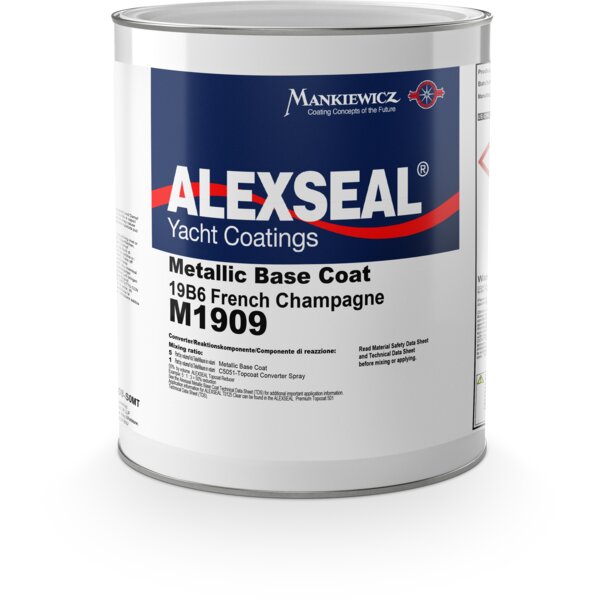
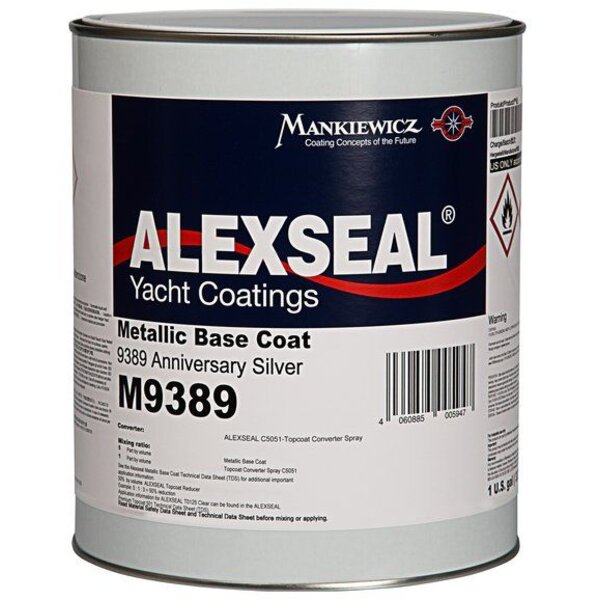
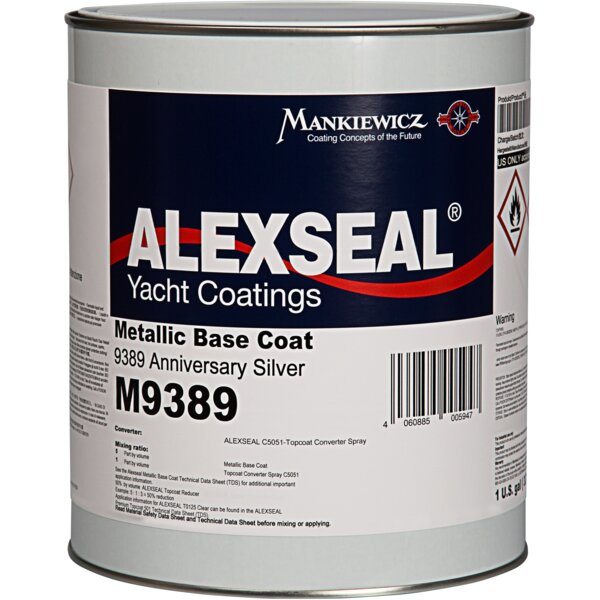
What is ALEXSEAL METALLIC BASE COAT and why choose it?
ALEXSEAL Metallic Base Coat (M-series) is a professional two-component metallic basecoat, designed to be used as part of a 2-stage Metallic Base Coat / Clear Coat system on yachts and other marine vessels. Formulated for even application on large surfaces, it provides reliable adhesion and helps to prevent colour differences and cloudiness in metallic finishes. Once overcoated with the appropriate ALEXSEAL Clear Coat, it delivers a durable, visually uniform metallic appearance suitable for demanding marine environments.
This system is intended for industrial and professional users who require controlled spray application, consistent film build and compatibility within the ALEXSEAL yacht coating system.
Main features
- 2-stage metallic system: Metallic Base Coat followed by an aliphatic two-component polyester–polyurethane Clear Coat.
- Even metallic appearance on large areas: Specifically developed to apply the metallic base uniformly, reducing shade variations and clouding.
- Two-component basecoat: Ensures good adhesion and contributes to overall system durability.
- Optimised for yacht applications: For internal or external areas of yachts not subject to permanent water immersion.
- Factory-packaged and custom colours: Available in standard colours and, on request, custom metallic shades; reference via ALEXSEAL colour cards and part numbers.
- Controlled film build: Recommended application in 2–3 cross coats, with defined wet and dry film thickness ranges.
- Professional spray application parameters: Defined viscosity, nozzle sizes and atomizing pressures for reproducible application results.
Technical characteristics and specifications
System and use
- Product name: ALEXSEAL Metallic Base Coat (M-series)
- Type: Two-component metallic basecoat for use under ALEXSEAL Clear Coat / Premium Topcoat Clear.
- Intended use: Professional, industrial serial painting and yacht finishing.
- Areas of application: Interior or exterior yacht areas not exposed to permanent water immersion.
Appearance and composition
- Physical state: Liquid (20 – 25 °C, 1,013 hPa).
- Colour: According to product name; metallic, factory-packaged and available as custom shades on request.
- Chemical nature: Mixture of synthetic resins, organic solvents and pigments.
Volume solids and coverage
- Volume solids (without reducer): 25 – 40 % (depending on colour).
- Note: Coverage figures are calculated on combined base and converter. Reducer is added as a percentage of the total base + converter volume.
Coverage for Metallic Base Coat (theoretical and practical)
- Theoretical coverage @ 25 µm DFT:
- 10.5 m²/litre
- 40 m²/gallon
- 428 sq. ft./gallon
- Practical coverage @ 25 µm DFT (approx.):
- Conventional air spray – parts and superstructure / multiple passes:
- 2.45 m²/litre
- 9.29 m²/gallon
- 100 sq. ft./gallon
- Conventional air spray – flat panel or hull side:
- 4.41 m²/litre
- 16.72 m²/gallon
- 180 sq. ft./gallon
Substrate preparation
- Substrate must be clean, dry and free from dust, grease, oil and other contaminants.
- For optimum performance and adhesion, use ALEXSEAL Finish Primer 442 as undercoat.
- Final sanding of ALEXSEAL Finish Primer 442:
- P280 – P320 grit dry sand paper, or
- P500 – P600 wet sand paper.
- For refit jobs, contact your ALEXSEAL sales representative, as the integrity of the old coating may influence the priming decision.
Trade names and packaging (metallic base layer)
- Base material: M…. ALEXSEAL Metallic Base Coat (Base Color), 1 quart and 1 gallon.
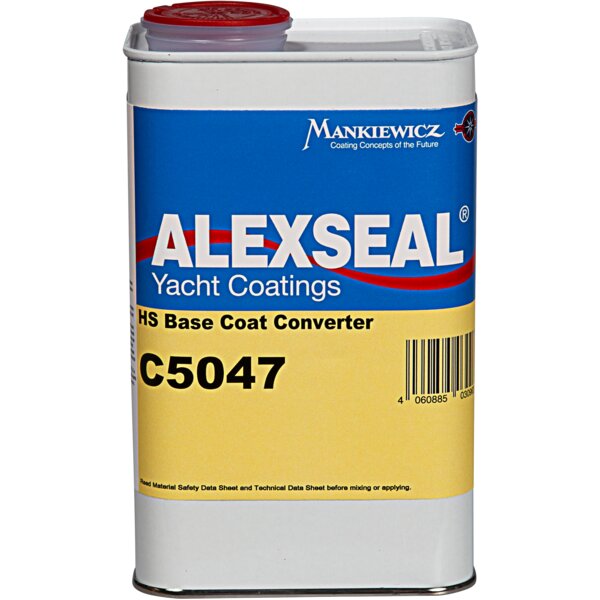
- Catalyst / converter: C5051 ALEXSEAL Topcoat Converter Spray, 1 quart and 1 gallon.
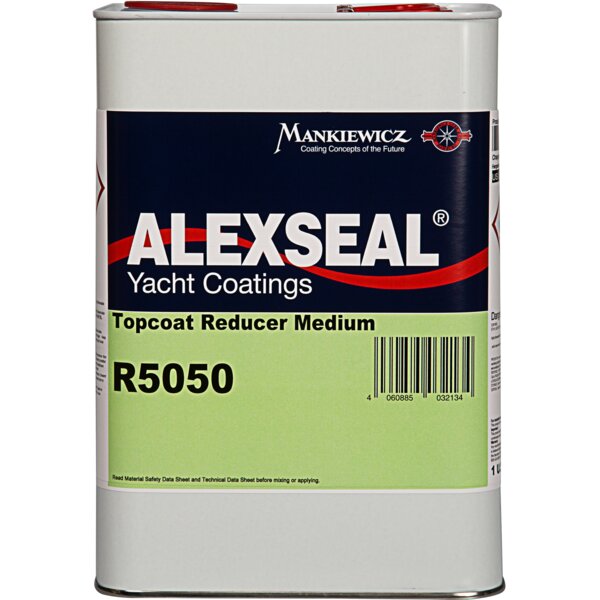
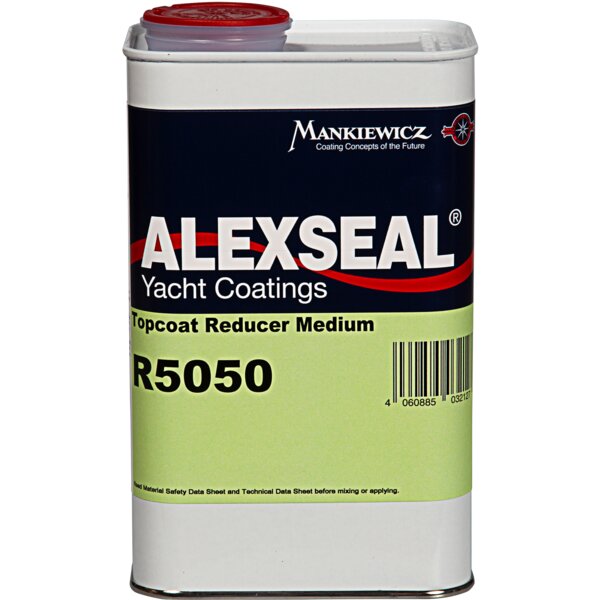
- Reducer (medium): R5050 ALEXSEAL Topcoat Reducer Medium, 1 quart and 1 gallon.
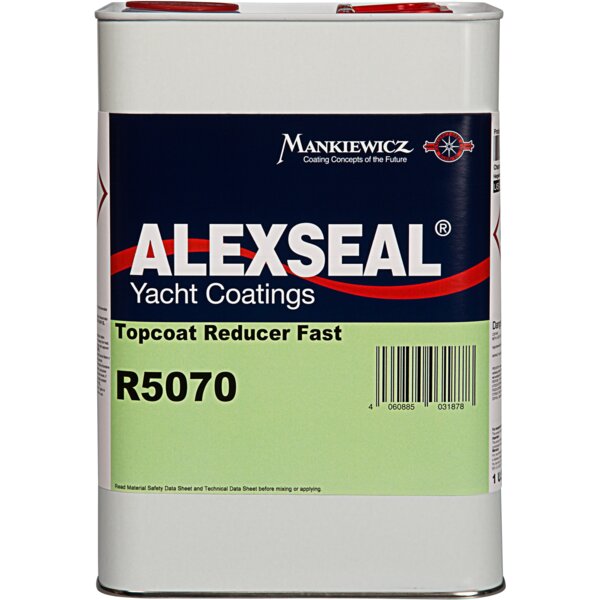
- Reducer (fast): R5070 ALEXSEAL Topcoat Reducer Fast, 1 quart and 1 gallon.
Mixing ratio (metallic base layer)
- 5 parts by volume M…. ALEXSEAL Metallic Base Coat (Base Color).
- 1 part by volume C5051 ALEXSEAL Topcoat Converter Spray.
- 3 parts or 50 % by volume ALEXSEAL Topcoat Reducer (R5050 or R5070).
- Example: 5 : 1 : 3 = 50 % reduction.
- Important: Do not use accelerator in the metallic base coat.
Application data
- Viscosity (reduced for spraying):
- Zahn #2: approx. 15 – 17 seconds.
- DIN 4 cup, 4 mm: approx. 14 – 18 seconds.
- Nozzle size – gravity gun: 1.2 – 1.4 mm (0.047 – 0.055 in).
- Fluid nozzle size – pressure pot: 1.0 – 1.2 mm (0.039 – 0.047 in).
- Atomizing pressure: 3.0 – 5.0 bar (42 – 70 PSI); 4 bar (50 PSI) is indicated as optimal.
- Pot pressure: 0.7 – 1.2 bar (10 – 15 PSI).
Application by spraying (Metallic Base Coat)
- Step 1 – Metallic Base Coat application:
- Apply 2 cross coats of ALEXSEAL Metallic Base Coat.
- Wet film thickness (WFT): 25 – 50 microns (1 – 2 mils) per cross coat.
- Tack time between cross coats: 30 minutes up to 4 hours.
- This results in a dry film thickness (DFT): 20 – 40 microns (1 – 2 mils) for 2 cross coats.
- Maximum recommended film thickness during spray application:
- Up to 3 cross coats in total.
- Approx. 150 microns (6 mils) WFT or 50 microns (2 mils) DFT.
- Some colours may require an additional mist/drop coat to achieve a uniform finish. This may be applied wet-on-wet or after the previous coat has dried.
- The mist/drop coat helps avoid shade variations and clouding.
- Step 2 – Clear Coat application:
- After the Metallic Base Coat has dried for at least 3 hours at 30 °C (longer at lower temperatures, see drying table), and not more than 12 hours at 25 °C, apply the appropriate ALEXSEAL Clear Coat to seal the metallic base.
- Overcoating times depend on temperature and humidity (see “Pot life and drying” below).
- Some very coarse metallic colours may require an additional clear coat layer.
- Remove masking tape that has been overcoated with Clear Coat as soon as possible (for example, after about 2 hours).
- Step 3 – Additional Clear Coat for higher gloss (optional):
- To obtain a higher level of gloss, a further application of ALEXSEAL Clear Coat may be required.
- Careful sanding of the first clear coat with 320 – 400 grit dry sand paper or 500 – 600 grit wet sand paper is possible after at least 24 hours (4 days considered optimal), depending on temperature and humidity.
- Graphics can be added between Step 2 and Step 3.
- Note: Do not sand through the clear coat, as this can change or affect the colour of the metallic base coat.
Pot life and drying
Recommended environmental range for application: minimum 15 °C (60 °F), 40 % RH; maximum 30 °C (85 °F), 80 % RH.
Pot life (approximate) – Metallic Base Coat
- 15 °C: 12 hours
- 20 °C: 10 hours
- 25 °C: 8 hours
- 30 °C: 6 hours
Recoat intervals – Metallic Base Coat over Metallic Base Coat (after tack up)
- 15 °C: 45 minutes
- 20 °C: 30 minutes
- 25 °C: 30 minutes
- 30 °C: 30 minutes
- Maximum time between base-over-base coats: 4 hours
Overcoating with Clear Coat over Metallic Base Coat
Minimum and maximum intervals (approximate) depending on temperature and relative humidity:
- At 20 % RH:
- 15 °C: min 6 h, max 24 h
- 20 °C: min 4 h, max 24 h
- 25 °C: min 3 h, max 12 h
- 30 °C: min 3 h, max 6 h
- At 50 % RH:
- 15 °C: min 6 h, max 24 h
- 20 °C: min 4 h, max 12 h
- 25 °C: min 3 h, max 12 h
- 30 °C: min 3 h, max 6 h
- At 80 % RH:
- 15 °C: min 6 h, max 24 h
- 20 °C: min 4 h, max 12 h
- 25 °C: min 3 h, max 6 h
- 30 °C: min 3 h, max 6 h
Note: In tropical climates (> 30 °C (85 °F) or > 25 °C (77 °F) with RH > 50 %), the maximum overcoating time for the metallic base coat is reduced to 6 hours.
During drying, the minimum temperature is 15 °C (60 °F). Ideal temperature is around 25 °C (77 °F). Minimum application conditions should be at least 3 °C (5.4 °F) above the dew point.
Physical and chemical properties (selected data)
- Boiling range: approx. 120 °C.
- Flash point: 31.5 °C (ISO 13736 / ISO 2719).
- Auto-ignition temperature: > 400 °C.
- Lower explosion limit (LEL): 1 % (v/v).
- Upper explosion limit (UEL): 10 % (v/v).
- Vapour pressure: approx. 100 hPa at 50 °C.
- Density: approx. 0.95 g/cm³ at 20 °C.
- Water solubility: Insoluble; immiscible with water.
- pH (10 % in water at 20 °C): 7 – 9.
- Solvent separation: < 3 % (v/v).
Applications and use cases
- Yacht exteriors: Metallic finishing of hull sides, superstructures and other areas not permanently immersed in water.
- Yacht interiors: Decorative metallic finishes on interior surfaces where a high-end appearance and colour uniformity are required.
- Refit and repair work: When combined with appropriate surface preparation and ALEXSEAL primers and clear coats. For refit projects, users are advised to consult their sales representative as existing coating integrity can influence system selection.
- Industrial serial painting: Suitable for controlled production environments that can maintain the specified temperature, humidity and ventilation conditions.
FAQ – ALEXSEAL Metallic Base Coat
- Is ALEXSEAL Metallic Base Coat a standalone topcoat?
No. The Metallic Base Coat must be overcoated with an appropriate ALEXSEAL Clear Coat to seal and protect the metallic finish.
- Where can this coating be used on a yacht?
It can be used internally or externally on yacht areas that are not subject to permanent immersion in water.
- Which primer should be used under Metallic Base Coat?
For optimum performance and adhesion, ALEXSEAL Finish Primer 442 is specified as the recommended undercoat.
- How many coats of Metallic Base Coat are recommended?
Typically 2 cross coats are applied, with an optional third cross coat or a mist/drop coat for certain colours, within the specified film thickness limits.
- What is the typical dry film thickness of the Metallic Base Coat?
Two cross coats yield approximately 20 – 40 µm (1 – 2 mils) DFT, with a maximum recommended DFT of about 50 µm (2 mils).
- How long can I wait before applying Clear Coat over the base?
Depending on temperature and humidity, minimum overcoating time is about 3 – 6 hours and maximum ranges from 6 – 24 hours as detailed in the drying table. In tropical conditions the maximum is reduced to 6 hours.
- Can I sand the Metallic Base Coat?
The documentation specifies sanding of the Clear Coat (not the metallic base layer) when an additional clear application is required. Sanding through the clear must be avoided to prevent affecting the metallic colour.
- What type of spray equipment is suitable?
Conventional air spray equipment with gravity or pressure-pot guns is used, with nozzle sizes between 1.0 and 1.4 mm and atomizing pressures of 3.0 – 5.0 bar.
- Is accelerator allowed in the mix?
No. Accelerators must not be used in the Metallic Base Coat.
- Is this product intended for consumer use?
No. All documentation clearly states Professional Use Only.
Section 14 – Transport information
- UN number / ID number: UN 1263
- UN proper shipping name: PAINT
- Transport hazard class: Class 3 (Flammable liquids)
- Packing group: III
- ADR / RID:
- Class: 3
- Packing group: III
- Classification code: F1
- Hazard identification number: 30
- Labels: 3
- Tunnel restriction code: (D/E)
- Environmentally hazardous: no
- IMDG:
- Class: 3
- Packing group: III
- Proper shipping name: PAINT
- Labels: 3
- EmS code: F-E, S-E
- Marine pollutant: no
- IATA (air transport):
- Class: 3
- Packing group: III
- Proper shipping name: PAINT
- Cargo aircraft only packing instruction: 366
- Passenger aircraft packing instruction: 355
- Limited quantities packing instruction: Y344
- Labels: Flammable Liquids
- Additional transport remarks (within user’s premises):
- Transport only in closed, upright and secure containers.
- Ensure personnel handling the product are informed about emergency procedures in case of incident or spillage.
Section 8 – Personal protective measures
Exposure controls and personal protection
- Ventilation / engineering controls: Provide good general ventilation and, where practicable, local exhaust. If ventilation does not maintain aerosol and solvent vapour levels below occupational exposure limits, suitable respiratory protection must be used.
Individual protection measures
- Eye/face protection: Wear safety goggles offering protection against solvent splashes.
- Hand protection:
- Use chemical-resistant protective gloves tested to EN 374.
- Recommended glove materials for short contact (splash protection): nitrile rubber or neoprene.
- Minimum material thickness: > 0.4 mm.
- Breakthrough time: > 480 minutes.
- Check glove suitability for the specific workplace (mechanical resistance, product compatibility, antistatic properties).
- Replace gloves immediately if damaged or at first signs of wear.
- Use preventive skin protection (skin protection cream) and wash contaminated skin promptly.
- Skin and body protection:
- Wear anti-static clothing made from natural fibres (e.g. cotton) or heat-resistant synthetic fibres.
- Depending on the likelihood of explosive atmospheres, use suitably rated protective clothing.
- Respiratory protection:
- If solvent vapour concentration exceeds air limit values, wear an approved breathing apparatus.
- Use a half-mask with appropriate combined filter (minimum class A1P2) or air-fed respirator.
- During spray application in booths where operators must be inside, wear compressed air-fed respirators until particulate and vapour levels fall below exposure limits.
- Dry grinding, cutting or welding of coated surfaces can generate hazardous dust or vapour; work with wet methods where possible and/or provide extraction and suitable respiratory protection.
- General protective measures:
- Do not eat, drink or smoke while using this product.
- Avoid contact with skin, eyes and clothing.
- Avoid inhalation of vapours, mists and sanding dust.
Contenido generado por IA