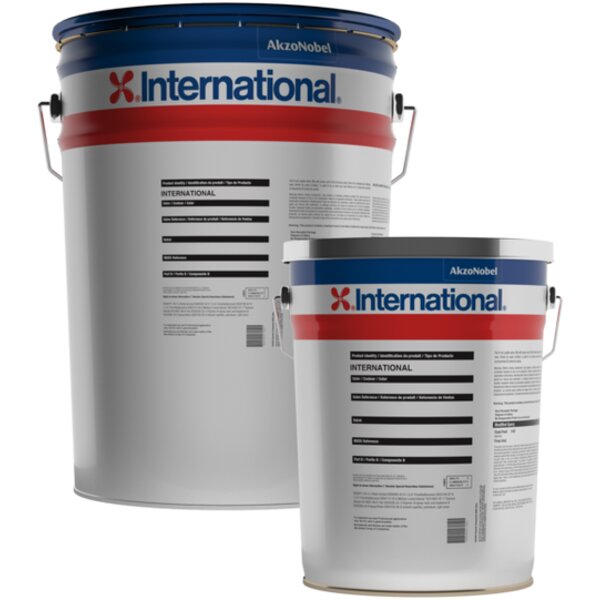
What is INTERTHANE 990E PART A INDIVISIBLE KIT and why choose it
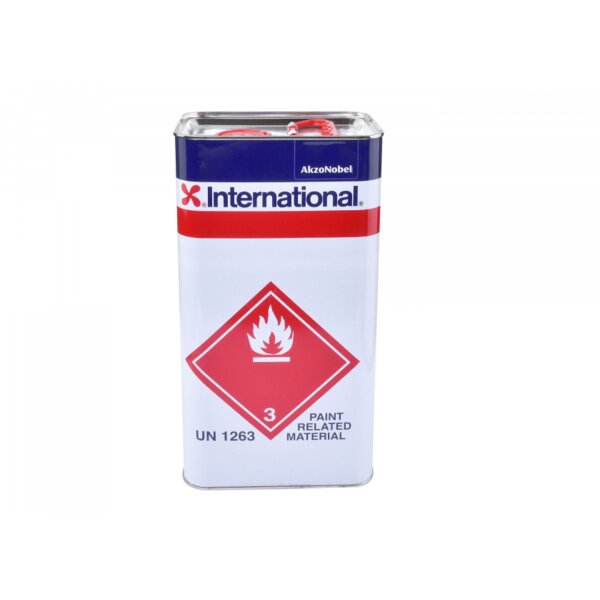
INTERTHANE 990E PART A INDIVISIBLE KIT from International Marina is the base component of a two-component, solvent-borne, high-solids aliphatic acrylic polyurethane topcoat. Designed for professional use, it delivers an exceptionally durable, high-gloss finish with optimised application properties and superior aesthetics. When mixed with its dedicated curing agent and applied over a suitable anti-corrosive system or passive fire protection system, it contributes to long-term protection and an attractive appearance on industrial and commercial assets.
Main features
- Two-component polyurethane topcoat – aliphatic acrylic chemistry for excellent appearance and durability.
- High-solids, solvent-borne formulation – 70% ± 3% volume solids to help achieve specified film builds efficiently.
- High-gloss finish – designed to deliver superior gloss and visual appearance, especially when applied by conventional air spray.
- Wide colour range – tintable via the Chromascan system.
- Versatile application methods – suitable for airless spray, air spray (pressure pot or conventional), brush and roller.
- Flexible application thickness – typical dry film thickness of 50–75 microns (2–3 mils), equivalent to 71–107 microns (2.8–4.3 mils) wet.
- Efficient coverage – theoretical coverage of 14 m²/litre at 50 microns DFT (561 ft²/US gallon at 2 mils DFT), allowing for appropriate loss factors.
- Low VOC for its class – 2.58 lb/gal (310 g/L) VOC (EPA Method 24), meeting multiple international VOC directives.
- Compatible with multiple primers and PFP systems – can be applied over a wide range of recommended primers and intermediates, including Chartek, Interchar, Intergard, Intercure, Interzone, Interseal and Intershield series (where specified).
- Wide application temperature window – capable of curing even at temperatures below 0°C (32°F), with defined drying and overcoating intervals.
Technical specifications
- Product type: Aliphatic acrylic polyurethane topcoat (Part A of a two-component system).
- Use: Two-component coating for interior and exterior use; contributes to an anti-corrosion system when used over appropriate primers/intermediates.
- Volume solids: 70% ± 3%.
- Typical dry film thickness: 50–75 microns (2–3 mils).
- Typical wet film thickness: 71–107 microns (2.8–4.3 mils).
- Theoretical coverage: 14 m²/litre at 50 microns DFT; 561 ft²/US gallon at 2 mils DFT.
- Gloss level: High gloss.
- Colour availability: Wide range via the Chromascan system.
- Application methods: Airless spray, air spray (pressure pot), conventional air spray, brush, roller.
- Mix ratio (Part A : Part B): 8 : 1 by volume.
- Working pot life (mixed unit): approx. 3 h at -5°C; 2.5 h at 5°C; 2 h at 15°C; 1.5 h at 25°C; 1 h at 40°C.
- Touch dry (typical): 22 h at -5°C; 6 h at 5°C; 2.5 h at 15°C; 2 h at 25°C; 90 min at 40°C.
- Hard dry (typical): 68 h at -5°C; 24 h at 5°C; 10 h at 15°C; 6 h at 25°C; 4 h at 40°C.
- Minimum overcoating interval with recommended topcoats: 60 h at -5°C; 21 h at 5°C; 10 h at 15°C; 6 h at 25°C; 4 h at 40°C (maximum: extended).
- Flash point (typical, Part A): 26°C (79°F).
- Mixed flash point (Part A + Part B): 29°C (84°F).
- Product weight (mixed): 1.49 kg/L (12.4 lb/gal).
- VOC (various standards): 2.58 lb/gal (310 g/L) EPA Method 24; 207 g/kg (EU Solvent Emissions Directive 2010/75/EU); 284 g/L (Chinese GB23985); 303 g/L (Korea Clean Air Conservation Act).
- Recommended thinner: International GTA713 (or GTA733 or GTA056, subject to local legislation).
- Recommended cleaner: International GTA713 (or International GTA733).
- Recommended airless spray tip: 0.33–0.45 mm (13–18 thou); minimum fluid pressure at tip 155 kg/cm² (2204 psi).
- Recommended conventional air spray equipment: DeVilbiss MBC or JGA gun, air cap 704 or 765, fluid tip E.
- Brush/roller DFT per coat: typically 40–50 microns (1.6–2.0 mils) achievable.
- Surface preparation standard for damaged areas: Sa2½ (ISO 8501-1:2007) or SSPC-SP6 (abrasive blasting) or SSPC-SP11 (power tool cleaning), with patch priming.
- Recommended primers/intermediates: Chartek 8E, Chartek 1709, Interchar 1190, Interchar 2060, Interchar 1260, Interchar 1290, Interchar 3120*; Intercure 200HS; Intergard 251HS, 2511*, 269, 345, 475HS; Interseal 1052, 670HS; Intershield 300, 4000USP; Interzone 954, 954GF (*available only in selected countries).
- Topcoat compatibility: designed to be topcoated only with Interthane 990E.
- Pack sizes (Part A only): 20 L pack containing 17.78 L; 5 L pack containing 4.45 L.
- Typical shipping weight (Part A): 27.2 kg (20 L unit); 7.31 kg (5 L unit).
- Shelf life: minimum 12 months for Part A and 18 months for Part B at 25°C (77°F), subject to re-inspection. Store in dry, shaded conditions away from heat and ignition sources.
Applications and use cases
INTERTHANE 990E PART A INDIVISIBLE KIT is intended for professional applicators working on:
- New construction projects – industrial plants, infrastructure and commercial facilities where a high-gloss, durable finish is required over a complete anti-corrosion scheme or passive fire protection.
- Maintenance and refurbishment – over existing, suitably prepared and compatible primed surfaces, including aged Interthane 990E, provided all surface contamination (oil, grease, salts, traffic film) is removed.
- Power generation assets – structural steel and associated equipment requiring both aesthetic and protective performance.
- Oil and gas assets – a wide variety of structures where the coating forms the decorative and weathering-resistant top layer of a multi-coat system (not for immersion service).
- Manufacturing and general industrial structures – including infrastructure, fabrication, and plant steelwork.
Best appearance and gloss are obtained by conventional air spray. When applying by brush or roller, and for certain colours (especially bright, lead-free yellows and oranges) or over dark undercoats, two coats may be required to achieve uniform coverage. A colour-compatible intermediate or anti-corrosive coating is recommended underneath.
This product is not recommended for immersion conditions. When severe chemical or solvent splash is expected, suitability must be evaluated for the specific exposure conditions. Condensation during or immediately after application may cause a matt finish and inferior film, and early ponding water can cause colour change, particularly in dark colours and at low temperatures.
Section 6 – Transport information (from Section 14 of the SDS)
- UN number / ID number: UN1263.
- UN proper shipping name: PAINT.
- Transport hazard class: Class 3 (flammable liquid).
- Packing group: III.
- Environmental hazards: Not classified as environmentally hazardous for transport.
- ADR/RID additional information: Tunnel code (D/E).
- IMDG additional information: Emergency schedules F-E, S-E; IMDG segregation group not applicable.
- IATA: Ships as UN1263, PAINT, Class 3, Packing group III.
- Bulk transport according to IMO instruments: Not applicable.
- On-site transport advice: Transport within user’s premises only in closed, upright and secured containers. Personnel transporting the product must know the procedure in case of accident or spillage.
Section 7 – Individual protection measures (from Section 8 of the SDS)
Engineering controls and hygiene
- Use only with adequate ventilation; employ process enclosures or local exhaust to keep airborne concentrations below regulatory limits and below lower explosive limits.
- Use explosion-proof ventilation and electrical equipment.
- Wash hands, forearms and face thoroughly after handling; remove contaminated clothing and protective equipment before entering eating areas.
- Ensure eyewash stations and safety showers are available near work areas.
Eye and face protection
- Wear safety glasses with side shields or other eye protection complying with relevant standards when there is a risk of splashes, mists or vapours.
Hand protection
- Wear chemical-resistant, impervious gloves complying with approved standards.
- For prolonged or frequent contact: protection class 6 gloves (breakthrough time > 480 minutes, EN374) recommended. Typical choices: Viton or nitrile, thickness ≥ 0.38 mm.
- For brief contact: protection class 2 or higher (breakthrough time > 30 minutes, EN374). Typical choice: nitrile, thickness ≥ 0.12 mm.
- Replace gloves regularly and whenever damage or degradation is observed.
Skin and body protection
- Wear protective clothing selected according to the task and risks, approved by a specialist before use.
- Where ignition from static discharge is possible, use anti-static protective clothing (overalls, boots, gloves) complying with EN 1149.
- Choose suitable protective footwear and additional skin protection as required by the specific work conditions.
Respiratory protection
- Select a respirator that meets relevant standards based on the assessed exposure.
- Use a respirator conforming to EN140 fitted with an A/P2 filter or better when ventilation is inadequate.
- For spray application, the SDS for Interthane 990E (system) warns that the product contains isocyanate and recommends the use of an air-fed hood.
- During dry sanding, flame cutting or welding of the dry film, provide local exhaust ventilation or suitable respiratory protection to control dusts and fumes; wet sanding/flatting is preferred where possible.
FAQ – INTERTHANE 990E PART A INDIVISIBLE KIT
-
Is INTERTHANE 990E suitable for both new construction and maintenance?
Yes. It is specifically described for use in both new construction and maintenance projects across industrial and commercial environments.
-
On which types of systems can this topcoat be applied?
It is designed to be applied over suitable primers, intermediate coats or passive fire protection systems that are part of a recommended anti-corrosive scheme.
-
Can INTERTHANE 990E be used in immersion service?
No. The product is not recommended for immersion conditions.
-
What is the recommended mixing ratio for Part A and Part B?
The mix ratio is 8 parts Interthane 990E Part A to 1 part curing agent (Part B) by volume.
-
How should the surface be prepared before application?
Surfaces must be clean, dry and free from contamination, prepared in accordance with ISO 8504:2000. Damaged or breakdown areas should be prepared to Sa2½ (ISO 8501-1:2007) or SSPC-SP6 or SSPC-SP11 and patch-primed before topcoating.
-
What is the minimum surface temperature for application?
The surface temperature must be at least 3°C (5°F) above the dew point during application.
-
Can I thin the product with any solvent?
No. Only the recommended International thinners (GTA713, GTA733 or GTA056 subject to local legislation) should be used. Alternative thinners, especially those containing alcohols, can severely affect curing.
-
Is this product suitable for consumer or DIY use?
No. It is intended only for use by professional applicators in industrial situations, following the Safety Data Sheet and relevant regulations.
-
What happens if condensation occurs during drying?
Condensation during or immediately after application can result in a matt finish and an inferior film, and may lead to early colour change, especially in dark colours at low temperatures.
-
Where can I find data not listed here (e.g. detailed chemical resistance)?
Consultar ficha técnica del fabricante.
Contenido generado por IA