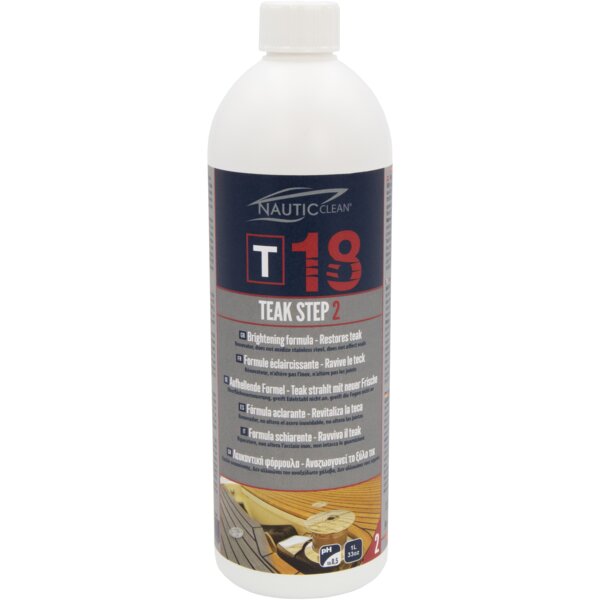
What is NAUTICCLEAN 18 TEAK STEP 2 and why choose it
NAUTICCLEAN 18 TEAK STEP 2 is an acid-based renovator specially formulated and tested in the laboratory for cleaning and restoring teak on boats. Used as the second phase in the two-step system TEAK STEP 1 – TEAK STEP 2, it brightens and stabilizes teak, removing greying and helping the wood regain its clear, natural appearance. The product does not oxidize stainless steel and does not affect seals.
Main features
- Teak renovator, brightener and stabilizer for boating applications.
- Special laboratory formulation developed specifically for teak.
- Designed as step 2 of the system TEAK STEP 1 – TEAK STEP 2.
- Perfect de-greyer for teak, restoring its original look.
- Does not oxidize stainless steel (tested in laboratory).
- Does not affect seals or joints (tested in laboratory).
- Acid-based formulation without hydrochloric acid.
- Surfactants compliant with biodegradability criteria of Regulation (EC) No 648/2004 on detergents.
Technical specifications
- Commercial name: T18 TEAK STEP 2
- Article number: NCT18
- Physical state: liquid
- Colour: colourless
- Odour: characteristic
- pH (20 °C): approx. 0.5
- Density (20 °C): approx. 1.13
- Composition (hazardous components):
- Phosphoric acid: 20–40 %
- Isotridecanol ethoxylate: 1–5 %
- Surfactants: < 5 % non-ionic surfactants
- Packaging:
- NCT18-1: bottle 1 l / 33 oz
- NCT18-5: can 5 l / 169 oz
- Storage conditions: keep container tightly closed and protected from cold, frost, heat and UV rays in a ventilated place.
Applications and use cases
- Renovator for teak surfaces on boats.
- Second step of a two-phase cleaning and renovation process after using TEAK STEP 1.
- Suitable where restoration of greyed teak and recovery of its original appearance is required.
Instructions for use
- Apply pure or diluted up to 50% with water depending on the condition of the teak, after prior application of TEAK STEP 1.
- Without rinsing after TEAK STEP 1, pour TEAK STEP 2 (pure or diluted) into a bucket.
- Spread the product with a clean, soft deck brush following the direction of the grain of the wood.
- The teak will clear up and regain its original appearance as the product is spread.
- Leave to act for 5 to 10 minutes.
- Rinse with plenty of water, brushing softly with a soft deck brush to avoid damaging the teak fibres.
- Do not allow the product to dry on the teak wood.
FAQ
1. What type of wood is NAUTICCLEAN 18 TEAK STEP 2 designed for?
It is formulated and tested specifically for teak used in boating.
2. In which step of the cleaning process should I use TEAK STEP 2?
TEAK STEP 2 is the second phase of a two-step system and must be applied after TEAK STEP 1.
3. Can TEAK STEP 2 damage seals or joints on the deck?
No, it does not affect seals or joints, as tested in the laboratory.
4. Is TEAK STEP 2 compatible with stainless steel fittings?
Yes, it does not oxidize stainless steel, as tested in the laboratory.
5. Does the product contain hydrochloric acid?
No, the formulation is acid-based but free from hydrochloric acid.
6. Do I need to rinse between TEAK STEP 1 and TEAK STEP 2?
No, no rinsing is required between the two phases.
7. How concentrated should TEAK STEP 2 be for application?
It can be applied pure or diluted up to 50% with water, depending on the condition of the teak.
8. Are the surfactants in TEAK STEP 2 biodegradable?
Yes, the surfactants comply with the biodegradability criteria of Regulation (EC) No 648/2004 on detergents.
9. How should I store the product?
Keep the container tightly closed, protected from cold, frost, heat and UV rays, in a ventilated place.
10. What should I do if the product gets in my eyes or on my skin?
In case of eye contact, rinse cautiously with water for several minutes and seek medical advice immediately. In case of skin contact, wash with plenty of water. For persistent irritation, consult a doctor.
Section 14 – Transport information
- UN number: UN1805
- Official transport name:
- ADR: 1805 PHOSPHORIC ACID, SOLUTION (ÁCIDO FOSFÓRICO EN SOLUCIÓN)
- IMDG, IATA: PHOSPHORIC ACID, SOLUTION
- Transport hazard class:
- ADR: Class 8, corrosive substances (label 8)
- IMDG, IATA: Class 8, corrosive substances (label 8)
- Packing group: III (ADR, IMDG, IATA)
- Environmental hazards: not applicable.
- Special precautions for user: attention, corrosive substances.
- Kemler number: 80
- EMS code: F-A, S-B
- Segregation group (IMDG): Acids
- Transport in bulk according to MARPOL Annex II and the IBC Code: not applicable.
- ADR additional data:
- Limited quantities (LQ): 5 l
- Excepted quantities (EQ): code E1 (maximum 30 ml per inner packaging, 1000 ml per outer packaging)
- Transport category: 3
- Tunnel restriction code: E
- IMDG additional data:
- Limited quantities (LQ): 5 l
- Excepted quantities (EQ): code E1 (maximum 30 ml per inner packaging, 1000 ml per outer packaging)
Section 8 – Personal protective measures
- Avoid contact with eyes and skin.
- Use personal protective equipment during handling.
- Hand protection: protective gloves resistant and impermeable to the product.
- Eye protection: tightly sealed safety goggles.
- Body protection: protective suit.
- Respiratory protection: for brief or low-level exposure, use a respiratory mask; for intense or long-term exposure, use self-contained breathing apparatus.
- Hygiene measures:
- Keep away from food, drink and animal feed.
- Remove contaminated clothing immediately and wash before reuse.
- Wash hands before breaks and at the end of work.
Contenido generado por IA