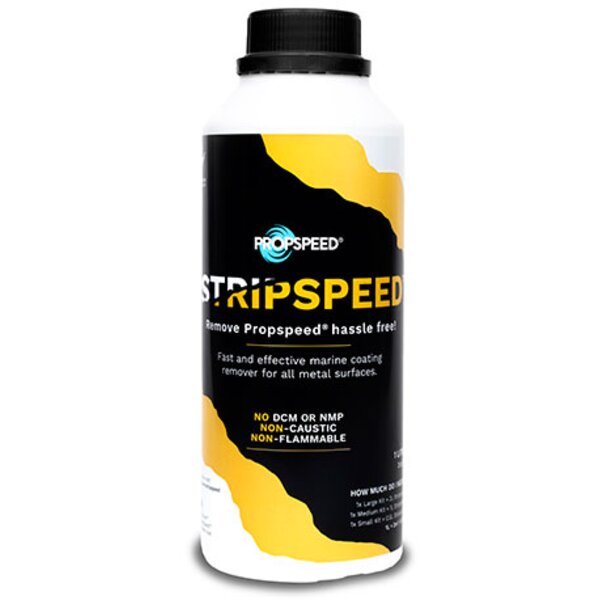
What is Propspeed Stripspeed and why choose it
Propspeed Stripspeed is a professional paint stripper specifically formulated to remove Propspeed foul-release systems and similar coatings from metal substrates. Supplied as a creamy gel, it hangs on vertical and overhead surfaces, allowing efficient one-step removal of the Propspeed etching primer and clear topcoat in 30 minutes or less (depending on atmospheric conditions and temperature 15–27°C / 60–80°F). Stripspeed is supplied ready to use, with no mixing required – just shake, pour and apply.
Designed for use by Propspeed applicators and marine professionals, Stripspeed combines strong coating-removal performance with a non-flammable, DCM- and NMP-free aromatic solvent blend, making it suitable for controlled use in boatyards and metal-maintenance environments.
Main features
- Purpose-built for Propspeed systems: Developed to help Propspeed applicators prepare metal surfaces for reapplication by removing existing foul-release coatings from metal substrates.
- Fast action: Removes Propspeed etching primer and topcoat together in a single step, typically within 30 minutes or less, subject to atmospheric conditions.
- Thick, creamy gel: Gel/liquid consistency that easily hangs on vertical and overhead surfaces without running, improving dwell time and efficiency.
- Ready-to-use formula: No mixing required. The product is simply shaken well, poured into a tray and applied with a brush.
- Non-flammable stripper: Classified as non-flammable, with a flash point of 68°C.
- DCM- and NMP-free: Formulated without dichloromethane (DCM) and N-methyl-2-pyrrolidone (NMP).
- Designed for metal substrates only: Intended exclusively for metal surfaces; it must not be used on hulls, transducers or lights or any non-metal substrate.
- Professional-grade safety information: Supported by a full Safety Data Sheet (SDS) and Technical Data Sheet (TDS) with detailed guidance for handling, PPE, storage and transport.
Technical specifications
- Product line: Stripspeed
- Product use: Paint stripper for metal products; coating remover for Propspeed and similar systems on metal substrates
- Solvent type: Aromatic blend
- Physical state: Gel / liquid
- Appearance: Creamy
- Odour: Vinegar
- pH: Acidic
- Theoretical coverage: 2 m² per litre
- Shelf life: 36 months
- VOC content: 768 g/L (6.41 lb/US gal) as supplied (EPA Method 24; may vary slightly due to manufacturing tolerances)
- Specific gravity: 0.96 (water = 1)
- Flash point: 68°C
- Flammability classification: Non-flammable
- Typical temperature range for optimum performance: 15–27°C (60–80°F)
- Key hazardous components (by SDS): ethylene glycol monobutyl ether, diethylene glycol monobutyl ether, formic acid, aromatic 150, oxalic acid
Applications and use cases
Typical uses
- Removal of existing Propspeed foul-release systems from metal underwater hardware.
- Stripping similar foul-release or coating systems from metal substrates in marine and metal-maintenance environments.
Surface preparation and application overview
Step 1: Surface preparation
- Ensure the metal substrate is free of all marine growth or fouling using a putty knife or rag.
- Make sure the surface is completely dry and free of water to optimise efficiency. Water contact will decrease the efficiency of Stripspeed.
Step 2: Product application
- Shake Stripspeed very well before use to evenly distribute key ingredients.
- Pour the product into a mixing tray or suitable container.
- Apply generously with a brush, ensuring an even layer at least 2 mm thick.
- Allow Stripspeed to dwell for 20–30 minutes, then perform a test patch. The clear coat and etching primer should become weak and easily scratched away when ready for removal.
- In hotter climates (>30°C / 86°F), reapply approximately every 10 minutes to keep the surface wet.
Step 3: Coating removal
- Remove softened coating with a paint scraper.
- Use a brass wire brush or scotch-brite pad for difficult or detailed areas.
- Remove any remaining etching primer with a Propclean wipe.
- Wash residues using water, scotch-brite, mineral spirits and a rag.
- Do not hose or water-blast Stripspeed to avoid splashback on the hull and to prevent product entering waterways.
- Touch up any missed areas with Stripspeed, repeating the same application process.
Performance notes and limitations
- Shake extremely well before use to ensure performance.
- Do not allow the product to dry out; remove while still wet.
- In hotter climates (>30°C) Stripspeed may become slightly thinner.
- In some cases Stripspeed may dry as a white cast; this can usually be removed with a rag and water, Propclean, acetone, mineral spirits or a light hand sand with 80-grit sandpaper.
- Use only on metal substrates. Do not use on hulls, transducers, lights or any non-metal substrate.
FAQ
- What is Propspeed Stripspeed used for?
- Stripspeed is a paint stripper for metal products, designed as a coating remover for Propspeed and similar foul-release systems on metal substrates.
- How long does Stripspeed take to remove Propspeed coatings?
- Under ideal atmospheric conditions and temperatures between 15–27°C (60–80°F), Stripspeed removes the Propspeed etching primer and topcoat together in 30 minutes or less. A test patch after 20–30 minutes will confirm if the coating is ready to be removed.
- On what surfaces can I use Stripspeed?
- Stripspeed is intended only for metal substrates. It must not be used on non-metal substrates such as hulls, transducers or lights.
- Is Stripspeed flammable?
- No. Stripspeed is classified as non-flammable and has a flash point of 68°C.
- Do I need to mix Stripspeed before use?
- No mixing is required. However, the product must be shaken very well before use to evenly distribute key ingredients and ensure performance.
- What is the recommended application thickness?
- Apply Stripspeed with a brush in a generous, even layer at least 2 mm thick over the area to be stripped.
- What personal protective equipment (PPE) is required?
- According to the SDS, users must wear tight fitting safety goggles or a face shield, elbow-length PVC gloves, full protective overalls, rubber boots and a suitable respirator (Type AB-P filter) when there is a risk of overexposure. Adequate ventilation is required during application.
- How should I clean the surface after using Stripspeed?
- Remove softened coatings with a scraper and, where necessary, a brass wire brush or scotch-brite pad. Any remaining etching primer can be removed with a Propclean wipe. Finally, wash remaining residue with water, scotch-brite, mineral spirits and a rag.
- How should Stripspeed be stored?
- Store locked up in its original, clearly labelled container, in a cool, dry, well-ventilated place away from incompatible materials and foodstuffs. Keep the container tightly closed and protected from physical damage. Unopened containers are considered safe to store for up to 18 months; opened containers should not be stored for more than 12 months.
- What is the shelf life of Stripspeed?
- The stated shelf life is 36 months.
Section 14 – Transport information
- UN number: 3265
- Class (primary): 8
- Packing group: II
- Proper shipping name: CORROSIVE LIQUID, ACIDIC, ORGANIC, N.O.S.
- Marine pollutant: Yes
- Australia: Classified as Dangerous Goods for road and rail transport under the ADG Code (7th edition).
- New Zealand: Classified as a Dangerous Good for transport under NZS 5433:2020.
- Small inner packaging: If the individual container is below 1 L, it may be transported as non-DG provided the packaging remains labelled as per Dangerous Goods requirements and the driver is supplied with safety information in accordance with Chapter 3.4 of the UNRTDG.
Section 8 – Personal protective measures
When handling Propspeed Stripspeed, appropriate personal protective equipment must be worn at all times, as specified in the Safety Data Sheet.
- Eye protection: Tight fitting safety goggles or a face shield. Avoid wearing contact lenses.
- Hand protection: Elbow-length PVC gloves.
- Skin and body protection: Full protective overalls and rubber boots.
- Respiratory protection: Use only outdoors or in a well-ventilated area. If risk of overexposure exists, wear an approved respirator with a Type AB-P filter of sufficient capacity (AS/NZS 1716 & 1715, EN 143:2000 & 149:2001, ANSI Z88 or national equivalent). Supplied-air respirators may be required in special circumstances.
- General safety measures: Avoid breathing fumes, mist, vapours or spray. Wash hands thoroughly after handling, do not eat, drink or smoke when using the product, and launder contaminated clothing before reuse.
*Contenido generado por IA