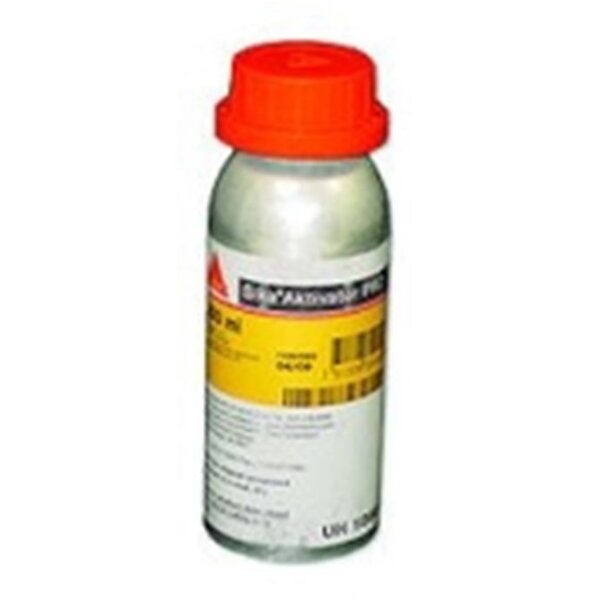
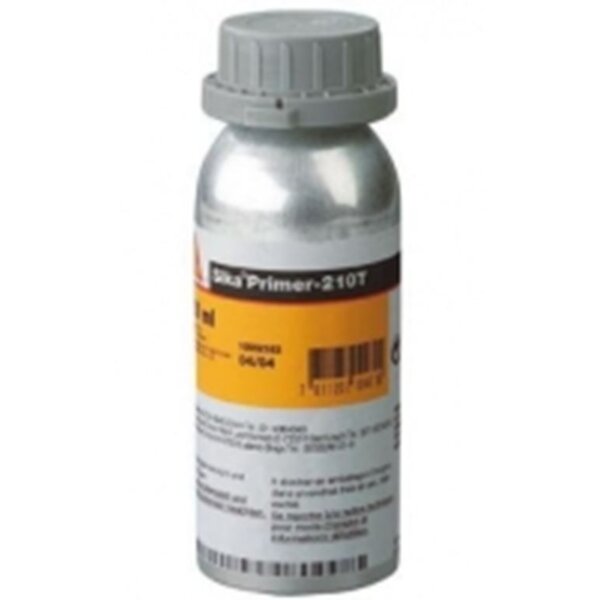
What is SIKA Aktivator-100 and why choose it?
SIKA Aktivator-100 is a transparent, solvent-based adhesion promoter designed for the pretreatment of bond faces before applying Sika elastic adhesives and sealants. It reacts with atmospheric moisture and deposits active groups on non-porous substrates, creating a reliable chemical bridge between the surface and Sika primers, sealants or adhesives. With short flash-off times, easy wipe-on application and proven performance on glass, ceramic screen prints and aged polyurethane adhesive beads, it is a practical choice for professional bonding operations.
Main features
- Solvent-based adhesion promoter: specifically formulated for the pretreatment of bond faces.
- Transparent, colourless to slightly yellow: unobtrusive on visible bond lines.
- Easy wipe-on, wipe-off application: applied sparingly with lint-free paper towels or dedicated pads.
- Short flash-off time: typically 10 minutes above 15 °C, 30 minutes below 15 °C, with a maximum of 2 hours.
- Optimised for Sika systems: improves adhesion of Sika elastic sealants and adhesives on non-porous substrates.
- Broad substrate compatibility: float glass, ceramic screen prints, cut faces of old polyurethane adhesive beads and paints.
- Moisture-reactive system: forms active groups on the surface to promote durable bonding.
- For professional users: intended for experienced applicators, with testing recommended on actual substrates.
Technical specifications
- Chemical base: solvent-based adhesion promoter.
- Colour (CQP001-1): colourless to slightly yellow, transparent to slightly yellowish.
- Physical state: liquid.
- Odour: hydrocarbon-like.
- Application temperature: 5 – 40 °C.
- Ideal application and surface temperature: 15 – 25 °C.
- Application method: wipe-on, wipe-off with clean, lint-free paper towel; cleaning and forced drying.
- Consumption / coverage: approx. 20 ml/m² (typical product data) – actual consumption depends on substrate.
- Flash-off (airing) time:
- ≥ 15 °C: approx. 10 minutes.
- < 15 °C: approx. 30 minutes.
- Maximum before bonding: 2 hours (after this, activation must be repeated once).
- Boiling point: approx. 78 °C.
- Flash point: approx. -4 °C (closed cup).
- Upper explosion limit: 7.4 % (v/v).
- Lower explosion limit: 1.1 % (v/v).
- Viscosity, kinematic: < 20.5 mm²/s (40 °C).
- Density: approx. 0.727 g/cm³ (20 °C).
- Water solubility: insoluble.
- VOC content (approx.): 94–97 % w/w (according to regulatory data).
- Shelf life: 12 months when stored in sealed containers in a dry place at ≤ 25 °C.
- Packaging:
- Can: 30 ml.
- Can: 250 ml.
- Can: 1000 ml.
- Pad: 3.3 ml (single-use pad).
- Single-use items: 30 ml cans and pads are for one-time application only.
Applications and use cases
Recommended substrates
- Float glass.
- Ceramic screen-printed glass areas.
- Cut face of aged polyurethane adhesive beads.
- Painted surfaces.
- Other non-porous substrates where Sika sealants and adhesives are used, after testing.
Typical use cases
- Pretreatment for Sika elastic adhesives and sealants: applied to bond faces before using Sika products to enhance adhesion.
- Refurbishment and repair: improving adhesion on the cut face of old Sika polyurethane adhesive beads.
- Glass bonding: preparation of float glass and ceramic frit areas prior to application of compatible Sika bonding systems.
- Non-porous coatings: promoting adhesion on painted and other coated, non-porous substrates, subject to prior testing.
Important limitations
- Never apply on porous substrates, as the activator may not dry completely and can prevent proper curing of the adhesive or sealant.
- Can dull or matt the surface finish of some freshly applied paints; preliminary trials are necessary.
- When used on transparent or translucent substrates (e.g. float glass, plastics), adequate UV protection is mandatory, except when used with Sikasil silicone sealants and adhesives.
- Must not be used as a cleaning agent or for tooling/smoothing of sealants or adhesives.
- Do not dilute or mix with any other substances.
Method of application (summary)
- Ensure surfaces are clean, dry and free from grease, oil, dust and contaminants.
- Pre-treatment such as light scuffing and cleaning may be used to further improve adhesion.
- Moisten (do not soak) a clean, lint-free paper towel with SIKA Aktivator-100.
- Wipe the bond faces using only a clean side of the towel.
- Immediately wipe off with a separate clean, dry, lint-free paper towel.
- Do not dip towels into the activator; do not moisten the same towel twice and change towels frequently.
- Apply sparingly; excess activator may cause adhesion failure.
- If bonding is not carried out within the maximum flash-off time, repeat activation once.
- After use, reseal the container immediately with the inner plastic liner and screw cap to protect from moisture.
- Discard the product if it becomes opaque instead of clear, or approximately one month after opening in case of frequent use (two months for infrequent use).
Pad application
- Hold the pad directly against the ceramic frit on the glass.
- Pinch the handle with thumb and index finger to break the internal vials and release SIKA Aktivator-100 into the pad (do not bend the pad).
- Use the saturated pad to treat the bond area following the same wipe-on, wipe-off principles.
FAQ
1. On which substrates can I use SIKA Aktivator-100?
It is designed for non-porous substrates such as float glass, ceramic screen prints, the cut face of old polyurethane adhesive cords and paints. It can also enhance adhesion of other Sika sealants and adhesives on non-porous substrates after appropriate testing.
2. Can I apply it on porous materials like concrete or wood?
No. SIKA Aktivator-100 must never be applied on porous substrates, as it may not dry completely and can block the curing of the adhesive or sealant.
3. How much product do I need per square metre?
The typical consumption is about 20 ml/m². Actual usage depends on the specific substrate and application method.
4. What is the correct flash-off time before bonding?
At temperatures ≥ 15 °C, allow about 10 minutes; below 15 °C, about 30 minutes. The maximum time before bonding is 2 hours; if this is exceeded, the activation process must be repeated once.
5. How should I store SIKA Aktivator-100?
Store in a cool, dry place at ≤ 25 °C in tightly sealed containers. The shelf life is 12 months in unopened, properly stored packaging.
6. Can I reuse an opened 30 ml can or pad?
No. According to the product data, 30 ml cans and pads are intended for single application only.
7. Why did the liquid turn cloudy or opaque?
If SIKA Aktivator-100 becomes opaque instead of clear, prolonged exposure to atmospheric moisture has likely made it inactive and it must be discarded.
8. Does it affect paint finishes?
Yes, the solvent content can dull or matt the surface of some freshly applied paints. Always carry out preliminary trials on the actual coating.
9. Can I use it to clean tools or to smooth sealant joints?
No. It must not be used as a cleaning agent or for tooling/smoothing of sealants or adhesives.
10. Is special UV protection required after use on glass?
Yes. When used on transparent or translucent substrates such as float glass or plastics, adequate UV protection is mandatory, except when used with Sikasil silicone sealants and adhesives.
Section 14 – Transport information
- UN number: UN 1866.
- UN proper shipping name: RESIN SOLUTION.
- Transport hazard class: Class 3 (flammable liquids).
- Packing group: II.
- ADR:
- Classification code: F1.
- Hazard identification number: 33.
- Tunnel restriction code: (D/E).
- Environmentally hazardous: yes.
- IMDG:
- Marine pollutant: yes.
- EmS code: F-E, S-E.
- IATA (air transport):
- Cargo aircraft packing instruction: 364.
- Passenger aircraft packing instruction: 353.
- Limited quantity packing instruction (LQ): Y341.
- Labels: Flammable Liquids.
- Environmental hazards: classified as environmentally hazardous for ADR and IATA; marine pollutant under IMDG.
- The listed transport classifications are based on the unpackaged material and may vary with package size, transport mode and local regulations.
Section 8 – Personal protective measures
Exposure controls and personal protection
- Engineering controls: maintain air concentrations below occupational exposure limits and ensure adequate ventilation, especially in confined or mixing/stirring areas.
Eye and face protection
- Wear safety glasses with side shields conforming to EN166.
- Have an eye-wash bottle with clean water available.
Hand protection
- Use chemical-resistant, impervious gloves complying with EN 374, according to glove manufacturer instructions.
- Suitable for short contact or splashes: butyl rubber/nitrile rubber gloves (> 0.1 mm).
- Suitable for longer exposure: Viton gloves (0.4 mm), breakthrough time > 30 min.
- Remove and dispose of contaminated gloves.
Skin and body protection
- Wear protective clothing, e.g. safety shoes according to EN ISO 20345, long-sleeved work clothing and long trousers.
- Rubber aprons and protective boots are additionally recommended for mixing and stirring work.
- Select body protection appropriate to the task, concentration and quantity handled.
Respiratory protection
- In case of inadequate ventilation, wear respiratory protection with organic vapour filter type A.
- Filter capacity guidance: A1 < 1000 ppm; A2 < 5000 ppm; A3 < 10000 ppm.
- Respirator selection must be based on anticipated exposure levels, product hazards and equipment working limits.
Environmental exposure controls
- Prevent the product from entering drains, waterways or soil.
- If contamination of rivers, lakes or drains occurs, inform the relevant authorities.
*Contenido generado por IA