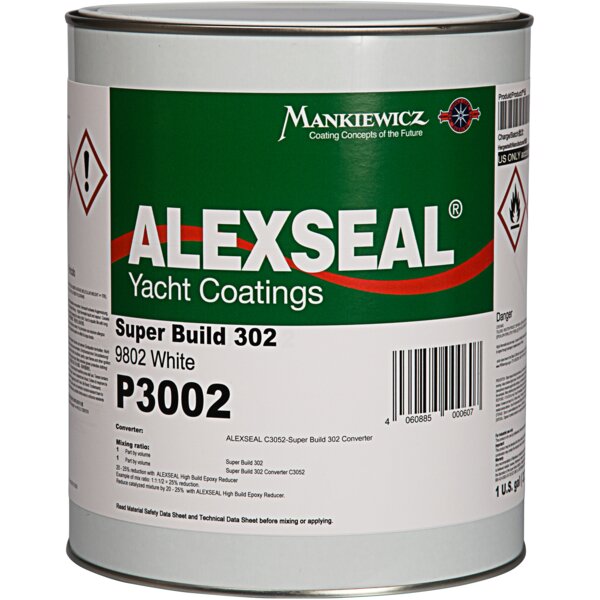
What is ALEXSEAL R3040 High Build Epoxy Reducer and why choose it
ALEXSEAL R3040 High Build Epoxy Reducer is a halogen-free mixture of organic solvents designed to reduce the viscosity of compatible ALEXSEAL epoxy systems, such as ALEXSEAL Super Build 302. It is formulated for industrial serial painting and provides controlled thinning to optimise spray application, flow and film build. The product is a clear, colourless/transparent, highly flammable liquid with a characteristic odour and is intended for professional use in environments where precise application properties and reliable film formation are required.
Main characteristics
- Purpose-formulated epoxy reducer – specified in the Super Build 302 technical data sheet as the dedicated reducer for ALEXSEAL high build epoxy primers.
- Optimised for spray application – enables adjustment of viscosity for conventional, HVLP and airless spray systems as indicated in ALEXSEAL Super Build 302 mixing examples (10–25% by volume depending on application method).
- High solids compatibility – supports very high dry film thickness (up to 500 µm / 20 mils DFT for Super Build 302 systems) when used according to the specified mixing ratios.
- Halogen-free solvent blend – chemical nature specified as a halogen-free mixture of organic solvents.
- Highly flammable liquid – classified as Flammable Liquid Category 2 with flash point of 6 °C (ISO 13736), requiring strict handling and storage controls.
- Health hazard classification – causes serious eye irritation, may cause drowsiness or dizziness, and repeated exposure may cause skin dryness or cracking.
- Industrial-grade formulation – intended for industrial serial painting processes where professional safety and environmental controls are in place.
Technical specifications
Product identification
- Commercial product name: ALEXSEAL R3040-High Build Epoxy Reducer
- Appearance: liquid, colour according to product name (farblos / transparent)
- Chemical nature: mixture of organic solvents, halogen-free
- Main labelled components: propyl acetate, n-butyl acetate
Classification and hazard information (Regulation (EC) No 1272/2008)
- Flammable liquids: Category 2 – H225: Highly flammable liquid and vapour.
- Eye irritation: Category 2 – H319: Causes serious eye irritation.
- Specific target organ toxicity – single exposure (central nervous system): Category 3 – H336: May cause drowsiness or dizziness.
- Supplemental hazard statement: EUH066: Repeated exposure may cause skin dryness or cracking.
Physical and chemical properties
- Physical state: liquid (20–25 °C, 1,013 hPa)
- Boiling range: approx. 120 °C
- Flash point: 6 °C (ISO 13736)
- Auto-ignition temperature:> 400 °C
- Upper explosion limit: 10.0 % (V)
- Lower explosion limit: 1.0 % (V)
- Water solubility: insoluble; immiscible with water
- Vapour pressure: approx. 100 hPa (50 °C)
- Density: 0.884 g/cm³
- Viscosity, kinematic:> 6 mm²/s
- pH: substance/mixture is non-soluble in water
Regulatory information
- VOC content: 100 %, 884 g/l (Directive 2010/75/EU)
- PBT/vPvB: contains no components considered to be PBT or vPvB at ≥ 0.1 %.
- Endocrine-disrupting properties: does not contain components considered to have endocrine disrupting properties at ≥ 0.1 %.
Mixing and use within ALEXSEAL systems
- Recommended system: referenced as the dedicated reducer for ALEXSEAL Super Build 302 high build epoxy primer.
- Typical reduction range for Super Build 302: 10–25 % by volume R3040 based on total base + converter, depending on spray method (conventional or airless).
- Example mix ratios (Super Build 302 system):
- 1 : 1 : 1/2 (base : converter : R3040) ≈ 25 % reducer for conventional spray.
- 1 : 1 : 1/4 (base : converter : R3040) ≈ 12.5 % reducer for airless spray.
- Specific application parameters (nozzle size, pressures, film builds) are defined in the Super Build 302 technical data sheet.
Applications and use cases
- Industrial serial painting: the product is classified for use in industrial serial painting processes.
- High build epoxy primer systems: used as the thinning component in the ALEXSEAL Super Build 302 epoxy primer system to achieve target spray viscosity and film build.
- Adjustment of application viscosity: allows professional applicators to tune the viscosity of compatible ALEXSEAL epoxy coatings for conventional, HVLP and airless application as described in the Super Build 302 documentation.
FAQ
1. What type of product is ALEXSEAL R3040 High Build Epoxy Reducer?
It is a halogen-free mixture of organic solvents specifically designated as a high build epoxy reducer for ALEXSEAL systems such as Super Build 302.
2. In which applications is this reducer intended to be used?
It is intended for industrial serial painting and is referenced as the reducer for ALEXSEAL Super Build 302 high build epoxy primer.
3. Is the product flammable?
Yes. It is classified as a Flammable Liquid Category 2 and is a highly flammable liquid and vapour with a flash point of 6 °C.
4. Does ALEXSEAL R3040 mix with water?
No. It is insoluble and immiscible in water.
5. What are the main health hazards associated with this reducer?
It causes serious eye irritation, may cause drowsiness or dizziness, and repeated exposure may cause skin dryness or cracking.
6. Which components are listed on the label?
The hazardous components listed are propyl acetate and n-butyl acetate.
7. Can I use this reducer in any epoxy coating system?
Consultar ficha técnica del fabricante.
8. What is the typical reduction percentage when used with ALEXSEAL Super Build 302?
The Super Build 302 technical data sheet specifies 10–25 % by volume of R3040 based on total base plus converter, depending on the chosen spray application method.
9. Does the product contain substances of very high concern (SVHC) according to UK/UE REACH?
The safety data sheet indicates that candidate list and Annex XIV authorisation requirements are not applicable for this mixture.
10. How should waste and empty containers be handled?
Waste and uncleaned containers should be disposed of in accordance with local regulations. Contaminated packaging should be emptied as far as possible and, after appropriate cleaning, may be reused; packaging that cannot be cleaned must be disposed of via the regional waste disposal company.
Section 14 – Transport information
UN number or ID number
- ADR: UN 1263
- IMDG: UN 1263
- IATA: UN 1263
UN proper shipping name
- ADR: PAINT RELATED MATERIAL
- IMDG: PAINT RELATED MATERIAL
- IATA: PAINT RELATED MATERIAL
Transport hazard class(es)
- ADR: Class 3
- IMDG: Class 3
- IATA: Class 3
Packing group
- ADR packing group: II
- IMDG packing group: II
- IATA packing group (cargo and passenger): II
Additional ADR data
- Classification Code: F1
- Hazard Identification Number: 33
- Labels: 3
- Tunnel restriction code: (D/E)
- Remarks: Special Provision 640D
- If transported within the user’s premises, always transport in closed, upright and safe containers and ensure personnel are aware of emergency procedures in case of incident or spillage.
IMDG additional information
- Labels: 3
- EmS Code: F-E, S-E
- Marine pollutant: no
IATA additional information
- Cargo aircraft packing instruction: 364
- Passenger aircraft packing instruction: 353
- Limited quantity packing instruction: Y341
- Labels: Flammable Liquids
Environmental hazards
- ADR environmentally hazardous: no
- IMDG marine pollutant: no
Special precautions for user
The transport classifications summarised here are based solely on the properties of the unpackaged material as described in the Safety Data Sheet and are for information only. Classifications may vary depending on mode of transport, packaging size and regional or national regulations.
Section 8 – Measures of personal protection
Engineering controls
- Provide adequate ventilation through local exhaust and general extraction.
- If ventilation is insufficient to keep solvent vapour concentrations below occupational exposure limits, suitable respiratory protection must be worn.
Personal protective equipment
Eye and face protection
- Wear safety goggles to protect against solvent splashes.
Hand protection
- Use chemical-resistant protective gloves tested in compliance with EN 374.
- Recommended materials for short-term contact (splash protection): nitrile rubber or neoprene.
- Minimum material thickness: > 0.4 mm.
- Breakthrough time: > 480 min.
- Always verify glove suitability for the specific workstation (mechanical resistance, product compatibility, antistatic properties) and follow glove manufacturer instructions for use, storage, care and replacement.
- Replace protective gloves immediately if damaged or worn. Preventive skin protection (skin protection cream) is recommended and contaminated skin should be washed immediately.
Skin and body protection
- Depending on the probability of dangerous or explosive atmospheres, wear suitable protective clothing.
- In the Spanish data sheet, anti-static clothing of natural fibres (cotton) or heat-resistant synthetic fibres is recommended for related systems.
Respiratory protection
- If solvent concentration exceeds workplace air limits, a suitable breathing apparatus approved for this purpose must be worn.
- Use at least a half-mask model with cartridge or an air-fed respirator.
- When operators have to work inside spray booths, they should wear a compressed air-fed respirator during spraying until particulate and solvent vapour concentrations are below exposure limits.
General protective measures
- Do not eat, drink or smoke during use.
- Avoid contact with skin, eyes and clothing.
- Avoid inhalation of sanding dust, spray mist and solvent vapours.
*Contenido generado por IA