What this product is and why choose it
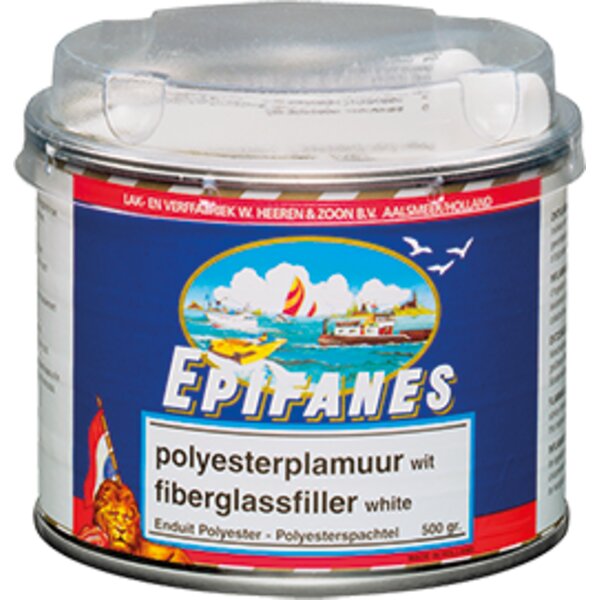
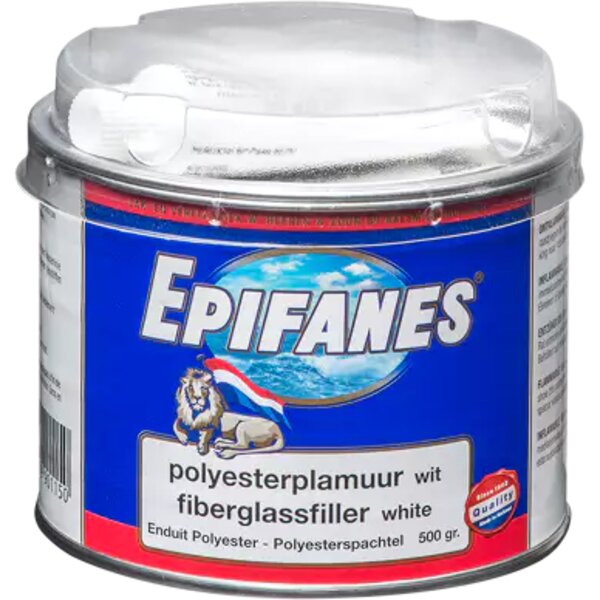
Epifanes Fiberglass Filler Polyester A + B is a fast drying, two-component polyester filler specially formulated for repairing fiberglass/GRP surfaces above the waterline. Based on an unsaturated polyester resin (component A) and a peroxide hardener (component B), it combines excellent adhesion on well-cleaned and degreased fiberglass with high filling power, shrink-free curing and easy sanding. It can be applied in relatively thick layers and is compatible with both one-component and two-component paint systems.
Main features
- Two-component polyester system: base component A (unsaturated polyester resin in monostyrene) and hardener B (dibenzoyl peroxide based).
- Fast drying: short potlife and rapid sanding times, even at moderate temperatures.
- High build and shrink-free: designed for high filling capacity without noticeable shrinkage after curing.
- Excellent adhesion on fiberglass: adheres strongly to properly cleaned and degreased GRP substrates.
- Easy to sand: once cured, the filler sands smoothly to achieve fair, even surfaces.
- Above-waterline use: solely suited for use on fiberglass/GRP above the waterline.
- Compatible with Epifanes primers and topcoats: can be recoated with specified Epifanes epoxy, polyurethane and mono-urethane systems.
- White colour: provides a neutral base coat under light-coloured finishes.
Technical specifications
Chemical and physical data (component A – base filler)
- Type: Chemical drying.
- Base: Unsaturated polyester resin dissolved in monostyrene.
- Colour: White.
- Density: approx. 2.00 kg/dm³.
- Form: Fluid filler.
- VOC content (mixture, from SDS): approx. 12.45 %; about 242.6 g/L.
- Solids content: approx. 88.8 %.
- Flash point: approx. 33 °C.
- Boiling range: approx. 145 °C.
- pH (20 °C): approx. 7.
Packing and storage (component A)
- Standard packs:
- 500 g base with 20 g white hardener.
- 1500 g base with 50 g white hardener.
- Shelf life (unmixed): approx. 2 years in closed container, stored in a dark location between 5 °C and 25 °C.
Hardener (component B – Fiberglass Filler hardener)
- Main reactive component: Dibenzoyl peroxide.
- Physical form: Solid paste.
- pH (20 °C): approx. 6.
- Density (20 °C): approx. 1.15 g/cm³.
- VOC content: 0 %.
Mixing and potlife
- Mixing ratio (by weight):
- Base component A: 100 parts.
- Curing component B: 2–4 parts.
- Mixing advice: mix small volumes only.
- Induction time: none required.
- Potlife after mixing:
- At 12 °C: approx. 8–10 minutes.
- At 20 °C: approx. 5–7 minutes.
- At 28 °C: approx. 2–3 minutes.
- Thinner: do not thin.
- Recommended application tool: filling knife.
Application and drying conditions
- Substrate: Fiberglass/GRP only, above the waterline.
- Temperature during application and drying (air and substrate):
- Minimum: 12 °C.
- Maximum: 28 °C.
- Substrate temperature must be at least 3 °C above dew point.
- Relative air humidity: 50–75 %.
Drying times at 20 °C / 65 % R.H.
- Sandable: approx. 30–60 minutes.
- Recoatable: after approx. 24 hours.
- Through hardened: after approx. 7 days.
Recoatability
After sanding and cleaning, Epifanes Fiberglass Filler Polyester A + B can be recoated with the following Epifanes products:
- Primers:
- Epifanes Multi Marine Primer.
- Epifanes Epoxy HB Coat.
- Epifanes Epoxy Primer.
- Epifanes Poly-urethane Primer.
- Topcoats:
- Epifanes Mono-urethane Yacht Coating.
- Epifanes Poly-urethane Yacht Coating.
Applications and use cases
- Fiberglass/GRP repairs above the waterline: designed specifically for filling imperfections, dents and small damaged areas in GRP hulls and superstructures where permanent immersion is not expected.
- Small repairs on fiberglass parts: suitable for localized filling of scratches, pinholes and small cavities on decks, cabins and other GRP constructions.
- Repairs in existing paint systems: can be used for small repairs in both one-component and two-component paint systems, provided surfaces are properly prepared.
Surface preparation and application guidance
- Ensure the fiberglass is well cleaned, degreased and free from wax.
- Degrease bare fiberglass with Epifanes Fibreglass Prep Cleaner to remove all wax.
- On the rough side of fiberglass, first remove the waxy layer with Scotch-Brite to obtain good adhesion.
- New polyester must be at least 14 days old and free of chemicals before applying the filler.
- After the filler has dried and been sanded, immediately apply one thinned topcoat (15–20 %) to fill the pores of the filler. This helps to prevent moisture uptake and staining due to absorption into the filler.
FAQ
-
Can Epifanes Fiberglass Filler Polyester A + B be used below the waterline?
No. According to the product information, it is solely suited for use on fiberglass/GRP above the waterline.
-
What is the correct mixing ratio between base and hardener?
The recommended mixing ratio by weight is 100 parts base component A to 2–4 parts curing component B.
-
How long can I work with the mixed filler?
The potlife after mixing is short and temperature-dependent: about 8–10 minutes at 12 °C, 5–7 minutes at 20 °C and 2–3 minutes at 28 °C. Mix only small quantities that can be applied within these times.
-
When can I sand the filled area?
At 20 °C and 65 % relative humidity, the filler is typically sandable after 30–60 minutes.
-
Which primers and paints can I use over this filler?
The filler can be recoated with Epifanes Multi Marine Primer, Epifanes Epoxy HB Coat, Epifanes Epoxy Primer, Epifanes Poly-urethane Primer, Epifanes Mono-urethane Yacht Coating and Epifanes Poly-urethane Yacht Coating.
-
Do I need to thin the filler or the following coat?
The filler itself must not be thinned. After sanding the filler, apply one topcoat thinned 15–20 % to fill the pores and reduce moisture uptake.
-
How should I prepare new polyester surfaces?
New polyester must be at least 14 days old, free of chemicals and wax. Degrease thoroughly and remove any waxy layer on the rough side of fiberglass with Scotch-Brite before applying the filler.
-
How should I store unopened cans?
Store unmixed product in closed containers in a dark location between 5 °C and 25 °C. Under these conditions the approximate shelf life is 2 years.
Section 14 – Transport information
Component A – Epifanes Fiberglass Filler (base)
- UN number: UN1263.
- Proper shipping name: Paint.
- Transport classification: Class 3, flammable liquids.
- Packing group: III.
- Marine pollutant: No.
- Special precautions for user: Warning: flammable liquids.
- DOT quantity limitations: On passenger aircraft/rail: 60 L; on cargo aircraft only: 220 L.
- ADR excepted quantities (EQ): Code E1; maximum 30 ml per inner packaging, 1000 ml per outer packaging.
- IMDG limited quantities (LQ): 5 L.
- IMDG excepted quantities (EQ): Code E1; maximum 30 ml per inner packaging, 1000 ml per outer packaging.
- UN model regulation description: UN 1263 PAINT, 3, III.
Component B – Epifanes Fiberglass Filler (hardener)
- UN number: UN3108.
- Proper shipping name: Organic peroxide type E, solid.
- Transport classification: Class 5.2, organic peroxides.
- Packing group: Void (organic peroxide specific classification).
- Environmental hazards: Product contains environmentally hazardous substances (isononylbenzoaat).
- Marine pollutant: No (IMDG); Yes for DOT marking (symbol fish and tree).
- Special marking (ADR): Symbol fish and tree.
- Special precautions for user: Warning: organic peroxides. Protect from sources of heat.
- Stowage category: D.
- Stowage code: SW1 – protected from sources of heat.
- Segregation codes: SG35 – stow separated from acids (SGG1); SG36 – stow separated from alkalis (SGG18).
- IMDG limited quantities (LQ): 500 g.
- Excepted quantities (EQ): Code E0 – not permitted as excepted quantity.
- UN model regulation description: UN 3108 ORGANIC PEROXIDE TYPE E, SOLID, 5.2, ENVIRONMENTALLY HAZARDOUS.
Section 8 – Individual protection measures
General protective and hygienic measures
- Keep away from foodstuffs, beverages and feed.
- Immediately remove all soiled and contaminated clothing.
- Wash hands before breaks and at the end of work.
- Avoid contact with eyes and skin.
- Ensure good ventilation or local exhaust at the workplace; avoid breathing vapors, mists or sprays.
Respiratory protection
- When ventilation is inadequate, use suitable respiratory protection; for the base filler a filter type AX is indicated.
Hand protection
- Wear protective gloves that are impermeable and resistant to the product.
- The choice of glove material must take into account penetration times, diffusion rates and degradation; this must be checked with the glove manufacturer.
Eye and face protection
- Wear tightly sealed safety goggles or appropriate eye/face protection during mixing, application, sanding and cleaning.
Additional safety notes
- The product and hardener are classified as flammable and/or oxidizing; keep away from heat, sparks, open flames and hot surfaces. No smoking.
- Follow all applicable national regulations for health, safety and environmental protection.
*Contenido generado por IA