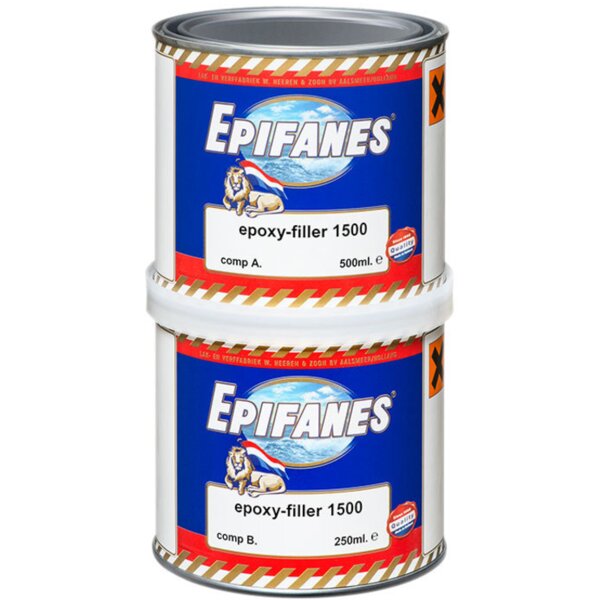
What is Epifanes Epoxy Filler 1500 and why choose it
Epifanes Epoxy Filler 1500 is a high‑build, two‑component epoxy filler designed for durable fairing and repair work above and below the waterline. Based on phenol‑free epoxy resins, it is completely shrink‑free, water‑resistant and highly mechanically resistant, with excellent impact strength and sandability. The filler can be applied in a single layer up to 15 mm (1.5 cm), making it suitable for both minor imperfections and deeper repairs on stable substrates.
Used in combination with appropriate Epifanes epoxy or polyurethane primers, Epoxy Filler 1500 offers a robust base for long‑term protective and decorative coating systems on wood, steel, aluminium and polyester (FRP).
Main features
- Two‑component epoxy system: base (Component A) and hardener (Component B) for strong, chemical‑curing performance.
- Shrink‑free curing: 100 % shrink‑free during drying and after full cure for dimensionally stable repairs.
- High mechanical strength: highly resistant to impact and abrasion; suitable for demanding marine environments.
- Water‑resistant and immersion‑resistant: suitable for use under and above the waterline when overcoated with the correct primers and systems.
- High build in one pass: apply up to 15 mm layer thickness without sagging.
- Good sandability: sands well after curing, allowing smooth fairing of hulls and superstructures.
- Low odour: more comfortable to use than many conventional fillers.
- Usable in one‑ and two‑component paint systems: commonly used within two‑component systems, but also increasingly incorporated under selected one‑component primers.
Technical specifications
Product composition and type
- Type: Chemically drying, two‑component epoxy filler.
- Base (Component A): phenol‑free epoxy resin.
- Hardener (Component B): epoxy hardener (polyamine based).
Colour and appearance
- Colour after mixing and curing: light grey.
- Form: fluid/viscous filler for application with knife, trowel or spatula.
Density
- Mixed density at 20 °C / 68 °F: approx. 1.50 kg/dm³.
Packaging
- 750 ml set: 500 ml Component A + 250 ml Component B.
- 1500 ml set: 1000 ml Component A + 500 ml Component B.
Shelf life and storage
- Approximate shelf life (EN datasheet): around 3 years in unopened cans stored in the dark between 41–77 °F.
- Approximate shelf life (NL datasheet): at least 2 years from production in unopened original packaging between 5–30 °C.
Mixing ratio
- By volume: 100 parts Base A : 50 parts Hardener B.
- By weight: 100 parts Base A : 50 parts Hardener B.
- Stir each component separately, then mix thoroughly together.
Pot life (after mixing)
- Approx. 40 min at 12–14 °C (54 °F).
- Approx. 30 min at 20 °C (68 °F).
- Approx. 10 min at 28–27 °C (82 °F).
- Pot life depends on the total quantity mixed; larger masses shorten pot life.
Application conditions
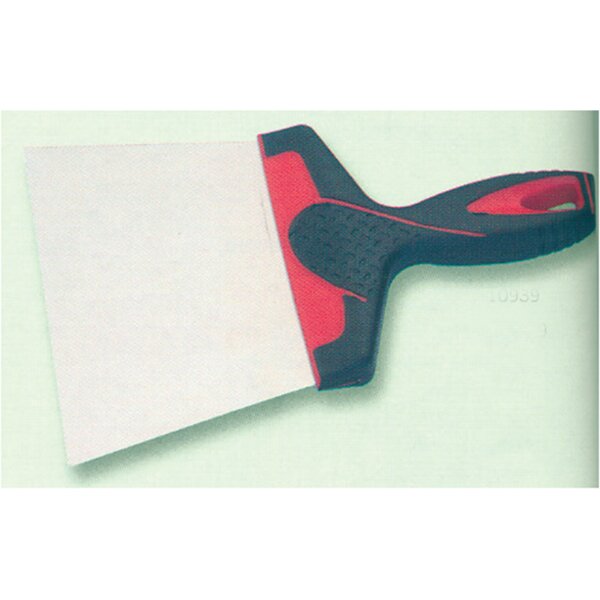
- Application tools: filling knife, trowel or spatula.
- Substrate / ambient temperature: minimum 12 °C / 54 °F, maximum 28–30 °C / 86 °F.
- Relative humidity: minimum 50 %, maximum 80–85 %.
- Surface temperature must be at least 3–5 °C (approx. 38 °F) above dew point.
- Do not apply wet‑on‑wet. Each coat must cure, then be cleaned and sanded before overcoating or applying the next filler layer.
Film thickness and coverage
- Maximum layer thickness: up to 15 mm in a single application, without sagging.
- Theoretical coverage: about 1000 ml per 11 ft² at 0.5 mm film thickness (approx. 1.1 m² per litre at 0.5 mm).
Drying and overcoating times
Approximate times after application, depending on temperature:
- At 12 °C / 54 °F:
- Sandable: 36 h
- Recoatable: 36 h
- Chemically cured: 72 h
- At 20 °C / 68 °F:
- Sandable: 24 h
- Recoatable: 24 h
- Chemically cured: 48–60 h
- At 28–30 °C / 82 °F:
- Sandable: 18 h
- Recoatable: 18 h
- Chemically cured: 36–48 h
Higher temperatures accelerate, and lower temperatures slow, the curing process and can influence final properties.
Suitable primers and overcoating systems
- Suitable primers for fairing / build‑up:
- Epifanes Epoxy Primer
- Epifanes Epoxy HB Coat
- Epifanes Multi Marine Primer (after at least 72 hours curing)
- Recoatable above the waterline with one‑component systems:
- Epifanes Multi Marine Primer
- Recoatable above the waterline with two‑component systems:
- Epifanes Epoxy Primer
- Epifanes Epoxy HB Coat
- Epifanes Poly‑urethane Primer
- Recoatable below the waterline:
- Epifanes Antifouling Primer CR
- Epifanes Epoxy Primer
- Epifanes Epoxy HB Coat
- Epifanes Interimcoat
Surface preparation
- All substrates must be dry, clean and free from oil, grease, wax, dust and other contaminants.
- FRP / polyester mouldings:
- Structures must be at least 14 days old and free from chemicals.
- Degrease thoroughly with Epifanes Fiberglass/Polyester Degreaser to remove waxy residues.
- Remove the paraffin layer with steel wool or Scotch‑Brite to obtain a clean, slightly rough surface.
- Steel and aluminium: preferably apply the filler between primer coats of the paint system rather than directly on bare metal.
- Small scratches and holes: clean, degrease and sand with a coarse grit, then fill directly.
- Larger areas or deeper defects: first prime the substrate with Epifanes Epoxy Primer or Epoxy HB Coat, allow to dry and sand with P120–150 before applying filler.
Sanding
- Before sanding, remove any amine blush from cured epoxy surfaces by wiping with:
- water with vinegar, or
- water with ammonia, or
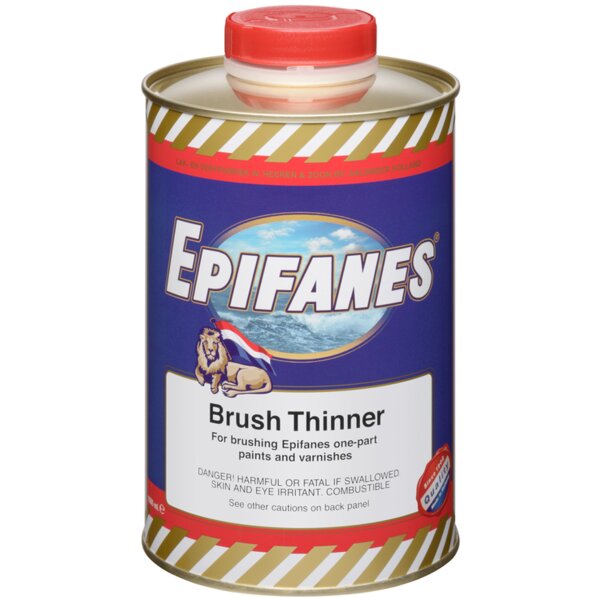
- Epifanes Cleaning Thinner / Cleaning Solvent, or
- Epifanes Fiberglass/Polyester Degreaser, or
- acetone.
- After cleaning, sand filled areas dry with P100–120 (or P120 dry as indicated).
- When applying multiple coats of filler, each coat must be cleaned and sanded with P80–100 before the next application; sand the final coat with P100–120.
Applications and typical uses
- Marine hull and superstructure fairing: smoothing and fairing of GRP, wood, steel and aluminium surfaces above and below the waterline in combination with suitable primers.
- Gelcoat repair: filling small holes and defects in gelcoat below the waterline prior to overcoating with Epifanes epoxy primers and finishing systems.
- High‑build filling: building up to 15 mm thickness in a single pass for deeper dents, joints or construction irregularities.
- Maintenance and refit: restoration of aged or damaged epoxy and polyester laminates after correct surface preparation.
- Industrial and structural components with minimal movement: filling and levelling on stable substrates that do not undergo large dimensional changes.
FAQ
-
On which substrates can Epifanes Epoxy Filler 1500 be used?
According to the product information, it can be used on wood, steel, aluminium and polyester (FRP) structures with minimal movement, both under and above the waterline, when combined with suitable primers.
-
What is the maximum thickness I can apply in one coat?
The filler can be applied up to a maximum of 15 mm (1.5 cm) in a single application without sagging.
-
How long should I wait before sanding?
At 20 °C / 68 °F, the filler is typically sandable after about 24 hours. At 12 °C this extends to around 36 hours, and at 28 °C it can be sandable after approximately 18 hours.
-
Which primers can I apply over the cured filler?
Suitable primers include Epifanes Epoxy Primer, Epifanes Epoxy HB Coat, Epifanes Poly‑urethane Primer and Epifanes Multi Marine Primer, depending on whether the area is above or below the waterline and whether a one‑ or two‑component system is used.
-
Can I apply the filler directly on bare steel or aluminium?
The product information advises not to apply the filler directly on bare steel or aluminium where possible, but to place it between the (two‑component) primer coats of the coating system.
-
How do I treat amine blush before sanding?
If curing occurs at lower temperatures and high humidity, an amine blush (sticky film) can form. This must be removed before sanding by wiping with water plus vinegar, water plus ammonia, Epifanes Cleaning Thinner, Epifanes Fiberglass/Polyester Degreaser or acetone, then allowing to dry.
-
Is the product suitable for continuous immersion?
The Dutch product sheet states that the filler is water‑resistant and resistant to immersion in water when used in combination with appropriate primers and paint systems.
-
What is the theoretical coverage?
A mixed volume of 1000 ml covers approximately 11 ft² at 0.5 mm thickness (about 1.1 m² per litre at 0.5 mm).
-
Can I use Epoxy Filler 1500 in a one‑component paint system?
Yes. Although mainly used within two‑component paint systems, the Dutch datasheet indicates that it is increasingly also processed in one‑component systems, when combined with suitable primers such as Epifanes Multi Marine Primer.
-
What should I do with leftover mixed filler?
Mixed filler has a limited pot life. Any remaining material that has started to react must be allowed to cure fully and disposed of according to local regulations. Do not pour uncured product into drains or the environment.
Section 14 – Transport information
The two components of Epifanes Epoxy Filler 1500 have the following transport classifications in their Safety Data Sheets:
Component A – Epifanes Epoxy Filler 1500 Component A
- UN number: UN3082.
- Proper shipping name: Environmentally Hazardous Substance, Liquid, N.O.S. (reaction product: bisphenol‑A‑(epichlorhydrin) epoxy resin (number average molecular weight = 700)).
- Transport hazard class: Class 9, Miscellaneous dangerous substances and articles.
- Packing group: III.
- Environmental hazard: classified as environmentally hazardous; special marking with "fish and tree" symbol.
- ADR/IMDG/IATA limited quantity (LQ): 5 L.
- Excepted quantity (EQ): Code E1 (max. 30 ml per inner packaging, 1000 ml per outer packaging).
- Additional notes: Transport category 3, tunnel restriction code E (ADR); EMS F‑A, S‑F (IMDG).
Component B – Epifanes Epoxy Filler 1500 Comp. B (cure)
- UN number: UN2735.
- Proper shipping name: Polyamines, Liquid, Corrosive, N.O.S. (phenol, dodecyl‑, branched, m‑phenylenebis(methylamine)).
- Transport hazard class: Class 8, Corrosive substances.
- Packing group: III.
- Environmental hazard: classified as environmentally hazardous; special ADR marking with "fish and tree" symbol.
- ADR/IMDG/IATA limited quantity (LQ): 5 L.
- Excepted quantity (EQ): Code E1 (max. 30 ml per inner packaging, 1000 ml per outer packaging).
- Additional notes: Danger code (Kemler) 80; EMS F‑A, S‑B; segregation group "Alkalis" and segregation code SG35 (stow separated from acids).
Section 8 – Personal protective measures
The Safety Data Sheets for Epifanes Epoxy Filler 1500 components provide the following guidance on personal protection and safe handling:
General hygienic measures
- Keep away from foodstuffs, beverages and animal feed.
- Do not eat, drink or smoke while using the product.
- Immediately remove all soiled or contaminated clothing.
- Wash hands thoroughly before breaks and after finishing work.
- Avoid contact with eyes and skin.
Respiratory protection
- With good general ventilation respiratory protection is not always necessary.
- If ventilation is insufficient or aerosols/vapours are generated, use a suitable respiratory protective device. The data sheets indicate the use of an AX‑type filter when ventilation is inadequate.
Hand protection
- Wear protective gloves impermeable and resistant to the product.
- Due to the mixture of substances, the exact glove material must be selected based on manufacturer information regarding breakthrough times and resistance.
- Recommended for prolonged contact: gloves made of PVA or fluorinated rubber, thickness > 0.7 mm, breakthrough time > 480 min (EN 374).
- Recommended for splash protection: nitrile gloves, thickness > 0.45 mm, breakthrough time > 30 min (EN 374).
Eye and face protection
- Wear tightly sealed safety goggles to protect against splashes.
Additional protective equipment and handling notes
- Ensure good ventilation or local exhaust at the workplace to prevent accumulation of vapours and aerosols.
- Keep respiratory protective equipment readily available.
- In case of accidental release, wear suitable protective equipment, keep unprotected persons away and prevent the product from entering drains or surface water.
*Contenido generado por IA