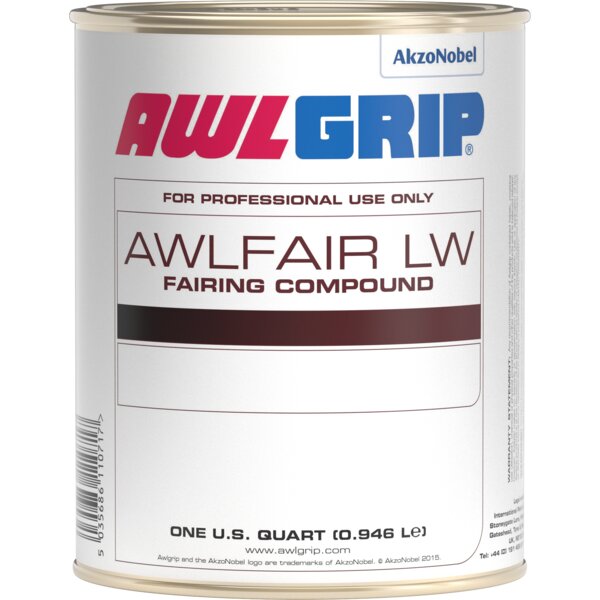
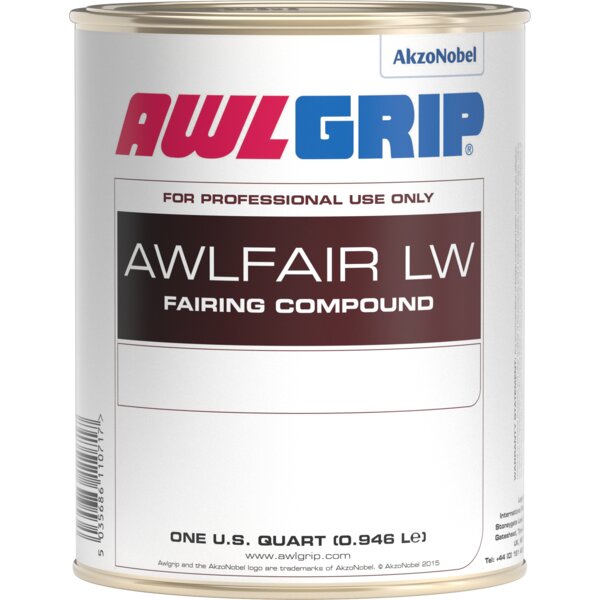
What is Awl Fair LW Fairing Red Converter and why choose it?
Awl Fair LW Fairing Red Converter (D7200) by Awlgrip is the red epoxy converter used in combination with Awlfair LW Base (D8200) to create a premium, trowelable epoxy fairing compound. Designed for professional fairing of yacht and commercial vessel hulls, it delivers a smooth, level surface that reduces drag and enhances final appearance. When mixed 1:1 by volume with the white base, it produces a pink, easily sanded filler suitable for use above and below the waterline.
This converter is formulated for demanding marine environments, offering reliable curing, excellent mechanical properties and compatibility with Awlgrip epoxy primers and topcoat systems.
Main features
- Converter for Awlfair LW system: Red component (D7200) used with D8200 base to form Awlfair LW trowelable epoxy filler.
- Marine fairing performance: Part of a system designed to smooth irregular surfaces, reduce drag and improve boat appearance.
- Premium epoxy chemistry: Provides high compressive, flexural and tensile performance when mixed with D8200 base.
- Use above and below the waterline: Awlfair LW fairing system can be applied on both underwater and topside areas when correctly sealed with suitable Awlgrip epoxy primers.
- Manual or automatic mixing: Suitable for hand mixing or use with approved automatic mixing machines.
- Controlled sanding properties: In the Awlfair LW mix, sanding can typically start from 17 hours at 25°C, depending on conditions.
- Very low theoretical VOC in the mixed system: The Awlfair LW system has low theoretical VOC values when mixed 1:1 by volume.
Technical specifications
Product identification
- Product name: Awl Fair LW Fairing Red Converter
- Code: D7200 / OD7200
- Brand: Awlgrip (AkzoNobel)
- Type: Epoxy converter for Awlfair LW fairing compound (mixture)
Physical data (converter as supplied)
- Appearance: Red paste
- Odour: Amine-like
- Relative density: approx. 0.70
- Solubility: Insoluble in cold water
- Flash point: 101°C (closed cup)
- Viscosity: Kinematic viscosity at ambient temperature approx. 800000 mm²/s
VOC data
All VOC information is theoretical; actual values may vary by batch and are determined according to standard test methodologies.
- D7200 Converter (as supplied, without reducer): 84 g/L; 0.70 lb/gal; 120 g/kg; 0.12 lb/lb
- Awlfair LW mixed 1:1 by volume (base + converter): 42 g/L; 0.35 lb/gal; 46 g/kg; 0.05 lb/lb
Mixing with Awlfair LW Base (D8200)
- Mix ratio (base : converter): 1:1 by volume; 1.59:1 by weight (D8200:D7200)
- Recommended thinning: Do not thin. No reducers, solvents or thinners may be added.
- Mixing procedure: Mix thoroughly until a uniform pink colour is obtained with no streaks, lumps or strings.
Key mechanical properties of the Awlfair LW system (mixed base + converter)
Values are based on internal tests under controlled conditions using hand-mixed product. Air pockets or poor application can significantly reduce performance.
- Specific gravity (mixed system): approx. 0.91
- Compressive strength: 47–66 MPa (from 20°C down to -20°C)
- Compressive strain: approx. 5–6 %
- Tensile strength: approx. 19–23 MPa
- Tensile modulus: approx. 2527–3541 MPa
- Flexural strength: approx. 36–42 MPa
- Flexural modulus: approx. 2272–2874 MPa
- Thermal expansion coefficient: 8 × 10⁻⁵ /°C
Theoretical coverage of Awlfair LW fairing compound (mixed system)
- Application methods: Batten, trowel, knife / listones, paletas de albañil, espátulas, rascadores
- Recommended wet film thickness per coat: 6000 µm (approx. 6 mm)
- Recommended dry film thickness per coat: 6000 µm (approx. 6 mm)
- Maximum dry film thickness per coat: 10000 µm (approx. 10 mm)
- Theoretical coverage at recommended DFT: approx. 0.17–0.63 m²/L (depending on data sheet version)
- Recommended maximum per application: 5–6 mm dry film to minimise air entrapment.
Drying and recoat times of Awlfair LW system (mixed base + converter)
Values depend on film thickness, ventilation, and environmental conditions.
- At 15°C (59°F):
- Touch dry: 16 hours
- Hard dry: 48 hours
- Sandable: 48 hours
- Pot life: approx. 2.5–3 hours
- At 25°C (77°F):
- Touch dry: 8 hours
- Hard dry: 24 hours
- Sandable: 17 hours
- Pot life: approx. 1.5–2 hours
- At 35°C (95°F):
- Touch dry: 5 hours
- Hard dry: 16 hours
- Sandable: 6.5 hours
- Pot life: approx. 45–60 minutes
- Hardness development (Shore D): approximately 60 ±10 after 48 h at 15°C, 24 h at 25°C, or 16 h at 35°C.
Overcoating Awlfair LW fairing compound
- Awlfair LW must be sanded before recoating with itself, Awlfair Surfacing Filler or any other high build primer (typical grit P36–P80, long-board or machine sanding).
- Must be overcoated with an approved high build epoxy primer to reduce print-through of the fairing profile.
- Typical overcoating window at 25°C: from 17 hours, with extended maximum recoat time, when overcoating with Epoxy Surfacing Primer, High Build, Sprayable Fairing Compound, Ultra Build or Awlfair Surfacing Filler.
Applications and use cases
Typical uses
- Converter component for Awlfair LW fairing compound used to fair, level or smooth surface defects such as pitting corrosion, dents, weld seams and other irregularities.
- Fairing of both live works (below waterline) and dead works (above waterline) on marine vessels.
- Preparation of hulls and superstructures prior to Awlgrip high build primers and topcoat systems.
Substrate and primer systems (Awlfair LW system)
- Apply Awlfair LW only over properly applied and prepared Awlgrip primers.
- Recommended substrate primers: Hullgard Extra Epoxy Primer and High Build (GRP only).
- Awlfair LW may be applied directly to Hullgard Extra without sanding.
- High Build must be sanded before applying Awlfair LW.
- When Awlfair LW is used below the waterline, it must be sealed with a suitable epoxy primer such as Hullgard Epoxy Primer (D6070/D3707).
- When Awlfair LW is used above the waterline, it should be sealed with an Awlgrip Epoxy Primer such as High Build or Ultra Build to maximise gloss and colour holdout in the Awlgrip topcoat system.
- Awlgrip Surfacing Filler can be applied over Awlfair LW to fill pinholes and sanding marks prior to priming.
Application conditions and guidance for Awlfair LW system
- Application temperature: Do not use below 13°C (55°F) or above 40°C (104°F).
- Avoid low temperature combined with high humidity, which can create an amine sweat surface by-product that must be removed by detergent and fresh water wash or by sanding.
- Apply by trowel or similar tools to areas that can be worked within 15–20 minutes.
- Start with thin coats up to 6 mm in low areas and build out to high areas; multiple applications may be required for larger areas.
- Block or machine sand with P36–P80 grit. Remove air pockets and chamfer edges before refilling.
- Stop sanding when the fairing quality required for the project has been achieved.
- When battens are used, grind out the batten area to a tapered transition greater than 7:1 and re-fill in max 6 mm applications to minimise voids, adhesion issues and batten line print-through.
FAQ – Awl Fair LW Fairing Red Converter
-
What is Awl Fair LW Fairing Red Converter used for?
It is the red epoxy converter (D7200) that reacts with Awlfair LW Base (D8200) to form the Awlfair LW fairing compound used for smoothing and fairing irregular marine surfaces.
-
Can the converter be used on its own as a filler?
No. D7200 is designed to be mixed 1:1 by volume with D8200 base. It is not intended to be used alone.
-
Do I need to thin Awlfair LW when using this converter?
No thinners, solvents or reducers may be added. The mixed Awlfair LW must be applied without thinning.
-
How long can I work with Awlfair LW after mixing?
Pot life depends on temperature: approximately 2.5–3 hours at 15°C, 1.5–2 hours at 25°C and 45–60 minutes at 35°C.
-
When can I sand the Awlfair LW fairing compound?
Typical sanding times are about 48 hours at 15°C, 17 hours at 25°C and 6.5 hours at 35°C, depending on thickness and conditions.
-
Is the Awlfair LW system suitable below the waterline?
Yes, but the cured fairing must be sealed with a suitable epoxy primer such as Hullgard Epoxy Primer when used below the waterline.
-
Which primers can I use over Awlfair LW above the waterline?
Awlgrip Epoxy Primers such as High Build or Ultra Build are recommended to maximise gloss and colour holdout.
-
What is the theoretical VOC content of the converter?
D7200 Converter has a theoretical VOC of 84 g/L (0.70 lb/gal); the mixed system at 1:1 by volume has 42 g/L (0.35 lb/gal), depending on batch.
-
Does automatic mixing change performance?
Yes. Automatic mixing generally increases the density of the mixed material and changes its mechanical properties, though it can improve productivity and health and safety. Follow local technical advice.
-
Where can I find more detailed performance data?
Consultar ficha técnica del fabricante.
Section 14 – Transport information (Awlfair LW Standard Red Converter)
- UN number: UN1759
- Proper shipping name (ADR/RID, IMDG, IATA): SÓLIDO CORROSIVO, N.E.P. (ácidos grasos, aceite de resina, productos de reacción con tetraetilenpentamina, Formaldehyde, polymer with benzenamine, hydrogenated)
- Transport hazard class: 8 (corrosive)
- Packing group: III
- Marine pollutant (IMDG): Yes – contains 3,6,9-triazaundecametilendiamina (marine contaminant).
- Environmental hazard (ADR): Dangerous for the environment.
- Environmental hazard (IATA): Not classified as environmentally hazardous under IATA.
- IMDG segregation group: Not applicable.
- Tunnel restriction code (ADR): (E)
- Special transport precautions: During transport within user premises, keep containers upright, closed and secure. Ensure personnel know what to do in case of accident or spillage.
- Bulk transport (MARPOL/IBC): Not available.
Section 8 – Individual protection measures (Awlfair LW Standard Red Converter)
The following personal protective equipment (PPE) information is based on the safety data for Awlfair LW Standard Red Converter (D7200). Always perform a site-specific risk assessment before use.
General hygiene measures
- Wash hands, forearms and face thoroughly after handling, before eating, smoking or using the restroom, and at the end of the work period.
- Do not eat, drink or smoke in areas where the product is handled, stored or processed.
- Remove contaminated clothing and protective equipment before entering eating areas; wash contaminated garments before reuse.
- Ensure eye-wash stations and safety showers are close to workstations.
Eye and face protection
- Use chemical splash goggles and/or a face shield that comply with approved standards when there is a risk of splashes, mists or dust.
- If there is a risk of inhalation and eye exposure simultaneously, a full-face respirator may be required instead.
Hand protection
- Wear chemical-resistant gloves compliant with EN 374 (protective gloves against chemicals and microorganisms).
- Recommended materials include Viton or nitrile gloves; select gloves suitable for the solvents and chemicals present in this product.
- For prolonged or frequently repeated contact, gloves with protection class 6 (breakthrough time > 480 minutes according to EN 374) are recommended.
- For brief contact, gloves with protection class ≥ 2 (breakthrough time > 30 minutes) are recommended.
- The final glove choice must take into account workplace conditions, other chemicals handled, required dexterity, cut resistance and thermal protection, and follow glove supplier instructions.
- Barrier creams may help protect exposed skin areas but must not be applied after exposure has occurred.
Skin and body protection
- Select suitable protective clothing (e.g. chemical-resistant coveralls, apron) based on the specific task and risks, approved by a specialist before use.
- Choose appropriate footwear and any additional skin protection needed for the activity and risks involved.
Respiratory protection
- If risk assessment indicates airborne exposure above recommended limits, use a properly fitted respirator with particulate filter that meets approved standards.
- Select the respirator based on actual or expected exposure levels, the hazards of the product and the reliability of the selected equipment.
Environmental exposure controls
- Check emissions from ventilation and process equipment to ensure compliance with environmental regulations.
- Where necessary, use fume scrubbers, filters or engineering modifications to reduce emissions to acceptable levels.
*Contenido generado por IA