What is ACRYLIC TOPCOAT REDUCER COLD #2 and why choose it
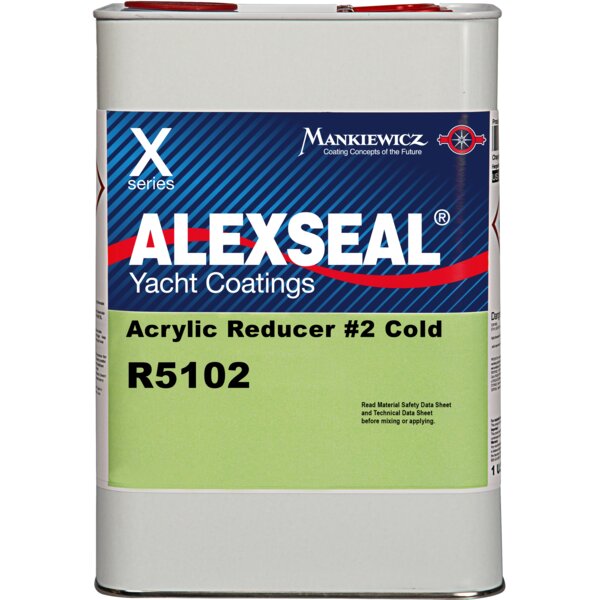
ACRYLIC TOPCOAT REDUCER COLD #2 by Alexseal is a halogen-free blend of organic solvents specifically formulated for industrial serial painting. It is designed as ALEXSEAL Acrylic Reducer #2 Cold (R5102), to be used in combination with ALEXSEAL Acrylic Topcoat X as part of a controlled, professional coating system. The reducer optimizes spray viscosity and flow, particularly under cooler application conditions, helping the topcoat achieve its specified film build, leveling and appearance.
When handled with the recommended safety and application measures, this reducer supports reliable processing of ALEXSEAL Acrylic Topcoat X in professional shipyards, workshops and industrial paint facilities.
Main features
- Purpose-built reducer for ALEXSEAL Acrylic Topcoat X – listed as Acrylic Reducer #2 Cold (R5102) in the Topcoat X system, for controlled thinning and atomization.
- For industrial serial painting – developed for professional use in production environments.
- Halogen-free solvent mixture – mixture of organic solvents, halogen-free.
- Supports correct spray viscosity – intended to bring mixed topcoat to the target viscosity ranges given for Topcoat X (e.g. Zahn #2, DIN 4, ISO 3 mm), aiding atomization and surface leveling.
- Compatible with multiple spray set-ups – used with the nozzle sizes and application parameters specified for Acrylic Topcoat X (conventional, HVLP, pressure pot and Airmix equipment).
- Professional-use product – classified as flammable and requiring suitable industrial safety measures according to Regulation (EC) No. 1907/2006 and CLP Regulation (EC) No 1272/2008.
Technical specifications
Chemical and physical properties
- Chemical type: Mixture of organic solvents, halogen-free.
- Main identified uses: Industrial serial painting; reducer for ALEXSEAL Acrylic Topcoat X.
- Appearance (20 °C): Liquid.
- Colour: According to product name.
- Odour: Characteristic.
- Boiling range: Approximately 120 °C.
- Flash point: 50 °C (ISO 13736).
- Explosion limits: Lower 1.0 % (v/v); upper 10.0 % (v/v).
- Auto-ignition temperature: > 400 °C.
- Water solubility: Insoluble; immiscible with water.
- Vapour pressure: Approximately 100 hPa at 50 °C.
- Density: Approximately 0.94 g/cm³ at 20 °C.
- Kinematic viscosity: > 6 mm²/s (DIN 53211, 4 mm); flow time < 12 s (4 mm), < 15 s (ISO 2431, 6 mm).
- Solvent separation: < 3 % (v/v).
- VOC content: 99.6 %, 940 g/l (Directive 2010/75/EU).
Composition (selected components)
- 2-methoxy-1-methylethyl acetate (CAS 108-65-6)
- Classification: Flam. Liq. 3; H226. STOT SE 3; H336 (central nervous system).
- Content: ≥ 40 – ≤ 100 % w/w.
- Aromatic hydrocarbons, C9; alkylbenzenes; C9-aromatics (CAS 128601-23-0)
- Classification: Flam. Liq. 3; H226. STOT SE 3; H336 (CNS), H335 (respiratory system). Asp. Tox. 1; H304. Aquatic Chronic 2; H411. EUH066.
- Content: ≥ 20 – < 25 % w/w.
- 2-butoxyethyl acetate (CAS 112-07-2)
- Classification: Acute Tox. 4; H302, H312, H332.
- Content: ≥ 1 – < 5 % w/w.
Classification and labelling (CLP Regulation (EC) No 1272/2008)
- Flammable liquids: Category 3 – H226: Flammable liquid and vapour.
- Specific target organ toxicity – single exposure: Category 3 (central nervous system) – H336: May cause drowsiness or dizziness.
- Specific target organ toxicity – single exposure: Category 3 (respiratory system) – H335: May cause respiratory irritation.
- Aspiration hazard: Category 1 – H304: May be fatal if swallowed and enters airways.
- Long-term aquatic hazard: Category 3 – H412: Harmful to aquatic life with long lasting effects.
- Supplemental hazard statement: EUH066: Repeated exposure may cause skin dryness or cracking.
Recommended storage conditions
- Storage temperature: 5 – 35 °C.
- Keep containers tightly closed, upright and in a cool, dry, well-ventilated place.
- Avoid heating and direct sunlight.
- Use only containers made of the same material as the original packaging.
- Keep away from oxidizing agents, strong acids and strong bases.
Applications and use cases
- Reducer for ALEXSEAL Acrylic Topcoat X – used as Acrylic Reducer #2 Cold (R5102) in the mixing ratio of the Topcoat X system (40–60 % by volume reducer on the mixed base and converter, depending on application conditions).
- Industrial serial painting – suitable for production environments where consistent spray behavior of ALEXSEAL Acrylic Topcoat X is required.
- Professional spray applications – supports the specified spray viscosities for conventional air spray, HVLP, pressure pot and Airmix equipment when applying Acrylic Topcoat X in multiple coats.
The exact reducer amount within the given range should be adjusted according to temperature, humidity, and spray equipment, within the limits provided by the Topcoat X technical data sheet.
FAQ
How is ACRYLIC TOPCOAT REDUCER COLD #2 used in the system?
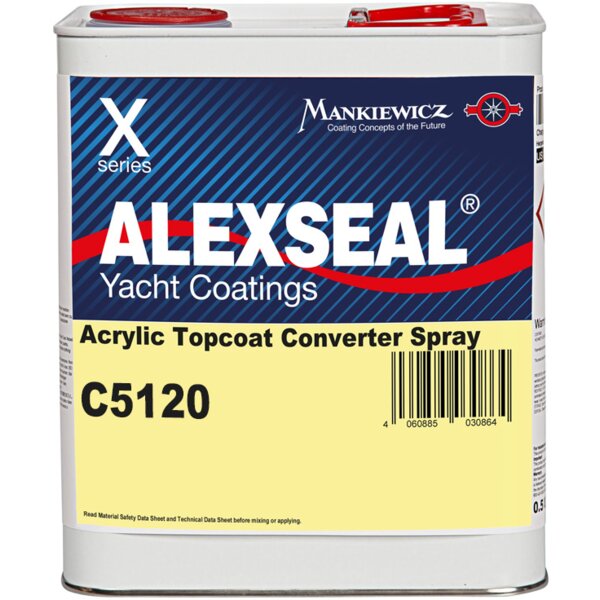
It is added to ALEXSEAL Acrylic Topcoat X (base color) and the designated converter. The recommended mix for spray application is 2 parts base, 1 part converter and 40–60 % by volume of Acrylic Reducer (including #2 Cold), with the exact percentage adjusted to meet the specified spray viscosity.
Can this reducer be used with coatings other than ALEXSEAL Acrylic Topcoat X?
The identified use is as an acrylic reducer in industrial serial painting and as Acrylic Reducer #2 Cold for ALEXSEAL Acrylic Topcoat X. For other systems, Consultar ficha técnica del fabricante.
Is ACRYLIC TOPCOAT REDUCER COLD #2 water-miscible?
No. The product is insoluble and immiscible in water and should be kept away from drains and watercourses.
What are the main hazards of this reducer?
It is a flammable liquid and vapour, may be fatal if swallowed and enters airways, may cause respiratory irritation and drowsiness or dizziness, and is harmful to aquatic life with long lasting effects. Repeated exposure may cause skin dryness or cracking.
Which personal protective equipment is recommended during use?
In professional settings, use suitable respiratory protection when vapour concentrations exceed occupational exposure limits, chemical resistant gloves (e.g. nitrile or neoprene), safety goggles and appropriate protective clothing, as detailed in Section 8 of the safety data sheet.
How should spills be handled?
Eliminate ignition sources, ventilate the area, avoid inhaling vapours, contain with non-combustible absorbent material such as sand or earth, and collect for disposal in accordance with local regulations. Do not allow the product to enter drains or watercourses.
How should the product be stored?
Store tightly closed in upright containers of the same material as the original, in a cool, dry, well-ventilated area at 5–35 °C, away from heat, direct sunlight, oxidizing agents, strong acids and bases, and sources of ignition.
Is the product classified as environmentally hazardous for transport?
Under ADR and IMDG it is not classified as environmentally hazardous and is not a marine pollutant, but it is still harmful to aquatic life with long lasting effects and must be kept out of watercourses.
Who is allowed to use this reducer?
The product and the associated topcoat system are intended for professional and industrial users familiar with solventborne coating systems and applicable safety regulations.
Section 14 – Transport information
- UN number: UN 1263.
- UN proper shipping name (all modes): PAINT RELATED MATERIAL.
ADR (Road)
- Class: 3 (Flammable liquids).
- Packing group: III.
- Classification code: F1.
- Hazard identification number: 30.
- Tunnel restriction code: (D/E).
- Labels: 3.
- Environmentally hazardous: No.
- On-site transport remark: If transported within the user’s premises, always move in closed, upright and safe containers and ensure personnel are aware of emergency procedures in case of incident or spillage.
IMDG (Sea)
- Class: 3.
- Packing group: III.
- Labels: 3.
- EmS code: F-E, S-E.
- Marine pollutant: No.
- Bulk transport under IMO instruments: Not applicable for product as supplied.
IATA (Air)
- Class: 3 (Flammable liquids).
- Packing group: III.
- Cargo aircraft packing instruction: 366.
- Passenger aircraft packing instruction: 355; limited quantities: Y344.
- Labels: Flammable Liquids.
The transport classifications above refer to the unpackaged material as described in the safety data sheet. Actual classifications may vary with packaging, mode of transport and local regulations.
Section 8 – Individual protection measures
Engineering controls
- Provide adequate ventilation through local exhaust and general extraction.
- Where ventilation cannot keep solvent vapours below occupational exposure limits, suitable respiratory protection must be used.
Personal protective equipment
- Eye and face protection: Safety goggles to protect against solvent splashes.
- Hand protection:
- Chemical-resistant gloves tested according to EN 374.
- Recommended materials for short-term contact (splash protection): nitrile rubber or neoprene.
- Minimum glove thickness: > 0.4 mm; breakthrough time: > 480 minutes (indicative).
- Always verify glove suitability for the specific workplace and follow the glove manufacturer’s instructions. Replace damaged or worn gloves immediately.
- Skin and body protection: Appropriate protective clothing, adapted if there is a risk of explosive atmospheres.
- Respiratory protection:
- When solvent concentrations exceed air limit values, use an approved breathing apparatus.
- Half-mask with suitable cartridge or air-fed systems are recommended; in spray booths where operators work inside, a compressed air-fed respirator should be used until solvent vapour and particulate levels are below exposure limits.
General protective and hygiene measures
- Do not eat, drink or smoke while using this product.
- Avoid contact with skin, eyes and clothing.
- Avoid inhaling vapours, spray mist, sanding dust and particulates arising from use with coating systems.
- Wash contaminated skin immediately and apply preventive skin protection where appropriate.
*Contenido generado por IA