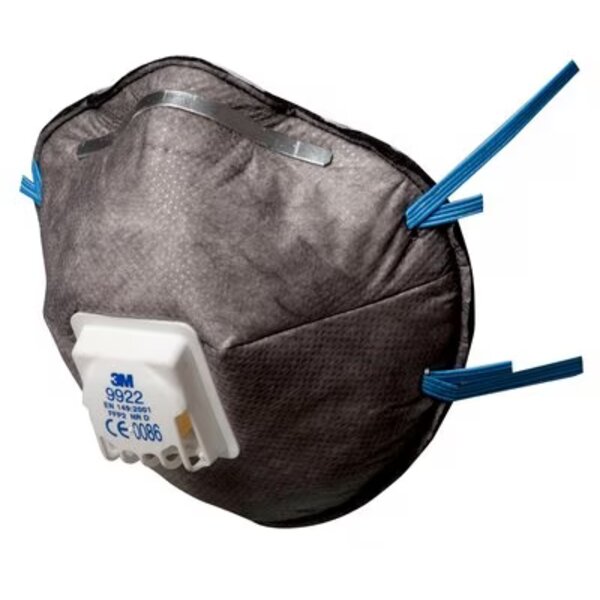
The 3M SPECIAL PARTICULATE RESPIRATOR FFP2 9922 is a cup-shaped FFP2 disposable respirator with exhalation valve designed to protect against fine dusts and mists, with additional relief from unpleasant odours and low levels of organic vapours thanks to its activated carbon layer (information based on 3M public data, not independently verified). Its convex design, adjustable nose clip and dual straps help improve fit and comfort for extended wear; please check the official 3M technical datasheet for detailed and confirmed specifications.
*Contenido generado por IA
| Protección: | FFP2 |
| Protección: | FFP2 |
The 3M SPECIAL PARTICULATE RESPIRATOR FFP2, 9922 is a disposable, cup-shaped filtering facepiece respirator designed to provide reliable FFP2-level protection against fine dusts, mists and nuisance levels of organic vapours and unpleasant odours. It features a robust shell, integrated exhalation valve and an activated carbon layer for additional comfort in environments with low concentrations of organic vapours and ozone. The information below is based on publicly available data from 3M and is provided as a general guide; specific performance values and regulatory details should always be confirmed in the official 3M technical datasheet, as some data here may not be fully verified.
The following technical aspects are taken from general information available for the 3M 9922 model and should be confirmed in the official manufacturer documentation for exact values and limits.
The 3M 9922 respirator is designed for occupational and professional environments where FFP2 particle protection is required, together with relief from nuisance organic vapours and odours. The list below is indicative and based on generic information about the model; suitability for a specific process or contaminant must be assessed by a qualified safety professional using the official technical data.
These examples are not exhaustive or validated for every situation. For each application, the user must confirm compatibility with the contaminants present, their concentration, exposure time and local legislation, consulting the official 3M technical sheet and internal risk assessments.
It is designed as an FFP2 respirator, which typically means at least 94 % filtration efficiency for standardised test aerosols under EN 149:2001+A1:2009. Exact tested performance and assigned protection factors should be checked in the official 3M documentation for your country.
The 9922 includes an activated carbon layer that provides relief from nuisance levels of certain organic vapours and odours and, according to 3M literature, low concentrations of some gases such as ozone within specified limits. It is not a full gas or vapour respirator and must not be used where concentrations exceed the limits indicated in the official datasheet or applicable regulations.
The 3M 9922 is a disposable filtering facepiece typically marked as non-reusable (NR). It is generally intended for single-shift use, or until it becomes damaged, soiled, difficult to breathe through or as otherwise limited by workplace procedures. Always follow the use and replacement instructions specified by 3M and your safety manager.
The exhalation valve does not reduce the particle filtration performance for inhaled air. Its function is to reduce heat and moisture build-up inside the mask by allowing exhaled air to exit more easily, improving comfort during work. The suitability of a valved respirator for specific environments (for example, sterile rooms) must be evaluated according to local protocols.
FFP2 respirators like the 3M 9922 can provide particle filtration that may be used in some infection control strategies, but specific suitability against biological agents (such as bacteria or viruses) depends on local guidelines, fit, correct use and risk assessment. For such uses, it is essential to consult current health and safety recommendations and the official technical sheet.
A correct fit requires following the donning instructions, adjusting the nose clip and headbands and performing a user seal check every time the respirator is worn. In occupational settings, a formal fit test according to local regulations is usually required to confirm that the mask provides the expected level of protection on the user’s face.
The cup-shaped design, nose clip and positioning of the straps are intended to be compatible with many 3M safety spectacles and hearing protectors. However, the full combination should be tested in practice to ensure that other PPE items do not compromise the seal or stability of the respirator.
As a general rule for disposable respirators, they should be stored in their original packaging, in a clean, dry place, protected from direct sunlight, extreme temperatures and chemicals. Exact storage temperature and humidity ranges for the 3M 9922 must be taken from the official 3M technical documentation.
The respirator must not be used beyond its marked expiry date and should be discarded earlier if it becomes damaged, deformed, visibly soiled or if breathing resistance increases noticeably. For detailed limits, always refer to the information on the packaging and the official technical sheet.
All critical performance data, approvals, limitations of use and detailed instructions are contained in the official 3M technical datasheet and user instructions supplied with the product. These documents should always be consulted to confirm any information before making decisions on safety at work.
This product is a disposable filtering facepiece respirator and, in normal commercial practice, it is generally not classified as dangerous goods for transport by road, sea or air. However, this information is based on generic knowledge of respiratory PPE and has not been specifically verified for the 3M 9922 model in official transport classifications. For precise and legally valid information, the user should review the safety or regulatory documentation provided by 3M and apply the applicable transport regulations in their country.
The 3M 9922 forms part of a personal protective equipment (PPE) system designed to reduce inhalation exposure to certain airborne particles and nuisance levels of organic vapours. For correct protection, the following general principles apply; these are generic recommendations and must be complemented with the official instructions and workplace risk assessments:
These measures should be integrated into a broader occupational risk prevention programme, with training, fit testing (where required) and regular review by competent safety professionals, always using the official manufacturer’s documentation as the primary reference.
*Contenido generado por IA
| Ref. | Amount* |
|---|---|
| 9922 | 7,40 € |

Color: Gray
1 X $113.88