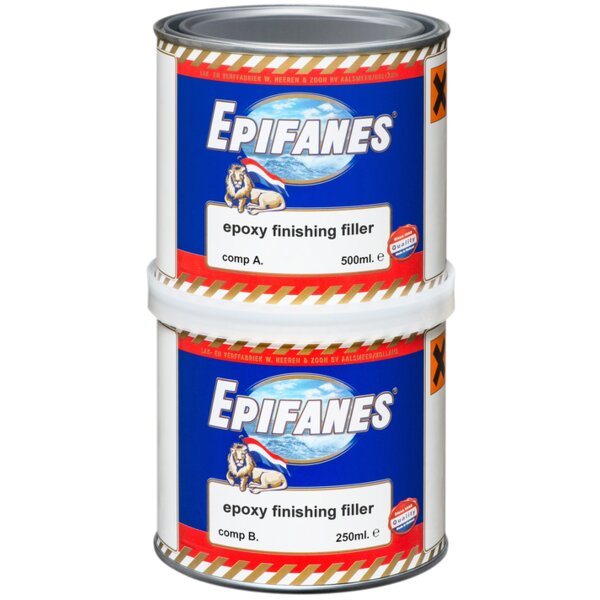
EPOXY FINISHING FILLER

Regular price 55,70€

*VAT not included

Epifanes Epoxy Finishing Filler is a chemical-drying, two-component epoxy finishing filler based on solvent- and phenol-free epoxy resin. Designed for fine surface finishing on fiberglass/GRP, steel, wood and aluminum over Epifanes Epoxy Filler 1500 in two-component paint systems above and, if needed, below the waterline, it provides a very fine, shrink-free filler layer for an extra smooth surface.

*Contenido generado por IA

    Presentation: Container
    Capacity: 750 g
    Colour:

Features

    Presentation: Container
    Capacity: 750 g
    Colour:

description

What is Epifanes Epoxy Finishing Filler and why choose it?

Epifanes Epoxy Finishing Filler is a strong, two-component, chemical-drying epoxy finishing filler based on a solvent- and phenol-free epoxy resin. It is designed as an ultra-fine, shrink-free finishing putty that creates a very smooth surface when applied in thin layers. Suitable for use above and, if required, below the waterline, it is ideal for high-quality repairs and fairing work on wood, steel, aluminum and fiberglass/GRP in two-component paint systems.

Thanks to its excellent mechanical properties, resistance to permanent water exposure and ease of sanding, this finishing filler is particularly suited for marine and demanding industrial environments where durability and surface quality are critical.

Main features

  • Two-component epoxy system: base (Component A) and curing agent (Component B) mixed just before use.
  • Shrink-free curing: formulated to be shrink-free during drying and through-hardening for dimensionally stable repairs.
  • Very fine finishing filler: provides a superbly smooth surface, ideal as a fine finishing layer over Epifanes Epoxy Filler 1500.
  • Permanent water resistance: suitable for structures exposed to continuous water contact.
  • High mechanical strength: impact- and shock-resistant surface after curing.
  • Wide substrate compatibility: can be used on wood, steel, aluminum and fiberglass/GRP when applied over suitable Epifanes epoxy primers.
  • Above and below waterline use: compatible with two-component systems in both areas of a hull or structure.
  • Good sandability window: best sanding properties between approximately 24 and 48 hours after application at about 68°F / 20°C.
  • VOC-free base component: Component A has 0% VOC content.

Technical specifications

  • Product type: Shrink-free, fine epoxy finishing filler; chemical drying.
  • Base: Solvent- and phenol-free epoxy resin.
  • Colour (mixed product): Light grey.
  • Density mixed product: 1.70 kg/dm³.
  • Packing size: 750 ml (500 ml base + 250 ml hardener).
  • Shelf life (unmixed): Consultar ficha técnica del fabricante.
  • Mixing ratio (base : curing agent):
    • By volume: 100 : 50
    • By weight: 100 : 50
  • Mixing instructions: Mix each component separately, then combine and mix thoroughly until the colour is completely uniform. No induction time required.
  • Pot life after mixing (dependent on mixture volume):
    • 40 minutes at 59°F / 15°C
    • 20 minutes at 68°F / 20°C
    • 10 minutes at 82°F / 28°C
  • Recommended application tools: Filling knife, trowel or spatula.
  • Application temperature (environment and substrate):
    • Minimum: approximately 12°C / 54°F
    • Maximum: approximately 28°C / 82°F
    • Substrate temperature: at least 3°F (or approximately 3°C) above dew point.
  • Relative humidity during application: 50–75% (English sheet), 50–80% (Dutch sheet).
  • Maximum wet film / layer thickness: 1 mm per application.
  • Theoretical coverage: 750 ml for approx. 4 m² at 0.1 mm film thickness.
  • Drying times at approx. 68°F / 20°C and 65% RH:
    • Sandable: 24 hours
    • Recoatable: 24 hours
    • Through hardened: 48 hours
  • Recommended sanding grades:
    • Between layers: P80–P100 dry.
    • Final finishing of filler: P100–P120 dry.
    • Primed substrate before filling: P120–P150 dry.
  • Thinner: Do not thin.
  • VOC content:
    • Component A: 0 g/l (0.00 lb/gal).
    • Component B: approx. 247.2 g/l (2.06 lb/gal), 6.25% VOC; organic solvents 6.3%.

Surface preparation and compatible primers

  • General substrate condition: All surfaces must be dry, clean, free from wax, grease, oil, chemicals and other contaminants.
  • Application over primers: Preferably apply between epoxy primer coats as a “sandwich” layer within the coating system.
  • Do not apply directly on: bare steel or bare aluminum.
  • Fiberglass/GRP:
    • Mouldings at least 14 days old and free from chemicals.
    • Degrease with Epifanes Fiberglass Prep Cleaner / Polyester Degreaser.
    • Remove any wax/paraffin layer with steel wool or Scotch-Brite.
    • Sand with P220–P280.
  • Steel:
    • Free of rust, well degreased.
    • Coarsely sanded with P60–P80.
  • Wood:
    • Well degreased.
    • Coarsely sanded with P60–P80.
  • Aluminum:
    • Well degreased (e.g. with Spraythinner PV according to sheet).
    • Sanded with approximately P220–P240 (English sheet) or coarsely sanded with P60–P80 (Dutch sheet).
  • Suitable epoxy primers (general): Epifanes Epoxy Primer, Epifanes Epoxy HB Coat, Epifanes Interimcoat, Epifanes Poly-urethane Primer, Epifanes Multi Marine Primer, Epifanes Antifouling Primer CR (below waterline), depending on whether the area is above or below the waterline and whether a one- or two-component system is used.

Applications and use cases

Marine and boatbuilding

  • Fine fairing of hulls and superstructures in epoxy systems above and below the waterline.
  • Smoothing minor imperfections, pinholes and surface irregularities in fiberglass/GRP laminate, steel or aluminum hulls after structural filling with Epifanes Epoxy Filler 1500.
  • Finishing wooden decks, cabin sides and transoms within two-component primer and topcoat systems.

Maintenance and repair

  • Local repairs on previously epoxy-primed steel or aluminum where a smooth, paint-ready surface is required.
  • Superfine finishing of repair areas prior to application of two-component polyurethane or epoxy topcoats, or, for smaller spots, suitable one-component primers and topcoats.

Coating system integration

  • Above the waterline:
    • One-component systems: overcoat with Epifanes Multi Marine Primer where specified.
    • Two-component systems: integrate between coats of Epifanes Epoxy Primer, Epifanes Epoxy HB Coat, Epifanes Interimcoat and/or Epifanes Poly-urethane Primer, followed by appropriate two-component or (if desired) one-component finish.
  • Below the waterline:
    • Use in combination with Epifanes Epoxy Primer, Epifanes Epoxy HB Coat, Epifanes Interimcoat and, where required, Epifanes Antifouling Primer CR within a complete underwater coating system.

Application and sanding guidance

  • Apply only in thin layers up to a maximum of 1 mm.
  • Do not apply wet-on-wet; allow each layer to cure and be sanded before applying the next one.
  • Before sanding, always clean the cured filler with a suitable degreaser or water with ammonia; this prevents clogging of the abrasive paper and improves sanding.
  • In multi-layer applications, sand each intermediate layer with P80–P100 and the final layer with P100–P120.
  • At temperatures below approximately 68°F / 20°C combined with high relative humidity, amine blush (a sticky surface film) can form; remove thoroughly using water with ammonia, water with vinegar, acetone, Epifanes Fiberglass Prep Cleaner, Epifanes Cleaning Thinner or appropriate degreaser before sanding or recoating.

FAQ

  1. On which substrates can Epifanes Epoxy Finishing Filler be used?

    It can be used on wood, steel, aluminum and fiberglass/GRP, provided these substrates are properly degreased, sanded and primed with suitable Epifanes epoxy primers. It should not be applied directly to bare steel or bare aluminum.

  2. Can it be used below the waterline?

    Yes. When incorporated in appropriate two-component epoxy primer systems, it is suitable both above and, if needed, below the waterline and is resistant to permanent water exposure.

  3. What is the correct mixing ratio of the two components?

    The mixing ratio is 100 parts Component A to 50 parts Component B by volume, or 100 : 50 by weight. Mix each part separately first, then together until a uniform light grey colour is obtained.

  4. How long can I work with the mixed filler (pot life)?

    Pot life depends on temperature and the volume mixed: about 40 minutes at 59°F (15°C), 20 minutes at 68°F (20°C) and 10 minutes at 82°F (28°C).

  5. When can I sand and overcoat the filler?

    At approximately 68°F / 20°C and 65% RH, the product is normally sandable after about 24 hours, recoatable after about 24 hours, and through hardened after about 48 hours. Best sanding properties are between 24 and 48 hours.

  6. Do I need to thin the product?

    No. The product should not be thinned.

  7. Can I overcoat it with one-component paints?

    For smaller repairs, overcoating with suitable one-component primers and topcoats is possible. Larger repair areas should always be finished with two-component primers and topcoats, optionally followed by a one-component finish if desired.

  8. What happens if amine blush appears on the surface?

    At lower temperatures combined with high humidity, a sticky amine blush may form. This layer must always be removed before sanding or recoating, using water with ammonia or vinegar, acetone, Epifanes Fiberglass Prep Cleaner, Epifanes Cleaning Thinner or a suitable degreaser.

  9. What is the maximum recommended film thickness per coat?

    The maximum recommended wet film thickness is 1 mm per coat. Thicker layers should be built up by multiple applications with sanding between coats.

  10. How should leftover material and empty packaging be disposed of?

    Do not dispose of product residues with household waste or into the sewage system. Disposal of product and uncleaned packaging must be carried out according to official local, regional and national regulations.

Section 14 – Transport information

Component A (Epifanes Epoxy Finishing Filler comp. A)

  • UN number: UN3082
  • Proper shipping name (general): Environmentally hazardous substance, liquid, n.o.s. (reaction product: bisphenol-A-(epichlorhydrin) epoxy resin (number average molecular weight = 700), formaldehyde, oligomeric reaction products with 1-chloro-2,3-epoxypropane and phenol).
  • Transport classification:
    • DOT / ADR / IMDG / IATA: Class 9, Miscellaneous dangerous substances and articles.
    • Packing group: III.
  • Environmental hazards: Product contains environmentally hazardous substances (reaction product: bisphenol-A-(epichlorhydrin) epoxy resin). Marine pollutant: yes (symbol fish and tree).
  • Special markings: Fish and tree symbol for ADR, IMDG and IATA where applicable.
  • Quantity limitations (DOT): On passenger aircraft/rail: no limit; on cargo aircraft only: no limit.
  • Excepted quantities (ADR / IMDG / IATA): Code E1; maximum 30 ml per inner packaging, 1000 ml per outer packaging.

Component B (Epifanes Epoxy Finishing Filler Component B)

  • UN number: UN1760
  • Proper shipping name (general): Corrosive liquid, n.o.s. (Isophoronediamine, m-phenylenebis(methylamine)).
  • Transport classification:
    • DOT / ADR / IMDG / IATA: Class 8, Corrosive substances.
    • Packing group: II.
  • Environmental hazards: Contains environmentally hazardous substances (phenol, styrenated). For ADR, classified as environmentally hazardous; for DOT, marine pollutant yes; general marine pollutant indication with fish and tree symbol where required.
  • Quantity limitations (DOT): On passenger aircraft/rail: 1 L; on cargo aircraft only: 30 L.
  • Excepted quantities (ADR / IMDG / IATA): Code E2; maximum 30 ml per inner packaging, 500 ml per outer packaging.
  • Limited quantities (IMDG): 1 L.

Section 8 – Individual protection measures

General protective and hygienic measures

  • Keep away from food, beverages and animal feed.
  • Do not eat, drink or smoke while using the product.
  • Immediately remove any soiled or contaminated clothing.
  • Wash hands thoroughly before breaks and after finishing work.
  • Avoid contact with eyes and skin.
  • Ensure good ventilation or local exhaust at the workplace.

Respiratory protection

  • Use a suitable respiratory protective device whenever ventilation is insufficient or aerosols and vapours may be formed.

Hand protection

  • Wear protective gloves that are impermeable and resistant to the product and its components.
  • The choice of glove material must take into account penetration time, diffusion rates and degradation; due to lack of specific test data, the glove type must be selected and confirmed with the glove manufacturer.
  • Observe the exact breakthrough time as indicated by the glove manufacturer and replace gloves accordingly.

Eye and face protection

  • Wear tightly sealed safety goggles to prevent splashes from entering the eyes.

Skin and body protection

  • Wear suitable protective clothing resistant to chemicals and liquid splashes.

Additional hazard information

  • Component A is classified as causing skin irritation, serious eye irritation and possible allergic skin reactions.
  • Component B is classified as harmful if swallowed, causing severe skin burns and serious eye damage, and may cause allergic skin reactions.

Contenido generado por IA

TECHNICAL SHEET

TECHNICAL SHEET

link

SAFETY DATA SHEETS

SAFETY DATA SHEETS

link
Ref. Amount*
EFF.750 55,70 €
Page up

Product Quick View Popup

Vendor: Optimal

Product Type: Tops

SKU: 50-ABC

In stock Pre-order Now Sold out Order now, Only 10 left!
$400.00$300.00
Optimal Multipurpose Bootstrap 5 Html Template that will give you and your customers a smooth shopping experience which can be used for various kinds of stores such as fashion..
  • Black
  • Green
  • Orange
  • Blue
  • Red
  • XS
  • S
  • M
  • L
  • XL

Added to your shopping cart successfully.

Added to your shopping cart successfully.
Ditsy Floral Dress

Color: Gray

1 X $113.88

Total: $113.88