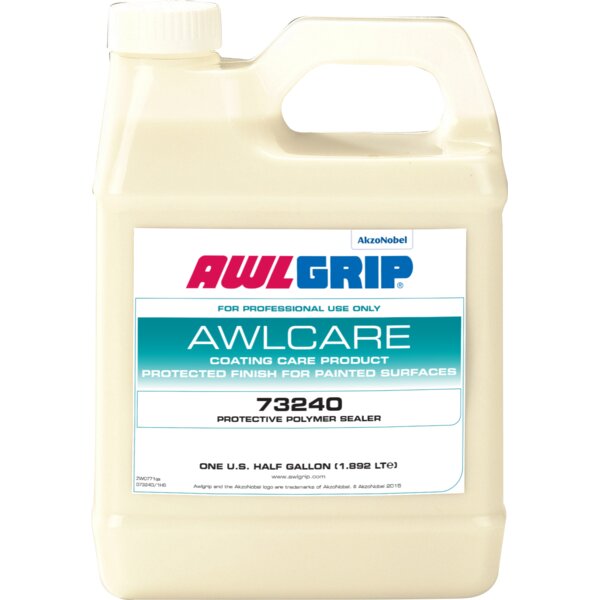
What is Awlcare Protective Polymer Sealer and why choose it?
Awlcare Protective Polymer Sealer is a hand-applied, non-abrasive synthetic polymer developed by Awlgrip to maintain and protect AWLGRIP®, AWLCRAFT® 2000, Awlcraft SE and Awlgrip HDT topcoats. It contains no harsh abrasives and will not scratch the painted surface. Once applied, it leaves a non-yellowing protective polymer coating that withstands multiple washings, helps remove light staining such as water spots and diesel soot, and, with regular application, improves resistance against acid rain and other environmental pollutants.
Main features
- Non-abrasive, hand-applied formula – will not scratch properly cured Awlgrip topcoats and is applied using a 100% cotton cloth.
- Durable, non-yellowing protection – creates a synthetic polymer film that remains clear and protective through repeated wash cycles.
- Light cleaning action – assists in removing mild surface stains including water spots and diesel soot.
- Enhanced environmental resistance – regular use increases resistance to acid rain and other atmospheric contaminants.
- Easy manual application – can be applied in sun or shade and over large areas before buffing off by hand.
- Optimized for Awlgrip systems – specifically formulated for AWLGRIP®, AWLCRAFT® 2000, Awlcraft SE and Awlgrip HDT topcoats.
- Two-coat initial system – two coats are recommended on first application for optimal protection.
Technical specifications
- Product type: Hand-applied synthetic polymer protective sealer
- Recommended substrates: Awlgrip, Awlcraft 2000, Awlcraft SE and Awlgrip HDT topcoats
- Application method: Cloth (100% cotton applicator or cloth by hand; no mechanical devices)
- Available pack sizes: 1 US Pint; 1/2 US Gallon
- Base: 73240
- Typical shelf life: 2 years
- Theoretical coverage: One pint (0.473 L) covers approximately 450 sq ft (42 m²) in a single coat
- Recommended number of coats: Two coats for the initial application; additional coats as needed in heavy water run-off areas
- VOC (product as supplied): 230 g/L (1.92 lb/gal)
- Color (wet product): White
- Physical state: Liquid
- Odor: Solvent
- Flash point: 42 °C (107.6 °F), closed cup (Pensky-Martens)
- Viscosity: 129 mm²/s at room temperature; 141 mm²/s at 40 °C (DIN EN ISO 3219)
- Density: 1.097 g/cm³ (DIN EN ISO 2811-1)
- pH: Not applicable (DIN EN 1262)
Surface preparation and application
Surface preparation
- Wash the surface with AWLWASH Wash Down Concentrate (73234) for NA & AP regions, or Awlwash 2.0 (73235) in the EU.
- Rinse thoroughly and wipe dry before applying Awlcare.
- Test the procedure on a non-critical area before proceeding on the full surface.
Mixing
- Shake Awlcare well before use.
- Mixing and reduction requirements may vary with conditions; if in doubt, apply a small test area first.
Application method
- Shake the container well.
- Apply Awlcare using a 100% cotton applicator or cloth.
- Application may be carried out in sun or shade.
- It can be applied to large areas before removal.
- Do not apply Awlcare with mechanical devices.
- Allow the product to haze, then wipe off with a clean 100% cotton cloth.
- Use AWLWASH Wash Down Concentrate (73234) NA & AP, or Awlwash 2.0 (73235) EU for routine washing to minimize removal of the Awlcare polymer film.
- Multiple coats may be needed on surfaces subject to constant water run-off.
Recommended maintenance
- Awlgrip recommends washing the surface once a week with AWLWASH (73234) or Awlwash 2.0 (73235) to prevent dirt build-up.
- Rinse and wipe dry after each wash.
Temperature conditions
- Optimal surface/ambient range: 18 °C (60 °F) to 35 °C (95 °F)
- Ambient temperature limits: Minimum 10 °C (50 °F), maximum 41 °C (105 °F)
- Do not apply to surfaces less than 3 °C (5 °F) above dew point.
- Do not apply to surfaces hotter than 41 °C (105 °F).
Applications and use cases
- Yacht and boat hulls and superstructures finished with Awlgrip, Awlcraft 2000, Awlcraft SE or Awlgrip HDT topcoats.
- Areas exposed to atmospheric fallout such as acid rain, industrial pollution, salt spray and diesel exhaust.
- Surfaces with light staining (water spots, soot) where gentle, non-abrasive cleaning and added protection are desired.
- High run-off zones such as sheer lines, scuppers and decks where extra coats may be used to maintain a protective film.
FAQ
-
What surfaces is Awlcare Protective Polymer Sealer designed for?
It is formulated specifically to protect AWLGRIP®, AWLCRAFT® 2000, Awlcraft SE and Awlgrip HDT topcoats.
-
Does Awlcare contain abrasives or scratch the paint?
No. Awlcare is a non-abrasive, hand-applied polymer that contains no harsh abrasives and will not scratch the painted surface when used as directed.
-
How many coats should I apply initially?
For the initial application, two coats are recommended. Additional coats can be applied in heavy water run-off areas if needed.
-
How much area does one pint cover?
One pint (0.473 L) of Awlcare will theoretically cover about 450 square feet (42 m²) with one coat.
-
Can Awlcare be applied in direct sunlight?
Yes. Awlcare may be applied in sun or shade and over large areas before wiping off.
-
How should I clean surfaces between Awlcare applications?
Wash the surface once a week with AWLWASH Wash Down Concentrate (73234) in NA & AP regions or Awlwash 2.0 (73235) in the EU, then rinse and wipe dry.
-
Can I use a machine polisher or buffer to apply Awlcare?
No. Awlcare must not be applied with mechanical devices; it is designed for hand application with 100% cotton cloths.
-
How should the product be stored?
Keep the container tightly closed and upright in a cool, well-ventilated area, away from heat, ignition sources and oxidizing materials, and protected from freezing.
Section 14 – Transport information
- UN number / ID number: UN1263
- UN proper shipping name: PAINT
- Transport hazard class: Class 3 (flammable liquid)
- Packing group: III
- Environmental hazards: Not classified as environmentally hazardous for transport.
- ADR/RID tunnel code: D/E
- IMDG emergency schedules: F-E, S-E
- Transport in bulk according to IMO instruments: Not applicable.
- On-site transport: Always move in closed, upright, secure containers and ensure personnel know procedures in case of accident or spillage.
Section 8 – Individual protection measures
The following information is summarized from the Safety Data Sheet for Awlcare Protective Polymer (SDS code O73240) and applies particularly to industrial and professional use.
Engineering controls
- Use only with adequate ventilation.
- Employ process enclosures and/or local exhaust ventilation to keep airborne concentrations below occupational exposure limits.
- Use explosion-proof ventilation and equipment to keep vapor levels below lower explosion limits.
Hygiene measures
- Wash hands, forearms and face thoroughly after handling and before eating, drinking or smoking.
- Remove contaminated clothing and protective equipment before entering eating areas.
- Ensure eyewash stations and safety showers are close to the work area.
Eye and face protection
- Use safety eyewear complying with an approved standard when there is a risk of exposure to liquid splashes, mists, gases or dusts.
- As a minimum, wear safety glasses with side shields where contact is possible.
Hand protection
- Wear chemical-resistant, impervious gloves compliant with relevant standards.
- For prolonged or frequently repeated contact, use gloves with protection class 6 (breakthrough time > 480 minutes, EN374); recommended materials: Viton® or nitrile, thickness ≥ 0.38 mm.
- For brief contact, use gloves with protection class 2 or higher (breakthrough time > 30 minutes, EN374); recommended material: nitrile, thickness ≥ 0.12 mm.
- Replace gloves regularly and immediately if damaged.
Skin and body protection
- Select protective clothing based on the specific task and risks, and have it approved by a safety specialist.
- When ignition risk from static electricity exists, wear anti-static protective clothing including overalls, boots and gloves (see EN 1149).
- Use appropriate footwear and any additional protective garments as required by the risk assessment.
Respiratory protection
- Where ventilation is insufficient or exposure limits may be exceeded, use a suitable respirator that meets the appropriate standard or certification.
- Respiratory protective equipment must be used within a formal respiratory protection program that includes fit testing and user training.
Environmental exposure control
- Check emissions from ventilation and process equipment to ensure compliance with environmental regulations.
- Where necessary, use fume scrubbers, filters or engineering modifications to reduce emissions.
*Contenido generado por IA