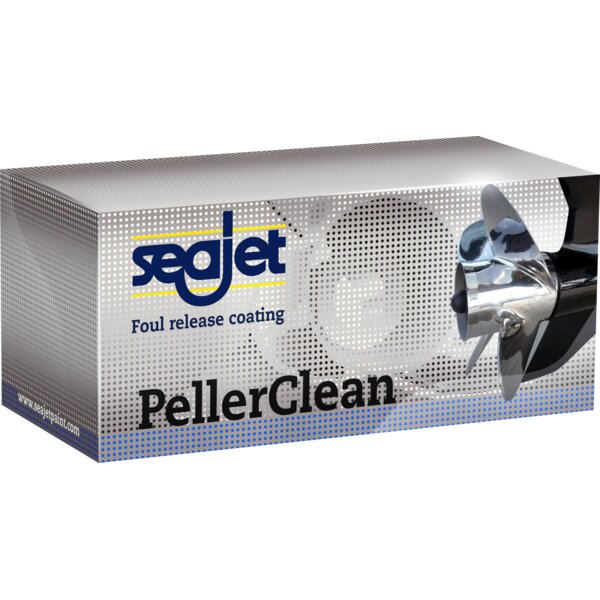
What is SEAJET PELLERCLEAN and why choose it?
SEAJET PELLERCLEAN CLEAR COAT is a one-pack, silicone-based foul-release coating designed for underwater use on propellers, stern gear, trim tabs, outdrives, light bulbs and other suitably primed underwater components. Instead of working like a traditional antifouling, it creates a very smooth, low-friction film that limits adhesion of fouling. Any growth that does form is loosely attached and is easily removed by water movement or simple washing with a hose and sponge. The coating offers long-term protection in both fresh and salt water and is ideal for users looking for a clear, durable and low-maintenance solution for complex underwater hardware.
Main features
- Foul-release technology: Silicone-based clear coat that minimises the adhesion of marine fouling rather than releasing biocides.
- Long-term underwater protection: Suitable for both fresh and salt water environments.
- Clear finish: Colourless coating that preserves the appearance of metallic substrates and primed surfaces.
- Designed for underwater hardware: Recommended for propellers, stern gear, trim tabs, light bulbs, outdrives and other submerged structures.
- Easy cleaning: Fouling is usually removed by vessel movement or by light pressure washing or cleaning with hose and sponge.
- One-pack product: No mixing ratio required; stir thoroughly before use until uniform.
- High volume solids: Approximately 94 ±2% volume solids for efficient film build.
- Low VOC content: VOC (theoretical) 51 g/l.
- Compatible system: Applied over SEAJET PELLERCLEAN PRIMER and overcoated with SEAJET PELLERCLEAN CLEAR COAT only.
- Airless spray by professionals: Can be applied by brush or roller; airless spray application is for professional users only.
Key technical specifications
- Product type: One pack foul-release clear coat.
- Recommended use: Propellers, stern gear, trim tabs, light bulbs, outdrives and other suitably primed underwater components on GRP, wood, steel, aluminium and other compatible substrates.
- Colour: Clear.
- Flash point: 56°C (26°C is also referenced under other test conditions).
- Volume solids: 94 ±2%.
- VOC (theoretical): 51 g/l.
- Pack sizes: 115 ml, 750 ml.
- Substrates: For use over suitably primed GRP, wood, steel, aluminium, etc.
- Preceding coating: SEAJET PELLERCLEAN PRIMER.
- Subsequent coating: SEAJET PELLERCLEAN CLEAR COAT.
- Application methods: Brush, roller (airless spray only by professional users).
- Recommended film thickness per coat (roller values):
- Theoretical spreading rate: 20.0 m²/l per coat at 47 µm DFT.
- Ambient temperature during application: Minimum 5°C, maximum 35°C.
- Product temperature during application: Minimum 5°C, maximum 35°C.
- Substrate temperature during application: Minimum 7°C, maximum 35°C.
- Maximum relative humidity: 85% RH.
- Thinner: SEAJET THINNER A.
- Thinning (spray): 0 – 1% by volume (690FR data). Older data indicate 0 – 5% by volume depending on application method.
- Spray nozzle tip (airless): Graco 619, 719 (690FR) / Graco 617, 719 (605FR).
- Paint output pressure (airless): 17.7 – 20.6 MPa (690FR) / 12.0 – 15.0 MPa (605FR).
Drying and overcoating data (at DFT 45 µm)
- 5°C:
- Surface dry: 50 min
- Hard dry: 8 hours
- Minimum overcoating interval: 8 hours
- Maximum overcoating interval: None
- Dry to launch: 1 day
- 10°C:
- Surface dry: 40 min
- Hard dry: 6 hours
- Minimum overcoating interval: 6 hours
- Maximum overcoating interval: None
- Dry to launch: 1 day
- 20°C:
- Surface dry: 30 min
- Hard dry: 5 hours
- Minimum overcoating interval: 4 hours
- Maximum overcoating interval: None
- Dry to launch: 1 day
- 30°C:
- Surface dry: 20 min
- Hard dry: 4 hours
- Minimum overcoating interval: 30 min
- Maximum overcoating interval: None
- Dry to launch: 1 day
Drying times and overcoating intervals will increase with increasing film thickness. Before re-coating, always check that the existing paint film is through dry. Maximum time between application and launch is one month, provided the coated propeller is not exposed to direct sunlight.
Applications and use cases
Recommended areas of use
- Propellers and stern gear: Helps keep blades and underwater running gear cleaner for longer, reducing drag caused by fouling.
- Trim tabs and outdrives: Suitable for complex shapes and moving parts that are difficult to protect with conventional antifouling.
- Underwater fittings and light bulbs: Clear coat preserves appearance and eases maintenance on underwater lights and fittings.
- Offshore and marine underwater structures: Based on the wider technical data (605FR), it is suitable for all boat hulls, propellers, outdrives and other offshore underwater structures when used as part of the specified system.
Surface preparation and application guidance
- First-time application:
- Ensure the substrate is suitably primed (e.g. GRP, wood, steel, aluminium primed with SEAJET PELLERCLEAN PRIMER).
- Apply 2–3 coats of SEAJET PELLERCLEAN CLEAR COAT over SEAJET PELLERCLEAN PRIMER.
- Recoating existing SEAJET PELLERCLEAN CLEAR COAT:
- Wash and degrease the surface.
- Repair only damaged areas by carefully abrading with P-180 abrasive paper.
- Wipe the abraded area with SEAJET THINNER A.
- Touch up damaged areas with SEAJET PELLERCLEAN PRIMER.
- Apply two fresh coats of SEAJET PELLERCLEAN CLEAR COAT.
- Cleaning in service: For removing fouling growth, a light pressure wash or cleaning by hose pipe and sponge is recommended to avoid damaging the coating and to restore a like-new surface.
- Repainting: SEAJET PELLERCLEAN CLEAR COAT should only be repainted by itself.
- Masking and tools: Due to the presence of silicone compounds, mask adjacent areas carefully to avoid contamination, which can lead to coating failures. Brushes, rollers and spray lines should be dedicated to this product or discarded after use.
FAQ
-
Is SEAJET PELLERCLEAN CLEAR COAT an antifouling paint?
No. It is a silicone-based foul-release coating. It does not work by releasing biocides but by creating a film that limits the adhesion of fouling. Any attached fouling is loosely bound and can usually be removed by water movement or light cleaning.
-
On which substrates can I use this product?
It can be used on suitably primed GRP, wood, steel, aluminium and other compatible surfaces, always over SEAJET PELLERCLEAN PRIMER.
-
How many coats are required?
For first-time application, 2–3 coats over SEAJET PELLERCLEAN PRIMER are recommended. For recoating, repair and prime damaged areas as specified, then apply two fresh coats of SEAJET PELLERCLEAN CLEAR COAT.
-
Can I apply it by spray?
Yes, but airless spray application is only for professional users. Typical nozzle tips are Graco 619 or 719, with an output pressure of approximately 17.7–20.6 MPa. Brush and roller application are suitable for general use.
-
How long before I can launch the boat after application?
At 5–30°C, the coating is typically dry to launch after 1 day, provided recommended film thicknesses and conditions are followed.
-
How should I clean fouling from coated propellers or gear?
Use a light pressure wash or clean with a hose and sponge. This avoids damaging the silicone film and restores the smooth surface.
-
Can I overcoat SEAJET PELLERCLEAN CLEAR COAT with other paints?
No. The product should only be repainted by itself. Other coatings may not adhere correctly due to the silicone-rich surface.
-
How should I store the unopened and opened cans?
Store between 0°C and 40°C in a dry, well-ventilated place away from heat and direct sunlight. Keep containers tightly closed. Once opened, reseal carefully and keep upright to prevent leakage. Containers should be kept firmly closed and handled with care.
-
Is the product flammable?
Yes. It is classified as a flammable liquid and vapour (Flam. Liq. 3, H226). Keep away from heat, hot surfaces, sparks, open flames and other ignition sources. No smoking.
-
What is the shelf life?
The indicated shelf life is minimum 2 years at 20°C when stored in unopened, original containers.
Section 14 – Transport information
- UN number / ID number: UN 1263.
- Proper shipping name: PAINT.
- Transport hazard class: Class 3 (flammable liquid).
- Packing group: III.
- Environmental hazards: Not classified as a marine pollutant; no specific environmental hazard indicated for transport.
- ADR / RID / ADN: UN 1263, PAINT, Class 3, Packing group III. Carriage in accordance with 2.2.3.1.5 – viscous substances up to 450 litre packs.
- IMDG Code: UN 1263, PAINT, Class 3, Packing group III. Transport in accordance with 2.3.2.5 of the IMDG Code – viscous substances up to 30 litre packs. Marine pollutant: No. Emergency Schedule (EmS): F-E, S-E.
- IATA: UN 1263, PAINT, Class 3, Packing group III. The “viscosity exemption” provision does not apply to air transport.
- General transport advice: Always transport in closed containers that are upright and secure. Ensure that persons transporting the product know what to do in the event of an accident or spillage.
Section 8 – Personal protective measures
The following key points summarise the individual protection and exposure control guidance given for SEAJET PELLERCLEAN CLEAR COAT:
Exposure controls
- Engineering controls: Provide adequate ventilation using local exhaust and good general extraction. If this is insufficient to keep particulate and solvent vapour concentrations below occupational exposure limits, suitable respiratory protection must be worn.
- Environmental controls: Do not allow the product to enter drains or water courses.
Personal protective equipment (PPE)
- Respiratory protection: When workers may be exposed above exposure limits, use a respirator to EN 140 fitted with a combined particulate and vapour filter to EN 14387 with an assigned protection factor of at least 10 (e.g. A2P3). During work inside spray booths where ventilation cannot ensure safe levels, a compressed air-fed respirator should be used while spraying and until vapour and particulate concentrations are below limits.
- Hand protection:
- There is no single glove material that gives unlimited resistance; use gloves tested according to EN 374.
- For repeated or prolonged exposure (> 480 min breakthrough, high protection): Polyethylene (PE) gloves (min. 0.062 mm) or PVA gloves (0.2–0.3 mm).
- For repeated or prolonged exposure (240–480 min, high protection): Polyethylene (PE) gloves (0.062 mm) or PVA gloves (0.2–0.3 mm).
- For repeated or prolonged exposure (120–240 min, medium protection): Polyethylene (PE) gloves (0.062 mm), PVA gloves (0.2–0.3 mm), Butyl/Viton gloves (0.70 mm).
- For repeated or prolonged exposure (60–120 min, medium protection): Polyethylene (PE) gloves (0.062 mm), PVA gloves (0.2–0.3 mm), Butyl/Viton gloves (0.70 mm), Butyl gloves (0.3 mm).
- For short-term exposure / splash protection (30–60 min): Polyethylene (PE) gloves (0.062 mm), PVA gloves (0.2–0.3 mm), Butyl/Viton gloves (0.70 mm), Butyl gloves (0.3 mm), Nitrile gloves (0.31 mm).
- For short-term exposure / splash protection (10–30 min): Polyethylene (PE) gloves (0.062 mm), PVA gloves (0.2–0.3 mm), Butyl/Viton gloves (0.70 mm), Butyl gloves (0.3 mm), Nitrile gloves (0.175 mm).
- Not suitable (breakthrough < 10 min, non-exhaustive): Natural rubber gloves (0.75 mm), nitrile gloves (0.75 mm), neoprene gloves (0.75 mm).
- Nitrile gloves offer good protection during spray application. Follow glove manufacturer instructions on use, storage, maintenance and replacement. Replace gloves regularly and whenever damaged.
- Barrier creams may assist protection of exposed skin areas but should never be applied after exposure has occurred.
- Use PE under-gloves in difficult situations such as high exposure or unknown chemical composition.
- Eye/face protection: Use safety eyewear tested to EN 166, designed to protect against liquid splashes.
- Skin and body protection: Wear anti-static clothing made from natural fibre or high-temperature-resistant synthetic fibre. Avoid skin contact by using suitable protective clothing where necessary.
Contenido generado por IA