What it is and why choose it
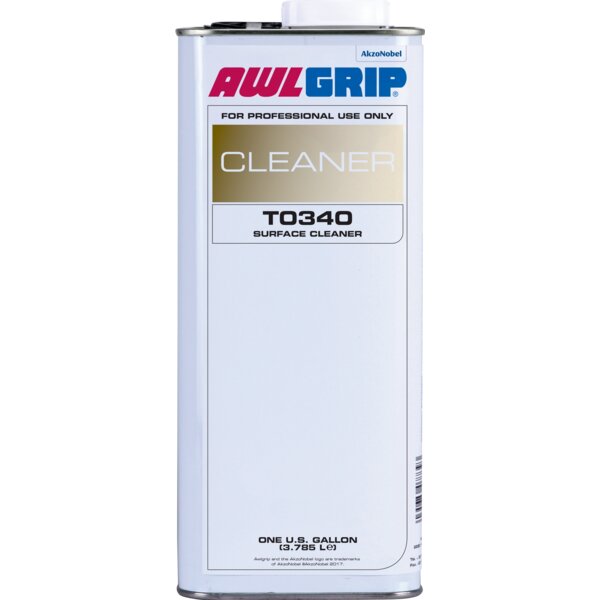
Awlgrip Surface Cleaner T0340 is a general-purpose solvent cleaner designed to wipe down substrates, finish primers and topcoats before and after sanding. Used with the recommended Two Cloth Method, it efficiently lifts dust, oils, waxes and other surface contaminants without leaving residue, helping to ensure optimal adhesion and appearance of Awlgrip coatings. Formulated for professional and industrial use, it is supplied ready for use with no mixing or reduction required.
Main features
- General-purpose surface cleaner: Developed for cleaning substrates, finish primers and topcoats before and after sanding.
- Two Cloth Method application: One cloth wets the surface with T0340 while a second dry cloth removes the contamination and solvent, minimizing smearing.
- High cleaning efficiency: Helps remove dust, dirt, greases, waxes and oils that can interfere with coating adhesion and finish quality.
- Ready to use: No mixing or reduction required before application.
- Controlled VOC composition: VOC content of 750 g/l (6.26 lb/gal) as supplied.
- Professional-grade product: For industrial use only and for application by trained personnel with proper equipment.
- Compatible with Awlgrip coating systems: Must not be mixed with thinners, additives, modifiers, converters or related products from other manufacturers.
Technical specifications
- Product type: Surface cleaner for substrates, finish primers and topcoats
- Product name/SDS code: Surface cleaner OT0340 / T0340
- Physical state: Liquid
- Color: Colorless
- Odor: Solvent
- VOC (as supplied): 750 g/l or 6.26 lb/gal
- Density: 0.761 g/cm³ (DIN EN ISO 2811-1)
- Flash point: 29°C (84.2°F), closed cup (Pensky-Martens)
- Boiling point (initial): 136°C (276.8°F)
- Viscosity: 1 mm²/s (kinematic, room temperature and at 40°C; DIN EN ISO 3219)
- Water solubility: Not soluble in cold water (OECD TG 105)
- Packaging: 1 US gallon and 1 US quart
- Typical shelf life: 3 years
- Main component: Hydrocarbons, C9–C10, n-alkanes, isoalkanes, cyclics, <2% aromatics (≥90%)
- Classification (Regulation (EC) No. 1272/2008): Flam. Liq. 3 (H226), STOT SE 3 (H336), Asp. Tox. 1 (H304), Aquatic Chronic 3 (H412)
- Use category: For professional and industrial use only; not intended for the general public
Applications and usage
Intended uses
- General-purpose cleaning of surfaces prior to application of Awlgrip primers and topcoats.
- Wipe-down of finish primers and topcoats before sanding to remove contaminants that could be driven into the surface.
- Wipe-down of finish primers and topcoats after sanding to remove dust and residues before recoating.
Surface preparation guidance
- Always begin with a clean, dry surface. Clean before sanding, as sanding can melt greases, waxes and oils into the surface and make cleaning more difficult.
- On primed or painted surfaces that are not fully cured, wipe-down products can attack epoxy, urethane coatings and some polyester fillers. Usually, if an epoxy or urethane can be sanded, it is cured enough to be wiped with Surface Cleaner T0340, but not with de-waxing or strong degreasing solvents.
- Polyester fillers may be sensitive to solvents in surface cleaners. Always test a small, inconspicuous area before treating a fully primed or topcoated surface.
- Detergent scrubbing with household cleanser and a 3M Scotch-Brite Pad before other preparation is described as an excellent practice. Continuous water film during rinsing indicates a clean surface; breaks, holes or beading indicate areas needing further cleaning.
Recommended application equipment
- Clean, oil-free, dry cotton cloths, or
- Prepackaged surface-cleaning lint-free towels designed for solvent wiping.
Two Cloth Cleaning Method (application steps)
- Thoroughly clean the surface of dust using a vacuum or clean, dry compressed air while wiping with clean, oil-free, dry cotton cloths. Remove the majority of dust and dirt before using Surface Cleaner T0340.
- Soak one cloth in Surface Cleaner T0340 and use it to wet the surface.
- Immediately use a second, dry, clean cloth to wipe the surface dry and lift contamination from the surface.
- Work small areas (up to approximately 4 sq. ft / 0.4 m²) so the cleaner does not dry before the second cloth wipes the surface clean and dry.
- Repeat steps 2 and 3, changing cloths frequently, until the surface is free of residue.
Important: Wiping with only one wet cloth will smear contamination rather than remove it. Ensure cloths are clean and suitable for solvent wiping. The surface must be completely dry before using tack rags.
FAQ
1. What is Awlgrip Surface Cleaner T0340 used for?
It is a general-purpose surface cleaner used to wipe down substrates, finish primers and topcoats before and after sanding, helping to remove contaminants that can affect coating adhesion and finish quality.
2. Do I need to mix or thin Surface Cleaner T0340 before use?
No. Mixing and reduction are not required; the product is supplied ready for use.
3. How should I apply Surface Cleaner T0340 correctly?
Use the Two Cloth Method: one cloth soaked with T0340 to wet the surface, followed immediately by a second dry cloth to wipe the surface dry and lift contamination. Work small areas and change cloths frequently.
4. Can I use other thinners or additives with this cleaner in the Awlgrip system?
No. The manufacturer specifies that no thinner, additive, modifier, converter or related product from any manufacturer other than Awlgrip should be incorporated into the Awlgrip Coating System, as substitutions can jeopardize the system’s chemical characteristics.
5. On which surfaces should I take extra care when using T0340?
Use particular care on primed or painted surfaces that are not fully cured, and on polyester fillers, as wipe-down products and certain solvents can attack these materials. Always test a small area first.
6. What packaging sizes are available?
Surface Cleaner T0340 is available in 1 US gallon and 1 US quart containers.
7. What is the VOC content of this product?
As supplied and without reducer, the VOC content is 750 g/l (6.26 lb/gal). All VOC values provided are theoretical and may vary by batch and test method.
8. What is the typical shelf life?
The typical shelf life is 3 years.
9. Is this product suitable for consumer or general public use?
No. It is designated for industrial use only and for professional, trained personnel using proper equipment. It is not intended for sale to or use by the general public.
10. How flammable is Surface Cleaner T0340?
It is classified as a flammable liquid (Flam. Liq. 3, H226) with a flash point of 29°C (84.2°F). Keep away from heat, hot surfaces, sparks, open flames and other ignition sources. No smoking.
Section 14 – Transport information
- UN number / ID number: UN1263
- UN proper shipping name: PAINT RELATED MATERIAL
- Transport hazard class: Class 3 (flammable liquids)
- Packing group: III
- Environmental hazards (ADR/RID, IMDG, IATA): Not classified as environmentally hazardous for transport.
- ADR/RID tunnel restriction code: (D/E)
- IMDG emergency schedules: F-E, S-E
- Special precautions for user: Within user’s premises, always transport in closed, upright and secure containers. Ensure that persons transporting the product know what to do in case of an accident or spillage.
- Transport in bulk according to IMO instruments: Not applicable.
Section 8 – Personal protective measures
The following personal protective equipment (PPE) and control measures are recommended when handling Surface Cleaner T0340. Selection must always be based on a site-specific risk assessment.
Engineering and hygiene controls
- Use only with adequate ventilation. Employ process enclosures, local exhaust ventilation or other engineering controls to keep airborne concentrations below applicable limits and below lower explosive limits.
- Use explosion-proof ventilation and electrical equipment.
- Wash hands, forearms and face thoroughly after handling, before eating, drinking or smoking and at the end of the working period.
- Remove contaminated clothing and protective equipment before entering eating areas; wash contaminated clothing before reuse.
- Ensure eyewash stations and safety showers are located close to the workstation.
Eye and face protection
- Use safety eyewear complying with an approved standard when a risk assessment indicates potential exposure to liquid splashes, mists, gases or dusts.
- If contact is possible, safety glasses with side-shields are recommended unless a higher level of protection is required.
Hand protection
- Wear chemical-resistant, impervious gloves complying with an approved standard whenever handling chemical products, where indicated by risk assessment.
- For prolonged or frequently repeated contact, gloves with protection class 6 (breakthrough time > 480 minutes according to EN374) are recommended. Recommended materials: Viton or nitrile, minimum thickness 0.38 mm.
- For brief contact, gloves with protection class 2 or higher (breakthrough time > 30 minutes according to EN374) are recommended. Recommended material: nitrile, minimum thickness 0.12 mm.
- Replace gloves regularly and whenever they show signs of physical or chemical damage. Glove performance can be reduced by poor maintenance.
Skin and body protection
- Personal protective clothing should be selected based on the task and risks involved and approved by a specialist before use.
- Where there is a risk of ignition due to static electricity, wear anti-static protective clothing. For maximum protection, clothing should include anti-static overalls, boots and gloves (see EN 1149 for requirements and test methods).
- Choose appropriate footwear and any additional skin protection measures according to the specific work conditions.
Respiratory protection
- When engineering controls are insufficient to maintain exposure below recommended limits, select a respirator that meets the appropriate standard or certification, based on the hazard and potential exposure.
- Respirators must be used in accordance with a respiratory protection program that covers proper fitting, training and maintenance.
Environmental exposure controls
- Check emissions from ventilation or process equipment to ensure compliance with environmental protection legislation.
- If required, use fume scrubbers, filters or modify process equipment to reduce emissions to acceptable levels.
*Contenido generado por IA