What UNI PRO 250 is and why choose it
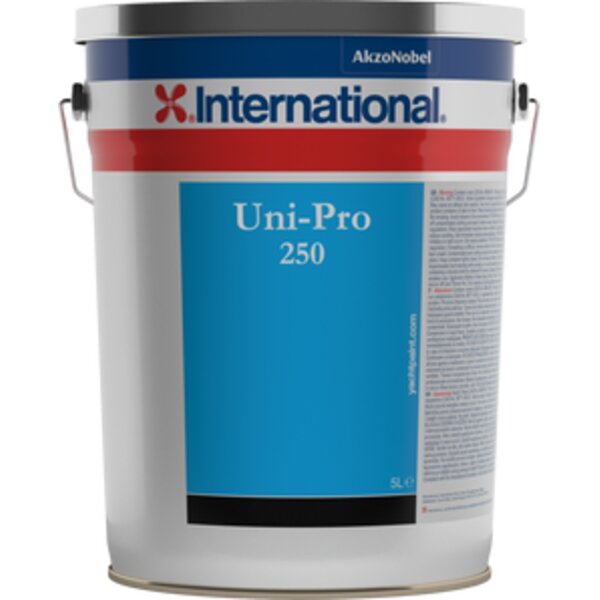
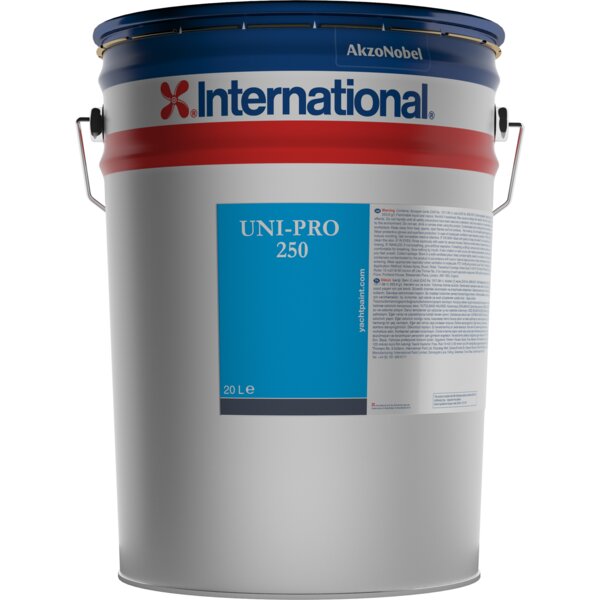
UNI PRO 250 by International Náutica is a solvent-borne, polishing antifouling coating designed to protect sailing and power boats operating in both fresh and salt water. Effective against fouling organisms such as slime, aquatic plants and animals, it provides up to one year of protection when applied at the recommended film thickness. Suitable for professional and amateur users, it is formulated for use on GRP, wood, steel/iron and lead hulls where a reliable, all-purpose antifouling is required.
Main features
- All-purpose antifouling for sailing and power vessels in fresh or salt water.
- Polishing technology helps maintain performance over the season while gradually renewing the active surface.
- Up to 12 months protection when the specified dry film thickness (DFT) is achieved.
- Wide colour range: Dover White (YBP160), Red (YBP161), Blue (YBP162), Navy (YBP163) and Black (YBP164).
- Matt finish for a low-glare underwater appearance.
- Professional application methods: airless spray (professional only), brush and roller.
- Broad substrate compatibility: suitable for GRP, wood, steel/iron and lead with appropriate priming.
- Not suitable for aluminium/alloy substrates or zinc-sprayed surfaces, and incompatible with VC17m/PTFE antifoulings.
- Biocidal formulation containing dicopper oxide and other actives for strong fouling control.
- Conforms to antifouling regulations, including compliance with the International Convention on the Control of Harmful Antifouling Systems on Ships (organotin-free ablative type).
Technical characteristics
- Product type: Solvent-borne polishing antifouling coating.
- Colour codes: YBP160 Dover White, YBP161 Red, YBP162 Blue, YBP163 Navy, YBP164 Black.
- Finish: Matt.
- Specific gravity: 1.8 (average).
- Volume solids: 60% (average).
- Typical shelf life: 2 years.
- Unit sizes: 5 L and 20 L.
- VOC (as supplied): 353 g/L (average).
- VOC (EU Solvent): 193 g/kg (average), according to EU Solvent Emissions Directive (Council Directive 1999/13/EC).
Drying and immersion times (at recommended DFT)
- Touch dry:
- 5°C: 1 h
- 15°C: 45 min
- 23°C: 30 min
- 35°C: 20 min
- Minimum time before immersion:
- 5°C: 8 h
- 15°C: 6 h
- 23°C: 4 h
- 35°C: 4 h
- Maximum immersion time: up to 6 months between 5°C and 35°C.
- Minimum drying time before lifting in straps:
Overcoating intervals (same product, UNI PRO 250)
Substrate temperature and minimum overcoating times:
- 5°C: 16 h (no maximum; “ext” as per datasheet).
- 15°C: 10 h (no maximum).
- 23°C: 6 h (no maximum).
- 35°C: 4 h (no maximum).
Recommended film thickness and coverage
- Number of coats:
- By brush/roller: 2 coats at 60 microns DFT each (total DFT 120 microns) for 12 months protection.
- By spray: 1 coat at 120 microns DFT for 12 months protection (total DFT 120 microns).
- Recommended DFT per coat:
- Brush/roller: 60 microns dry / 100 microns wet.
- Airless spray: 120 microns dry / 200 microns wet.
- Coverage by brush/roller:
- Theoretical: 10 m²/L per coat.
- Practical: 9 m²/L per coat.
- Coverage by spray (professional only):
- Theoretical: 5 m²/L per coat.
- Practical: 3 m²/L per coat.
Application equipment and parameters
- Application methods: airless spray (professional only), brush, roller.
- Airless spray settings:
- Pressure: 176–220 bar / 2500–3200 psi.
- Tip size: 517 to 521.
- Thinning: not recommended, as it can compromise antifouling performance if the correct DFT is not achieved.
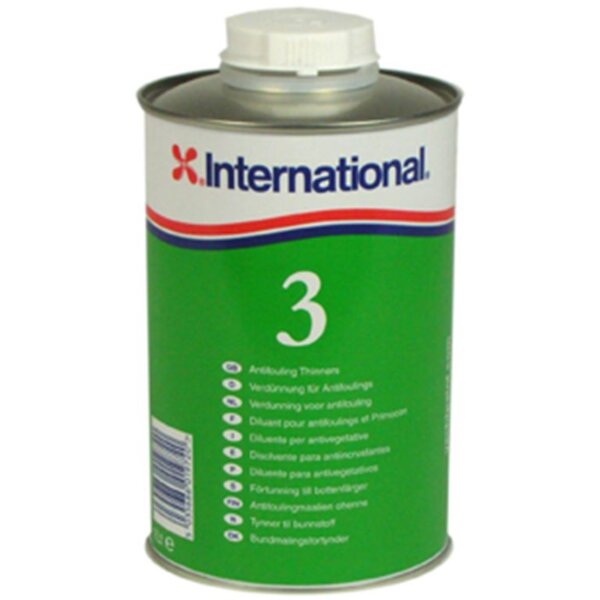
- Cleaner: YTA085 International Antifouling Thinners No. 3 for application equipment.
Application conditions
- Product temperature: 5–35°C (41–95°F).
- Ambient temperature: 5–35°C (41–95°F).
- Substrate temperature: at least 1°C / 5°F above dew point and not above 35°C / 95°F.
- Ventilation: ensure adequate ventilation during use.
Applications and use cases
Suitable substrates
- GRP (fibreglass) hulls.
- Wooden hulls.
- Steel/iron hulls.
- Lead.
Not suitable for aluminium or alloy substrates and for zinc-sprayed surfaces.
Typical use scenarios
- Sailing yachts needing up to one season of fouling protection in marinas, moorings and mixed cruising areas.
- Motor boats operating at moderate to higher speeds in coastal or inland waters.
- Boats in fresh water lakes and rivers exposed to slime and aquatic plant growth.
- Boats in salt water marinas where barnacles and other marine organisms are prevalent.
If a vessel regularly operates at very high speed (around 30 knots or more), premature wear of the coating may occur and more frequent maintenance or specific repainting advice may be required.
Surface preparation (summary)
- Previously antifouled surfaces in good condition:
- Remove all fouling and contamination, including the leached layer.
- High-pressure fresh water wash (approx. 3000 psi / 207 bar).
- Scrape and wet sand with 80–120 grade paper. Do not dry sand.
- If the existing antifouling is incompatible or unknown, seal with a suitable International barrier/sealer coat.
- Previously antifouled surfaces in poor condition:
- Remove all traces of antifouling using Interstrip.
- Bare substrates (primers to be chosen according to the relevant primer datasheets):
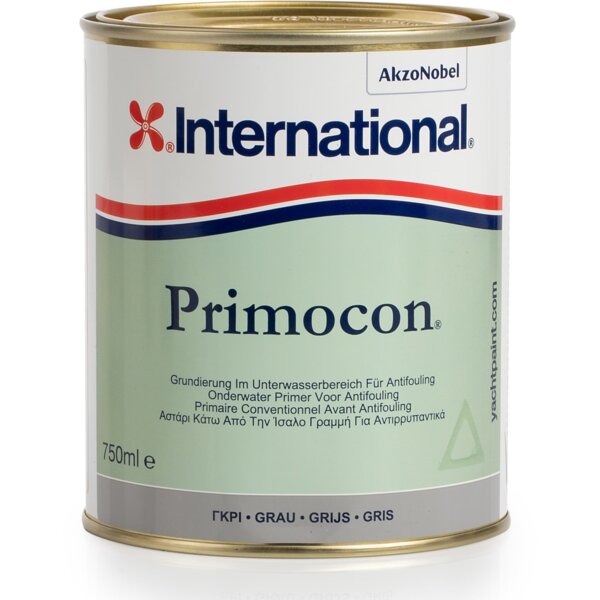
- Bare GRP: Gelshield 200 for osmosis protection, or Primocon or Interprotect.
- Steel/iron/lead/wood: Interprotect or Primocon.
- Plywood: Epiglass followed by Interprotect.
- High wear areas (chines, rudders, sterngear, leading edges): apply an extra stripe coat to reinforce protection.
FAQ
- How long does UNI PRO 250 protect my boat?
- When applied at the specified total dry film thickness of 120 microns, UNI PRO 250 is designed to provide up to 12 months of antifouling protection.
- On which hull materials can I use UNI PRO 250?
- It is suitable for GRP, wood, steel/iron and lead, over appropriate primers. It must not be used on aluminium/alloy substrates or zinc-sprayed surfaces.
- Can I apply UNI PRO 250 over an existing antifouling?
- Yes, it can be applied directly over most existing antifoulings that are in sound condition, except VC17m or PTFE antifoulings. If compatibility is uncertain, a suitable barrier/sealer coat should be used.
- How many coats are required?
- By brush or roller, apply 2 coats of 60 microns DFT each. By spray, apply 1 coat of 120 microns DFT. In both cases the total DFT should be 120 microns.
- What is the recommended drying time before launching?
- Depending on temperature, minimum immersion times range from 8 hours at 5°C to 4 hours at 23–35°C. Do not exceed the maximum immersion interval of 6 months between 5°C and 35°C.
- Can I thin the product to make application easier?
- Thinning is not recommended. Reducing the viscosity can lead to insufficient dry film thickness and compromise antifouling performance.
- How should I prepare a previously coated hull in good condition?
- Remove all fouling and the leached layer with a high-pressure fresh water wash, then scrape and wet sand with 80–120 grit paper. Do not dry sand. Ensure the old coating is compatible or sealed with an appropriate barrier if in doubt.
- What happens if my boat regularly runs at high speed?
- Regular operation at around 30 knots or more may cause faster wear of the antifouling film, so earlier maintenance or repainting might be necessary.
- Is UNI PRO 250 suitable for both fresh and salt water?
- Yes. It is specifically described as suitable for professional application on vessels in fresh or salt water.
- What is the approximate coverage per litre?
- By brush or roller the practical coverage is about 9 m²/L per coat. By spray (professional use only) the practical coverage is about 3 m²/L per coat.
Section 14 – Transport information
According to the safety data sheet for Uni-Pro 250 Dover White, this product is classified as a flammable liquid and an environmentally hazardous material for transport.
- UN number (ADR/RID, IMDG, IATA): UN1263.
- Proper shipping name: PAINT.
- Transport hazard class: Class 3 (flammable liquid).
- Packing group: III.
- Environmental hazards: Classified as hazardous to the aquatic environment. Marine pollutant for IMDG: dicopper oxide and zinc oxide.
- Marking exemptions:
- The environmentally hazardous substance mark is not required when transported in pack sizes of ≤ 5 L or ≤ 5 kg.
- For ADR/RID a tunnel code D/E is specified.
- For IATA, the environmentally hazardous mark may appear if required by other regulations.
- Special precautions for user: during on-site transport, always move the product in closed, upright and secure containers. Ensure personnel know what to do in case of accident or spillage.
- Transport in bulk: not applicable under IMO instruments.
Section 8 – Personal protective measures
UNI PRO 250 contains biocides and organic solvents and is classified as harmful if swallowed, causing serious eye damage, skin sensitisation and posing significant aquatic toxicity. During handling and application, appropriate personal protective equipment and exposure controls must be used.
Engineering controls
- Use only with adequate ventilation.
- Employ local exhaust ventilation or process enclosures to keep airborne concentrations below occupational exposure limits.
- Ventilation equipment should be explosion-proof and designed to maintain vapour levels below the lower explosive limit.
Hygiene measures
- Eating, drinking and smoking are prohibited in areas where the product is handled or stored.
- Wash hands, forearms and face thoroughly after use and before breaks.
- Remove contaminated clothing and protective equipment before entering eating areas; wash contaminated clothing before reuse.
- Ensure that eye-wash stations and safety showers are available near the work area.
Eye and face protection
- Wear chemical splash goggles and/or a face shield that complies with an approved standard whenever there is a risk of splashes or mists.
- If there is a risk of inhalation that also threatens the eyes, a full-face respirator may be required instead of separate goggles.
Hand protection
- Use chemical-resistant, impervious gloves in accordance with an approved standard.
- For prolonged or frequent contact, gloves with protection class 6 (breakthrough time > 480 minutes according to EN374) are recommended: Viton or nitrile, thickness ≥ 0.38 mm.
- For short, occasional contact, gloves with protection class ≥ 2 (breakthrough time > 30 minutes according to EN374) are recommended: nitrile, thickness ≥ 0.12 mm.
- Replace gloves regularly and immediately if damaged. Performance can be reduced by physical or chemical damage or poor maintenance.
Skin and body protection
- Select protective clothing based on the specific task and associated risks.
- Where there is a risk of ignition from static electricity, wear anti-static protective clothing (overalls, boots and gloves) that comply with EN 1149.
- Use appropriate footwear and any additional skin protection as required; such equipment should be approved by a safety specialist before handling the product.
Respiratory protection
- Select respiratory protection based on hazard and exposure potential and in line with a formal respiratory protection program.
- Wear a respirator conforming to EN140 with an A/P2 filter or better when ventilation is insufficient.
- Dry sanding, flame cutting and welding of the dry paint film generate hazardous dust and fumes; wet sanding/flatting is preferred. If adequate extraction cannot be provided, suitable respiratory protection must be used.
Environmental exposure control
- Emissions from ventilation systems and process equipment should be checked to ensure compliance with environmental legislation.
- Where necessary, use scrubbers, filters or engineering modifications to reduce emissions to acceptable levels.
*Contenido generado por IA