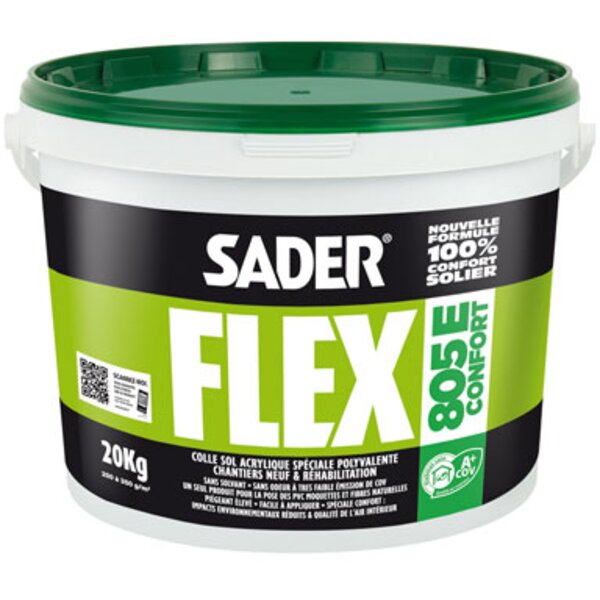
Multipurpose solvent-free acrylic adhesive for floor coverings
This Bostik acrylic construction adhesive is a versatile, solvent-free solution designed for professional installation of a wide range of resilient and textile floor coverings. With strong initial grab, high final bond strength and comfortable, low-odour application, it is suitable for residential areas with light traffic and can be used on heated floors and electric radiant heating systems.
Main features
- Multipurpose formulation: one adhesive for heterogeneous PVC, carpet, needlefelt, natural fibres and semi-flexible tiles.
- Solvent-free acrylic: low odour and comfortable application on site.
- High initial tack: good initial grab to securely hold floor coverings during positioning.
- Very resistant adhesive film: durable bond after full curing.
- Suitable for heated floors: can be used on hot-water underfloor heating and electric radiant floors, following the specified precautions.
- Recommended by major manufacturers: compatible with many common floor covering systems.
- Easy cleaning: fresh adhesive and tools can be cleaned with water.
Technical characteristics
- Chemical nature / colour: acrylic adhesive, cream-coloured.
- Density: 1.35 ± 0.05.
- Application temperature: from +10 °C to +30 °C.
- Tack-up time*: 10–15 minutes.
- Open time*: 45–50 minutes.
- Walk-on / traffic*: after approximately 12 hours.
- Full bond strength*: after 24–48 hours.
- Consumption (general): 250–400 g/m² depending on substrate, covering and trowel.
- Viscosity: 25,000–35,000 mPa·s at 23 °C.
- pH: 7.2–8.2.
- Water solubility: soluble in water.
- Solid content: approx. 81%.
- Liquid density: 1.55–1.60 g/cm³.
- Boiling point: approx. 100 °C.
- Flash point: > 100 °C.
*Data measured at 23 °C and 55% RH on normally absorbent substrates.
Coverage according to trowel and backing
- Smooth backings (PVC tiles and sheets, V.E.R., foams): TKB trowel No. 1 – A2, approx. 250 g/m².
- Non-smooth backings: TKB trowel No. 2 – B1, approx. 350 g/m².
- Strongly profiled backings (e.g. coconut on latex backing): TKB trowel No. 3 – B2, approx. 400 g/m².
Compatible coverings and substrates
Associated floor coverings
- Multilayer heterogeneous PVC.
- PVC on cork.
- Vinyls Expanded Reliefs (V.E.R.).
- Semi-flexible tiles.
- Needlefelt with or without backing.
- Carpets with foam backing.
- Carpets with non-woven and felt backing.
- Carpets with synthetic Action Bac backing.
- Coconut, sisal and seagrass with latex backing.
Admissible substrates*
- Power-trowelled concrete with smooth finish.
- Fluid or traditional cement screeds (incorporated or bonded).
- TECHNIS R, TECHNIS FIRST.
- Cement-based screeds (incorporated or bonded).
- Anhydrite screeds (according to technical approval).
- Existing ceramic tiles and old wooden floors properly smoothed.
- CTBX, CTBH and OSB3 panels.
- Hot-water heated screeds and electric radiant floors (PRE).
*Substrates must be prepared according to the surface preparation instructions and relevant standards.
Application and use
Substrate preparation
- Substrates must be strong, level, sound, dry, clean, dust-free and free of grease.
- Preparation must comply with current DTU, CPT and technical approvals, using a suitable Bostik primer and levelling compound certified QB.
- On anhydrite screeds and certain wooden substrates, direct bonding requires priming with BOSTIK GRIP A700 UNIVERSAL.
- Respect the required drying time of the substrate before bonding.
- Check moisture content with a carbide bomb; if too high, use the BOSTIK HYTEC E336 XTREM moisture barrier according to the applicable technical approval.
Application method
- Ensure adequate ventilation in the work area.
- Apply the adhesive in single-bond mode to the substrate using the appropriate TKB notched trowel.
- Observe the tack-up time and open time, which depend on ambient temperature and humidity, substrate porosity and roughness, and adhesive quantity.
Rolling and finishing
- After placing the floor covering, roll thoroughly over the entire surface with a heavy roller to fully collapse the adhesive ridges.
- Joints and trimming must be carried out according to the covering manufacturer’s installation instructions and good practice.
- Joint welding should be carried out 24 hours after installation.
Use on heated floors
- Underfloor heating must be switched off at least 48 hours before installation.
- Keep the system off throughout the installation and curing period, then restart it gradually in accordance with professional rules.
Cleaning and maintenance
- Clean fresh adhesive residues and tools with water.
- Remove dried adhesive mechanically by scraping.
- Close containers carefully after use and do not stack more than one pallet on top of another.
Storage
- Approximate shelf life: 1 year in original unopened packaging between +10 °C and +30 °C.
- Protect from frost; the product is reversible down to –5 °C, but freezing must be avoided.
- Keep containers tightly closed when not in use.
Typical applications and use cases
- Residential rooms: installation of heterogeneous PVC or carpet in bedrooms, living rooms and corridors subject to light traffic.
- Renovation over existing substrates: bonding new resilient or textile floorings over old ceramic tiles or properly smoothed wooden floors.
- Heated floors: securing PVC or textile coverings on compatible heated screeds and electric radiant systems, following the specified stopping and restart procedure.
- Natural fibre coverings: installation of coconut, sisal or seagrass with latex backing on suitable prepared substrates.
FAQ
1. On which floor coverings can this adhesive be used?
It is suitable for multilayer heterogeneous PVC, PVC on cork, V.E.R. vinyls, semi-flexible tiles, needlefelt with or without backing, carpets with foam, felt, non-woven or Action Bac backing, and coconut, sisal or seagrass with latex backing.
2. Can it be used over underfloor heating?
Yes, it is suitable for heated floors and electric radiant floors. The heating must be stopped at least 48 hours before installation and remain off during the work.
3. What is the recommended consumption?
Depending on the covering and trowel, consumption is approximately 250–400 g/m²: about 250 g/m² for smooth backings, 350 g/m² for slightly textured backings and 400 g/m² for highly profiled backings.
4. When can the floor be walked on?
Light traffic is generally possible after around 12 hours, with full bond strength reached after 24–48 hours (at 23 °C and 55% RH on normally absorbent substrates).
5. How should the substrate be prepared?
The substrate must be strong, flat, sound, dry, clean, dust-free and non-greasy. It must be prepared according to the relevant standards using appropriate Bostik primers and levelling compounds.
6. How do I clean tools and adhesive residues?
Fresh adhesive and tools can be cleaned with water. Once dry, adhesive should be removed by scraping.
7. Is the product classified as hazardous?
According to Regulation (EC) 1272/2008 [CLP], the mixture is not classified as hazardous, but it contains CMIT/MIT and BIT, which may cause allergic reactions. Safety data sheet is available on request.
8. What storage conditions are required?
Store in original, tightly closed containers between +10 °C and +30 °C and keep from freezing.
9. Can it be sprayed?
If applied by spraying, suitable respiratory protection is required as indicated in the safety data sheet.
10. What should I do if the substrate moisture is too high?
If moisture levels are above the professional limits, use the BOSTIK HYTEC E336 XTREM moisture barrier according to the current technical approval.
Section 14 – Transport information
- UN number: not regulated for ADR/RID, IMDG or IATA.
- Proper shipping name: not regulated.
- Transport hazard class: not regulated.
- Packing group: not regulated.
- Environmental hazards: product is not classified as a marine pollutant; environmental hazard is not applicable for land and air transport.
- Special precautions for user: none specified.
- Transport note: keep from freezing during storage and transport.
Section 8 – Personal protective measures
- General engineering controls: ensure adequate ventilation, especially in confined areas.
- Eye/face protection: wear safety glasses with side shields or goggles to avoid eye contact.
- Hand protection: wear protective nitrile gloves complying with EN 374.
- Skin and body protection: wear suitable protective clothing and gloves; avoid contact with skin, eyes and clothing.
- Respiratory protection: during spraying, use suitable respiratory equipment as recommended in the safety data sheet.
- Hygiene measures: handle in accordance with good industrial hygiene and safety practice.
- Environmental protection: avoid release into drains, soil or natural watercourses; inform local authorities in case of significant spills.
Content generated by AI