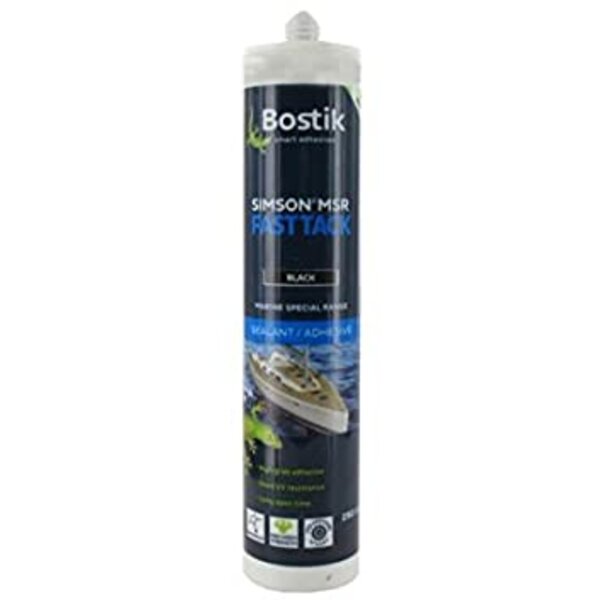
What is Bostik MSR Fast Tack and why choose it?
Bostik MSR Fast Tack (MSR FT) is a one-component, silyl modified polymer (SMP) construction adhesive that cures quickly to a permanently elastic bond. It is developed specifically for bonding and sealing applications in yacht and boat building and has also been approved for flooring applications. MSR Fast Tack combines a very high initial grab with excellent UV and weather resistance, making it suitable for exposed marine environments where durability and long-term watertight integrity are critical.
The product has been tested and certified according to the International Maritime Organization (IMO) Fire Test Procedures 2010 for surface flammability, and is approved as an elastomeric adhesive (GL class A and B). Production quality is regularly audited by Bureau Veritas, ensuring consistent product performance.
Main features
- High initial strength – reduces or can eliminate the need for clamping or mechanical fixing during curing.
- Fast curing, permanently elastic bond – humidity-curing SMP technology provides flexible joints that accommodate movement and vibration in marine structures.
- Excellent UV and weather resistance – suitable for external applications exposed to sunlight and harsh marine conditions.
- Primerless adhesion on many substrates – very good adhesion to commonly used materials such as ceramic-coated glass, PMMA and PC without primer (adhesion testing recommended).
- Good compatibility with industrial paint systems – compatible with most alkyd resin and dispersion-based paints and lacquers (pre-testing of specific systems is recommended).
- Easy application – can be extruded with manual or pneumatic guns in a wide application temperature range.
- Marine fire-tested and certified – compliant with IMO FTP 2010 procedures for surface flammability; elastomeric adhesive certification GL class A and B.
- Approved for flooring applications – suitable as a bonding solution where such approvals are required.
Key technical specifications
- Chemistry: Silyl Modified Polymer (SMP)
- Physical form: Paste
- Colour: Black
- Specific density: approx. 1.5 g/ml
- Skin formation time (23°C / 50% RH): approx. 20 minutes
- Curing mechanism: Moisture
- Curing speed: approx. 3 mm after 24 hours at 23°C / 50% RH
- Shore A hardness: approx. 60
- Volume change: < 3%
- Tensile stress at 100% (ISO 37): approx. 2.4 MPa
- Tensile strength at break (ISO 37): approx. 2.9 MPa
- Elongation at break (ISO 37): approx. 200%
- Shear strength (ISO 4587): approx. 2.3 MPa
- Temperature resistance: -40°C to +110°C (10 cycles of 7 h at 110°C followed by 17 h at 23°C / 50% RH)
- Application temperature: +5°C to +40°C
- UV and weather resistance: Excellent
- Packaging: 290 ml cartridge
- Storage stability: 18 months in cartridge and 12 months in sausage, in unopened original packaging stored dry between +5°C and +30°C
Applications and use cases
Marine construction and outfitting
- Direct bonding of windscreens and windows – suitable for glass, PMMA and polycarbonate window bonding on yachts and boats.
- Bonding of rubbing strakes and push bumpers – where strong, impact-resistant and elastic joints are required.
- Bonding and sealing of deck fittings – including hardware, hatches, portlights and bitts.
- Deck-to-hull connections – elastic structural bonding to help distribute loads and maintain watertight joints.
Flooring applications
- Approved for use in flooring – MSR Fast Tack can be used in applications where an elastomeric adhesive with marine approvals is needed.
Window bonding and sealing system
MSR Fast Tack forms part of Bostik’s Marine Special Range system for window bonding and sealing on yachts. It is used for elastic bonding of glass panes and other glazing materials to the vessel structure, transferring loads while maintaining watertight and weather-tight performance. The product’s high initial strength allows many windows to be installed without additional mechanical clamping when used with appropriate distance keepers and supports, as described in the application manuals.
Application guidelines (summary)
- Application temperature: between +5°C and +35°C (TDS) or between +5°C and +35°C / relative humidity up to 75% as described in the application manual.
- Equipment: apply using a manual or pneumatic cartridge gun.
- Open time for assembly: substrates should be brought together within 30 minutes after application at 23°C / 50% RH.
- Recommended adhesive thickness: minimum 2 mm in bonding applications.
- Cleaning (uncured product): remove with a clean, colourless, lint-free cloth moistened with Bostik Liquid 1 or Bostik Cleaner E.
Substrate preparation and adhesion notes
- Substrates must be clean, dry and free from dust and grease to obtain good adhesion.
- MSR FT adheres well without primer on most common substrates, including ceramic-coated glass, PMMA and PC. Due to the large variety of substrates, adhesion testing prior to use is recommended.
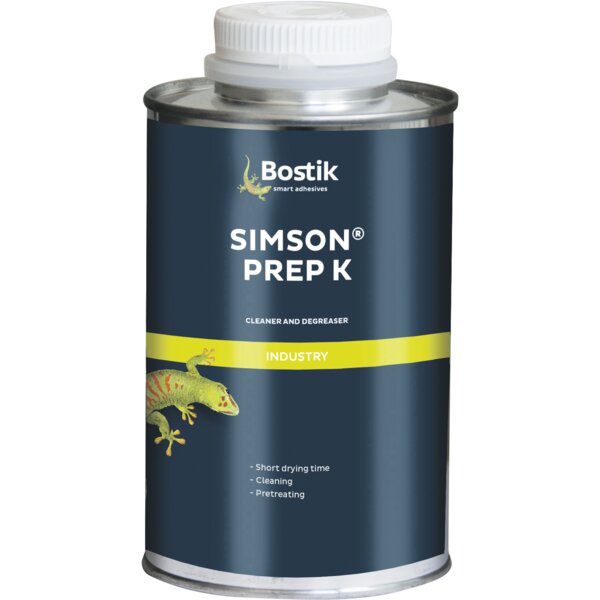
- Windows with ceramic coating/frit should be cleaned thoroughly with Bostik Cleaner I before applying MSR Fast Tack.
- When no ceramic coating/frit is present, or when the coating does not give sufficient UV protection, Bostik Prep G plus is mandatory to protect the adhesive bond line from UV.
- No adhesion will be obtained on untreated polyethylene, polypropylene and PTFE (Teflon).
- Where high adhesion is required due to high thermal or physical loads, particularly under wet conditions, the use of Bostik Prep CS or Prep M (TF) is recommended to degrease and prepare the surface.
- On bare wood and porous substrates, Bostik recommends using Prep P as a primer.
Section 8 – Individual protection measures
According to the Safety Data Sheet for BOSTIK MSR FAST TACK BLACK, the mixture is not classified as hazardous under Regulation (EC) 1272/2008, but small amounts of methanol can be released on curing and the product contains Trimethoxyvinylsilane, which may cause an allergic skin reaction in susceptible persons. The following controls are indicated:
Exposure controls
- Engineering controls: ensure adequate ventilation, especially in confined areas.
Personal protective equipment (PPE)
- Eye and face protection: wear safety glasses with side shields or goggles complying with EN 166.
- Hand protection: wear suitable chemical-resistant gloves conforming to EN 374. Recommended materials include Neoprene, nitrile rubber or butyl rubber with a thickness greater than 0.7 mm. Ensure that the breakthrough time specified by the glove supplier is not exceeded.
- Skin and body protection: none required under normal conditions of use.
- Respiratory protection: if ventilation is insufficient, wear respiratory protection conforming to EN 140 with a type A/P2 filter or better (organic vapour and particulate filter according to EN 14387). Ensure effective ventilation, particularly in confined spaces.
Environmental exposure controls
- Avoid uncontrolled discharge of the product into the environment and prevent product from entering drains, soil or subsoil.
Section 14 – Transport information
According to the Safety Data Sheets, Bostik MSR Fast Tack Black is not regulated as a dangerous good for transport by road, sea or air:
- ADR/RID (land transport): Not regulated – no UN number, no transport hazard class, no packing group, not classified as environmentally hazardous.
- IMDG (sea transport): Not regulated – no UN number, no transport hazard class, no packing group; not a marine pollutant (NP).
- ICAO-TI / IATA-DGR (air transport): Not regulated – no UN number, no transport hazard class, no packing group, not classified as environmentally hazardous.
No special transport precautions or bulk transport provisions under MARPOL/IBC are indicated for this product.
FAQ – Bostik MSR Fast Tack
-
Is Bostik MSR Fast Tack classified as a hazardous product?
The mixture is classified as not hazardous according to Regulation (EC) 1272/2008. However, the SDS notes EUH210 (safety data sheet available on request) and EUH208, as it contains Trimethoxyvinylsilane, which may cause an allergic skin reaction in susceptible individuals.
-
On which materials does MSR Fast Tack adhere without primer?
MSR Fast Tack adheres well without primer to many clean, dry, dust- and grease-free substrates, including ceramic-coated glass, PMMA and polycarbonate. Due to the variety of substrates, Bostik recommends adhesion testing before use.
-
Are there substrates on which MSR Fast Tack will not adhere?
Yes. No adhesion will be obtained on untreated polyethylene, polypropylene and PTFE (Teflon).
-
What is the recommended minimum adhesive thickness for bonding?
The technical data sheet recommends a minimum adhesive thickness of 2 mm in bonding applications.
-
How long do I have to assemble the parts after applying the adhesive?
At 23°C and 50% relative humidity, substrates should be assembled within 30 minutes after application of MSR Fast Tack.
-
Which cleaning agents are recommended before and after application?
For cleaning glass with ceramic coating before bonding, Bostik Cleaner I is recommended. Uncured adhesive residues and tools can be cleaned with a clean, colourless, lint-free cloth moistened with Bostik Liquid 1 or Bostik Cleaner E.
-
Is additional UV protection of the bond line necessary?
Yes. Although MSR products have high UV resistance, the adhesive bond line must be protected from direct UV radiation, typically using a ceramic frit on mineral glass or UV-impervious coatings. When ceramic coating is not present or insufficient, Bostik Prep G plus must be used for adequate UV protection.
-
Can MSR Fast Tack be painted over?
MSR Fast Tack is compatible with most industrial paint and lacquer systems based on alkyd resins or dispersions. Because of the variety of paint types, a compatibility test with the specific paint system is recommended before use and paint suppliers should be consulted.
-
How should MSR Fast Tack be stored?
Store in unopened original packaging in a dry place between +5°C and +30°C. Under these conditions the shelf life is 18 months for cartridges and 12 months for sausages.
-
Does curing release any by-products?
The Safety Data Sheet states that small amounts of methanol (CAS 67-56-1) are formed by hydrolysis and released upon curing when the product is exposed to moisture or water.
*Contenido generado por IA