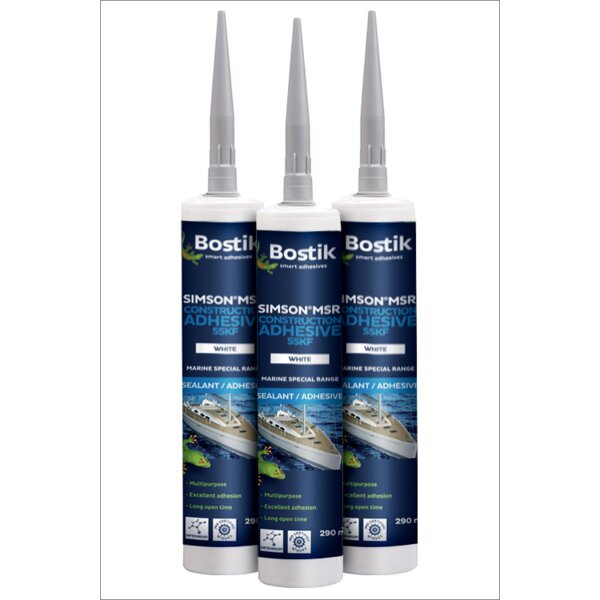
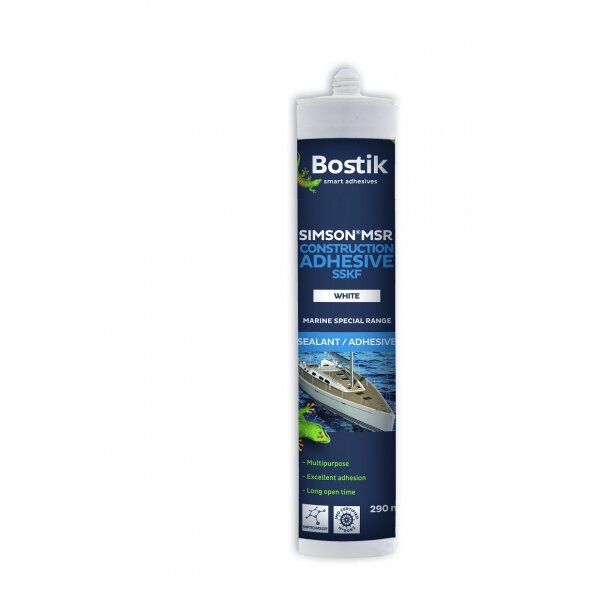
What BOSTIK MSR CONSTRUCTION ADHESIVE SSKF is and why choose it
BOSTIK MSR CONSTRUCTION ADHESIVE SSKF is a one-component, fast-curing, permanently elastic construction adhesive based on silane modified polymer (SMP). It has been specially developed for demanding bonding and sealing applications in the construction of yachts and boats, including structural window bonding and deck details. The product offers excellent adhesion on many common marine substrates, very good UV and weather resistance, and high elasticity across a wide temperature range.
This adhesive is certified according to the fire exposure test procedures of the International Maritime Organization (IMO) for low flame spread (resolution A.653(16)) and complies with the European MED directive (Bureau Veritas). It is also tested and approved according to DNV-GL and RINA structural glazing procedures as a class A and B adhesive for nautical window bonding, making it a reliable choice for high-performance marine construction.
Main features and benefits
- Marine-optimised formulation: designed for bonding and sealing in yacht and shipbuilding, including hull-to-deck joints and windows.
- Universal use: suitable for numerous bonding and sealing jobs in nautical construction where high adhesion and deformation capacity are required.
- Excellent adhesion: adheres well to many common substrates without primer, such as aluminium, stainless steel, galvanised steel, powder-coated metal, painted metal, glass, PVC, polyester (GRP) and painted/varnished wood.
- Always elastic: remains flexible between approximately -40 °C and +100 °C, absorbing movement, vibration and thermal expansion.
- Solvent- and isocyanate-free: contains 0 % solvent and 0 % isocyanate.
- Very good UV and weather resistance: durable against fresh and salt water and outdoor exposure.
- Paintable: most industrial alkyd resin and dispersion coatings can be applied after skin formation; compatibility tests are recommended.
- Sandable after cure: the cured material can be sanded for a smooth finish.
- Neutral and low odour: comfortable to work with in confined marine interiors.
- High green strength option: available in a Fast Tack version that reduces or eliminates clamping in many window bonding applications.
Technical specifications
Base chemistry and curing
- Base: silane modified polymer (SMP)
- Curing mechanism: moisture curing
- Solvent content: 0 %
- Isocyanate content: 0 %
Physical properties
- Form: paste
- Standard colours: white, grey, black
- Relative density: approx. 1.4 g/ml
- Shore A hardness (DIN 53505): approx. 55
- Shrinkage (DIN 52451): < 3 %
- Temperature resistance: -40 °C to +100 °C
- Application temperature: +5 °C to +35 °C
- UV and weather resistance: excellent
Curing and open times (20 °C / 50 % RH)
- Skin formation time: approx. 10 minutes (also available in a faster film-forming version; skin time around 10 minutes and open time about 15 minutes)
- Open time: approx. 15 minutes
- Curing speed after 24 h: approx. 3 mm
Mechanical properties
- Green strength: approx. 300 Pa (maximum load per m² of uncured adhesive without sagging)
- Tensile strength at 100 % (DIN 53504 / ISO 37): approx. 2.0 MPa
- Tensile strength at break (DIN 53504 / ISO 37): approx. 3.0 MPa
- Elongation at break (DIN 53504 / ISO 37): approx. 225 %
- Shear strength (Alu–Alu, 2 mm adhesive, DIN 53283 / ASTM D1002): approx. 2.5 MPa
- Tear propagation resistance (DIN 53515 / ISO 34, type C): approx. 15 N/mm
Packing and storage
- Packaging: 290 ml cartridges and 600 ml foil packs
- Shelf life (unopened, original packaging): approx. 18 months for cartridges; approx. 12 months for foil packs
- Storage conditions: store in a dry place between +5 °C and +30 °C
Applications and use cases
Typical marine bonding and sealing tasks
BOSTIK MSR CONSTRUCTION ADHESIVE SSKF is formulated for demanding nautical applications where both adhesion and flexibility must meet extreme requirements. Typical uses include:
- Bonding of rubbing strakes and push edges.
- Bonding and sealing of deck fittings.
- Bonding of deck coverings and deck veneers.
- Bonding of plates and sheets.
- Bonding and sealing of deck-to-hull joints.
- Bonding of deck hatches, portholes and mooring cleats.
- Waterproof sealing where higher initial strength is required (a low film formation speed version is recommended for such applications).
Structural window bonding on yachts and boats
The adhesive is widely used in direct glazing systems, where windows are bonded directly to the vessel structure. It complies with the relevant marine standards for bonded windows and structural glazing procedures (DNV-GL and RINA) and can be used for:
- Monolithic glass windows.
- Laminated glass windows.
- Polycarbonate or acrylic (PMMA) glazing.
- Chemically or thermally toughened glass.
- Single- or multi-curved windows.
- Structural applications such as insulating glass, single-pane safety glass, seat track bonding, door frames and single-pane polymer glass and windscreens (according to DNV-GL structural glazing approvals for MSR adhesives).
Adhesion and substrate preparation
In general, the adhesive adheres well without primer to clean, dry, dust- and grease-free substrates made of aluminium, stainless steel, galvanised steel, zinc, copper, brass, powder-coated metal, most painted metal surfaces, glass, PVC, polyester (GRP) and painted/varnished wood. It does not adhere to untreated polyethylene, polypropylene and PTFE (Teflon). In extreme environmental conditions (high thermal or mechanical loads, high humidity), a pre-treatment is recommended:
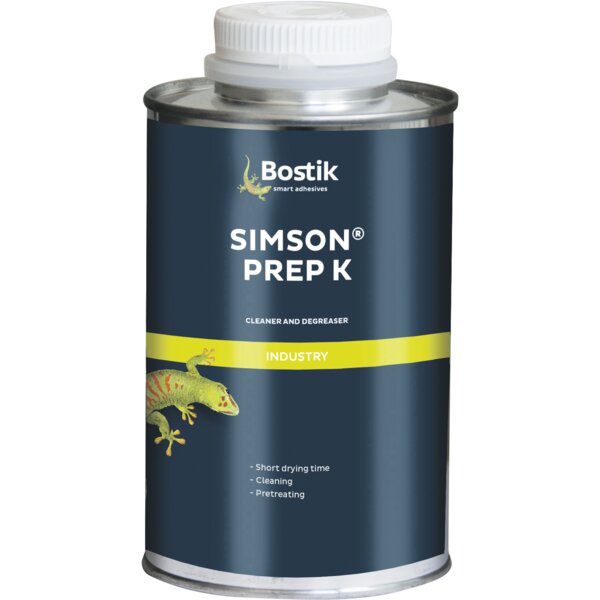
- Closed, non-porous substrates (e.g. metals): use Simson Prep M.
- Porous substrates (e.g. wood): use Simson Prep P.
For detailed instructions on Prep M and Prep P use, Consultar ficha técnica del fabricante.
Application guidelines
- Extrude using a manual or pneumatic gun.
- Recommended adhesive thickness for bonding applications: approx. 2 mm.
- For sealing, tool or smooth the bead before skin formation (within approx. 10 minutes at 20 °C / 50 % RH).
- For bonding, assemble substrates within approx. 15 minutes after application (20 °C / 50 % RH).
- Uncured residues and tools can be cleaned with a clean, lint-free cloth impregnated with Simson Liquid 1 or Simson Cleaner E. Pre-test to verify that cleaners do not damage the substrate.
Painting and finishing
- Due to rapid skin formation, the adhesive can usually be painted after about 10 minutes at 20 °C / 50 % RH.
- Compatible with many industrial paints and coatings (alkyd resin or dispersion systems). Because of the wide variety of paint systems, compatibility and curing tests are strongly recommended.
- The paint layer does not significantly influence the curing speed of the adhesive.
- After full cure, the material can be sanded to achieve a flush finish with surrounding surfaces.
Section 6 – Transport information
According to the safety data for related MSR CA SSKF formulations in cartridge form, this product is not regulated as a dangerous good for transport under the main international regulations:
- ADR (road): not regulated, no UN number assigned.
- RID (rail): not regulated.
- IMDG (sea): not regulated, not classified as a marine pollutant.
- ICAO/IATA (air): not regulated.
Standard precautions apply: keep containers closed, protect from moisture, and store and transport between approximately 10 °C and 35 °C. Avoid mechanical damage to cartridges and foil packs.
Section 8 – Individual protection measures
During professional use, follow the personal protection recommendations from the safety data sheets of MSR CA SSKF and related MSR products:
- General measures: ensure good ventilation, especially in confined spaces on board. Avoid contact with skin and eyes and avoid inhaling vapours or mists.
- Eye/face protection: wear well-fitting safety glasses with side shields or chemical splash goggles (conforming to EN 166 or equivalent).
- Hand protection: wear suitable chemical-resistant gloves. Recommended materials, based on related MSR Easy Black SDS, include neoprene, nitrile rubber or butyl rubber with a thickness > 0.7 mm and breakthrough time generally > 480 minutes. Consult glove supplier data and replace gloves regularly.
- Skin and body protection: wear suitable protective clothing to avoid contamination of skin and workwear.
- Respiratory protection: if ventilation is insufficient, wear a suitable respirator. For comparable MSR products an EN 140 half mask with A/P2 filter (or better) is recommended. Select filters for organic vapours and particulates according to local regulations.
- Hygiene measures: do not eat, drink or smoke during use. Wash hands thoroughly after handling and remove contaminated clothing before breaks.
FAQ – BOSTIK MSR CONSTRUCTION ADHESIVE SSKF
1. Can this adhesive be used for both bonding and sealing?
Yes. It is designed as a construction adhesive that can also be used as a high-performance sealant in marine applications, provided the joint dimensions are calculated according to Bostik recommendations.
2. Is primer always required?
No. On many clean, dry and grease-free substrates such as aluminium, stainless steel, galvanised steel, powder-coated metals, glass, PVC, polyester (GRP) and painted wood, adhesion is generally good without primer. In extreme conditions or on porous substrates, the use of Prep M (non-porous) or Prep P (porous) is recommended.
3. What materials should not be bonded with this product?
The adhesive does not adhere to untreated polyethylene, polypropylene or PTFE (Teflon). These substrates require special surface treatment or alternative fixing methods.
4. Can I paint over the joint?
Yes. Most common industrial alkyd and dispersion paints can be applied after skin formation (about 10 minutes at 20 °C / 50 % RH). Due to the variety of coatings, perform a compatibility test under actual conditions.
5. How thick should the adhesive layer be for structural bonding?
For typical bonding applications in marine construction, a bond line thickness of about 2 mm is recommended.
6. Is the product suitable for permanent immersion?
The adhesive has durable resistance to fresh and salt water. For detailed design recommendations in permanently immersed conditions, Consultar ficha técnica del fabricante.
7. How should uncured excess adhesive be removed?
Uncured material can be wiped off using a clean, colourless, lint-free cloth impregnated with Simson Liquid 1 or Simson Cleaner E. Always test cleaners beforehand on a small, inconspicuous area of the substrate.
8. What storage time can I expect?
In unopened original packaging, cartridges can typically be stored for up to 18 months and foil packs for up to 12 months, in a dry place between +5 °C and +30 °C.
Contenido generado por IA