What it is and why choose it
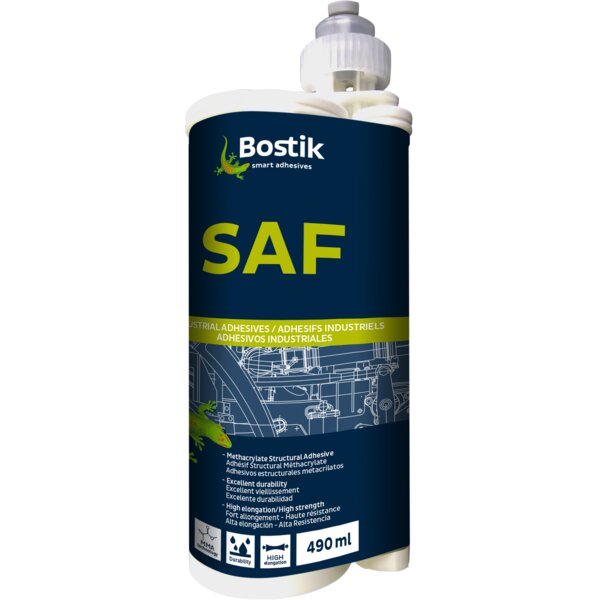
Bostik SAF 30-45 is a two-component methacrylate adhesive from the SAF range, supplied as a thixotropic, non-sag paste for structural bonding at room temperature. It is designed to bond a wide variety of dissimilar substrates, including metals, plastics and composite materials, while maintaining flexibility, fatigue resistance and excellent durability in aggressive environments and extreme temperatures. Its long open time and non-sag rheology make it especially suitable for precise work and vertical applications in industrial settings.
Main features
- Two-component methacrylate system with 10:1 volume mix ratio, curing at room temperature.
- Long curing time with open time of 25–35 minutes and fixture time of 40–60 minutes at 23 °C.
- Non-sag consistency for application on vertical or overhead surfaces.
- Structural performance with flexibility, providing lap shear strength, good elongation at break and fatigue resistance.
- Excellent environmental, weathering and ageing resistance, including exposure to aggressive environments and extreme temperatures.
- Minimal surface preparation required on many substrates; simple cleaning is often sufficient.
- Temperature resistance under stress, maintaining performance at elevated temperatures.
- Good adhesion to dissimilar substrates such as steel, stainless steel, aluminium, PVC, ABS, PMMA, PC and composite laminates.
- Non-running paste supplied as off-white resin and white/black hardener.
Technical characteristics
Product characteristics
- System: Two-component methacrylate adhesive.
- Mix ratio (by volume): 10:1.
- Polymerization: Room temperature.
Physical properties
- Appearance: Resin off white; hardener white/black.
- Density (resin): 1.03 g/cm³ (± 0.02).
- Density (hardener): 1.16 g/cm³ (± 0.02).
- Viscosity at 23 °C (resin): 200,000 – 600,000 mPa·s (Brookfield, mobile T-F @ 10 rpm).
- Viscosity at 23 °C (hardener): 80,000 – 250,000 mPa·s (Brookfield, mobile T-F @ 10 rpm).
- Type: Non-sag paste.
- State (SDS): Liquid, paste appearance, off-white colour.
Curing properties (23 °C)
- Open time: 25 – 35 minutes.
- Fixture time: 40 – 60 minutes.
- Full cure: 24 hours.
- Recommended application temperature: 15 – 25 °C (no post-curing required for optimum properties).
Mechanical properties
- Lap shear strength (thickness 250 µm): 21.0 MPa (cohesive failure, ISO 4587).
- Tensile strength at break: 12 – 17 MPa (ISO 527-1A).
- Tensile modulus: 800 – 1100 MPa (ISO 527-1A).
- Hardness: 70 – 80 Shore D.
- Elongation at break: 25 – 30% (ISO 527-1A).
Weathering and ageing resistance (lap shear strength, ISO 4587, D3 cycle)
- Aluminium 6060: 21.0 MPa before ageing (cohesive failure); 22.0 MPa after ageing (cohesive failure).
- Aluminium 6061: 21.0 MPa before ageing (cohesive failure); 22.0 MPa after ageing (cohesive failure).
- Stainless steel: 21.0 MPa before ageing (cohesive failure); 21.8 MPa after ageing (cohesive failure).
- Steel: 22.0 MPa before ageing (cohesive failure); 23.0 MPa after ageing (cohesive failure).
- PMMA: Substrate failure before and after ageing.
- ABS: Substrate failure before and after ageing.
- FRP: Delamination failure before and after ageing.
Chemical and safety-related properties (from SDS)
- Physical state: Liquid paste.
- Flash point: ≥ 10 °C / 50 °F.
- Initial boiling point: 100 °C / 212 °F.
- Autoignition temperature: 285 °C / 545 °F.
- Dynamic viscosity: 300,000 – 600,000 mPa·s.
- VOC content: Consultar ficha técnica del fabricante.
Classification and hazards (SDS, OSHA 29 CFR 1910.1200)
- Flammable liquids: Category 2 (highly flammable liquid and vapor).
- Skin corrosion/irritation: Category 2 (causes skin irritation).
- Serious eye damage/eye irritation: Category 2A (causes serious eye irritation).
- Skin sensitization: Category 1 (may cause an allergic skin reaction).
- Specific target organ toxicity, single exposure: Category 3 (may cause respiratory irritation).
- Ecotoxicity: Harmful to aquatic life with long lasting effects.
Storage
- SAF 30-45 adhesive shelf life: 9 months in unopened original packaging.
- SAF D hardener shelf life: 12 months in unopened original packaging.
- Recommended storage temperature (SDS): 5 – 25 °C (41 – 77 °F).
- Storage conditions: In a dry, cool, well-ventilated place, in tightly closed, properly labeled containers, away from heat, sparks, flames, and combustible materials. Store locked up.
- Effect of temperature excursions: Exposure to higher or lower temperatures will reduce the stated shelf life.
Packaging
- Cartridges: 50 mL and 490 mL side-by-side cartridges.
- Bulk: 20 L pails and 200 L drums.
- Mixers for 50 mL cartridges: M5.4/16.
- Mixers for 490 mL cartridges: MFX10-18.
Applications and uses
Recommended substrates
SAF 30-45 is suitable for bonding a wide range of dissimilar substrates in industrial applications:
- Metals: Steel, stainless steel, aluminium.
- Composites: Polyester, vinylester, epoxy, acrylic composites (Elium).
- Plastics: PVC, PS, ABS, PC, PMMA.
Typical industrial uses
- Structural and semi-structural bonding where both high lap shear strength and flexibility are needed.
- Applications exposed to weathering, ageing and temperature cycling.
- Bonding operations on vertical or overhead surfaces thanks to the non-sag paste consistency.
- Situations requiring long open time for part positioning and assembly before fixture.
Surface preparation
- Use Bostik T700 to remove grease, contamination or poorly adhering oxides from metal surfaces.
- Most plastics: usually require simple cleaning before bonding.
- Some plastics: may require light sanding to improve performance.
Application conditions
- For optimum performance, apply and cure at 15 – 25 °C.
- Use in a well-ventilated area due to typical odour and vapour emissions during polymerization.
- Follow the product operating guide for correct mixing, dispensing and bead geometry. For any specific substrate or process questions, contact your Bostik representative.
FAQ
1. What type of adhesive is Bostik SAF 30-45?
It is a two-component methacrylate structural adhesive that cures at room temperature with a 10:1 volume mix ratio.
2. Which materials can I bond with SAF 30-45?
It is recommended for metals (steel, stainless steel, aluminium), composites (polyester, vinylester, epoxy, acrylic/Elium) and plastics such as PVC, PS, ABS, PC and PMMA.
3. How long is the working time?
At 23 °C, the open time is 25–35 minutes and fixture time is approximately 40–60 minutes. Full cure is reached after 24 hours.
4. Does it run on vertical joints?
No. SAF 30-45 is a non-sag paste, specifically designed for vertical and overhead applications.
5. How much surface preparation is required?
Metals should be degreased using Bostik T700 to remove contaminants and weak oxides. Most plastics require only cleaning; some may benefit from sanding to increase performance.
6. Is SAF 30-45 resistant to outdoor weathering?
Yes. The SAF range has been developed for aggressive environments and extreme temperatures, showing excellent resistance to weathering and ageing, with lap shear strength maintained or slightly increased after D3 ageing cycles.
7. What are the main safety hazards?
The adhesive is a highly flammable liquid and vapour, causes skin and eye irritation, may cause an allergic skin reaction and may cause respiratory irritation. Use only in well-ventilated areas and with appropriate personal protective equipment.
8. How should the product be stored?
Store in unopened original packaging, in a dry, cool, well-ventilated place between 5 and 25 °C, away from heat, sparks and open flames. Shelf life is 9 months for SAF 30-45 adhesive and 12 months for SAF D hardener under these conditions.
9. In which formats is it supplied?
It is available in 50 mL and 490 mL side-by-side cartridges, 20 L pails and 200 L drums. Specific static mixers are required for each cartridge size.
10. Can SAF 30-45 be used without ventilation?
No. Due to vapour emissions and the potential for flammable mixtures, it should be used only outdoors or in a well-ventilated area, with local exhaust where necessary.
Section 14 – Transport information
The following transport data are taken from the Safety Data Sheet and apply primarily to bulk shipments. For non-bulk packaging, consult the applicable transport regulations.
DOT (US)
- UN number or ID number: UN1133.
- Proper shipping name: Adhesives.
- Transport hazard class: 3.
- Packing Group: II.
- Reportable quantity (RQ): Methyl methacrylate 1000 lb (454 kg).
- Special provisions: 149, B52, IB2, T4, TP1, TP8.
- Marine pollutant: Not a marine pollutant (NP).
- Description: UN1133, Adhesives, 3, II.
- Emergency response guide number: 128.
IATA (Air transport)
- UN number or ID number: UN1133.
- UN proper shipping name: Adhesives.
- Transport hazard class: 3.
- Packing group: II.
- Special provisions: A3.
- Description: UN1133, Adhesives, 3, II.
IMDG (Sea transport)
- UN number or ID number: UN1133.
- UN proper shipping name: Adhesives.
- Transport hazard class: 3.
- Packing group: II.
- EmS code: F-E, S-D.
- Marine pollutant: Not a marine pollutant (NP).
- Description: UN1133, Adhesives, 3, II, (10 °C c.c.).
Section 8 – Individual protection measures
The following personal protective equipment (PPE) guidelines are extracted from the Safety Data Sheet and should be implemented in conjunction with appropriate engineering controls and local regulations.
Engineering controls
- Provide showers and eyewash stations in the work area.
- Use appropriate ventilation systems, including local exhaust where necessary, to keep vapour concentrations below exposure limits.
Eye and face protection
- Wear tight sealing safety goggles.
- Avoid any direct contact with the eyes during handling, dispensing and cleanup.
Hand protection
- Wear suitable protective gloves, such as impervious gloves resistant to the product.
Skin and body protection
- Wear long-sleeved protective clothing.
- Use a chemical resistant apron where splashing is possible.
- Wear antistatic boots to reduce the risk of static discharge.
Respiratory protection
- If exposure limits are exceeded or irritation is experienced, use NIOSH/MSHA-approved respiratory protection.
- Positive-pressure supplied air respirators may be required in areas with high airborne contaminant concentrations.
- Respiratory protection must comply with current local regulations.
General hygiene measures
- Wear suitable gloves and eye/face protection at all times when handling the adhesive.
- Do not eat, drink or smoke while using the product.
- Avoid breathing vapours or mists and avoid contact with skin, eyes and clothing.
- Wash hands before breaks and immediately after handling.
- Contaminated work clothing should not be allowed out of the workplace.
- Remove and wash contaminated clothing and gloves, including the inside, before reuse.
- Regularly clean equipment, work areas and protective clothing to minimise contamination.
*Contenido generado por IA