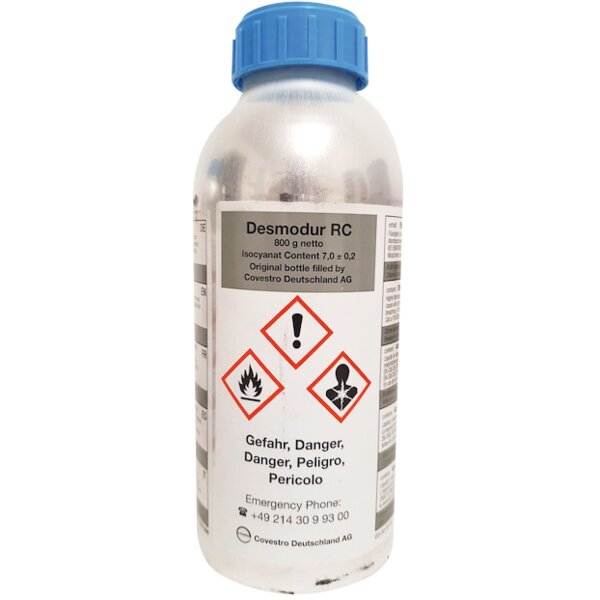
What VINYCOL 1520 HARDENER is and why choose it
VINYCOL 1520 HARDENER is a professional hardener designed for industrial use. It is supplied as a colourless liquid dispersion with a characteristic solvent odour and is based on a mixture that includes ethyl acetate and diisocyanate derivatives. According to its Safety Data Sheet (SDS), it is a highly flammable hardener that offers reactive performance for professional applications while requiring strict safety measures during handling, storage and transport.
This hardener is reserved for industrial and professional users. As from 24 August 2023, adequate training is required before any industrial or professional use.
Main characteristics
- Type of product: Hardener (mixture).
- Physical state: Liquid dispersion, colourless.
- Odour: Solvent-like.
- Flammability: Highly flammable liquid and vapour (Flam. Liq. 2, H225).
- Health hazards:
- Harmful if inhaled (Acute Tox. 4, H332).
- Causes serious eye irritation (Eye Irrit. 2, H319).
- May cause an allergic skin reaction (Skin Sens. 1, H317).
- May cause allergy or asthma symptoms or breathing difficulties if inhaled (Resp. Sens. 1, H334).
- May cause drowsiness or dizziness (STOT SE 3, H336).
- Repeated exposure may cause skin dryness or cracking (EUH066).
- Typical composition (mixture):
- Ethyl acetate: 40 – <80 %.
- m-TDI oligomers, isocyanurate: 20 – 25 %.
- Benzene, 2,4-diisocyanato-1-methyl-, homopolymer: 10 – <20 %.
- m-tolylidene diisocyanate: 0.1 – <0.5 %.
- End use: Hardener for industrial and professional systems.
- Use restrictions: Reserved for industrial and professional use; adequate training is mandatory for users.
Technical specifications
- Physical state: Liquid.
- Appearance: Colourless dispersion.
- Density: 1.01 g/cm³.
- Dynamic viscosity: 3 mPa·s at 20 °C.
- Boiling point (initial): 77 °C.
- Flash point: -4 °C (DIN 51755 Part 1).
- Autoignition temperature: 460 °C.
- Flammability limits in air:
- Lower: 0.9 % (v/v).
- Upper: 11.5 % (v/v).
- Vapour pressure: 97 hPa at 20 °C.
- Water solubility: Immiscible in water.
- Explosive properties: Sensitive to static discharge; forms flammable/explosive vapour–air mixtures during use.
- Stability: Stable under normal conditions; hazardous polymerisation can occur.
- Recommended storage temperature: between 5 and 25 °C.
Applications and use cases
According to the SDS, VINYCOL 1520 HARDENER is intended for use as a hardener. It is formulated for industrial and professional applications where a reactive hardening component is required. It must be used strictly in accordance with the product labelling, applicable regulations and appropriate training.
FAQ – VINYCOL 1520 HARDENER
-
What is the recommended use of VINYCOL 1520 HARDENER?
The product is recommended for use as a hardener in industrial and professional systems.
-
Who is allowed to use this hardener?
The SDS states that it is reserved for industrial and professional use. As from 24 August 2023, adequate training is required before any industrial or professional use.
-
Is this product flammable?
Yes. It is classified as a highly flammable liquid and vapour (Flam. Liq. 2, H225) and can form flammable or explosive vapour–air mixtures.
-
What are the main health hazards?
It is harmful if inhaled, causes serious eye irritation, may cause an allergic skin reaction, and may cause allergy or asthma symptoms or breathing difficulties if inhaled. It can also cause drowsiness or dizziness and repeated exposure may lead to skin dryness or cracking.
-
Is VINYCOL 1520 HARDENER soluble in water?
No. It is described as immiscible in water.
-
How should the product be stored?
Store tightly closed in a cool, dry, well-ventilated place, away from heat, sparks, open flames and other ignition sources. Keep between 5 and 25 °C, in properly labelled containers, and out of reach of children.
-
Does the product require special ventilation during use?
Yes. The SDS requires adequate ventilation, especially in confined areas, with vapours and aerosols extracted directly at the point of origin.
-
Can it be released into drains or the environment?
No. It should not be released into the environment and must be prevented from entering drains, sewers, soil or water bodies. Disposal must follow local environmental legislation.
-
What happens in case of a spill?
Evacuate personnel, eliminate ignition sources, ensure ventilation, and contain the spill with non-combustible absorbent materials such as sand or earth. Collected waste must be transferred to suitable containers for disposal according to regulations.
-
Is it suitable for general public or DIY use?
No. It is explicitly reserved for industrial and professional users with appropriate training.
Section 14 – Transport information
The following transport data are taken from Section 14 of the Safety Data Sheet and apply to bulk shipments. They describe the classification of the mixture as a dangerous good for transport.
- UN number (all modes): UN1866.
- UN proper shipping name (ADR/RID, IMDG, IATA): Resin solution.
- Transport hazard class: Class 3 (flammable liquids).
- Packing group: II.
- ADR/RID:
- Description: UN1866, Resin solution, 3, II, (D/E).
- Classification code: F1.
- Special provisions: 640C.
- Tunnel restriction code: (D/E).
- Limited quantity (LQ): 5 L.
- Hazard identification number (Kemmler): 33.
- Environmental hazards: Not applicable.
- IMDG (sea transport):
- Description: UN1866, Resin solution, 3, II, (-4 °C c.c.).
- Marine pollutant: No (NP).
- EmS code: F-E, S-E.
- Limited quantity (LQ): 5 L.
- IATA/ICAO (air transport):
- Description: UN1866, Resin solution, 3, II.
- Special provisions: A3.
- Limited quantity (LQ): 1 L.
- Emergency Response Guide (ERG) code: 3L.
- Environmental hazards: Not applicable.
Section 8 – Individual protection measures
The following information summarises the exposure controls and personal protective equipment (PPE) specified in Section 8 of the Safety Data Sheet.
Engineering controls
- Ensure adequate general and local exhaust ventilation, especially in confined areas.
- Vapours and aerosols must be extracted directly at the point of origin.
Eye and face protection
- Use tight-sealing safety goggles.
- Use a face protection shield when there is a risk of splashes or aerosol formation.
Hand protection
- Wear suitable protective gloves.
- The breakthrough time depends on glove material, thickness and temperature; select gloves accordingly.
Skin and body protection
- Wear antistatic footwear.
- Wear fire- or flame-resistant/retardant protective clothing.
- Use gloves made of plastic or rubber.
- Use an appropriate protective apron and additional protective clothing as required.
Respiratory protection
- If ventilation is inadequate, wear appropriate respiratory protection.
- In case of mist, spray or aerosol exposure, use a suitable respiratory protective device and protective suit.
- Recommended filter type: organic gases and vapours filter conforming to EN 14387.
Environmental exposure controls
- Do not allow the product to enter sewers, soil or any body of water.
*Contenido generado por IA