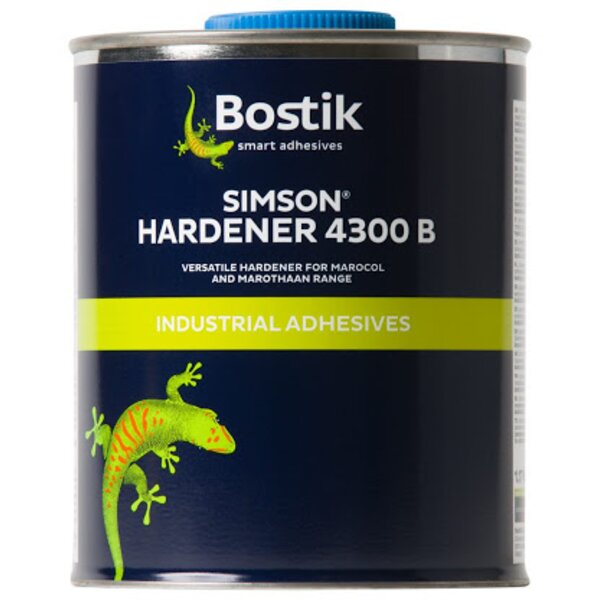
BOSTIK MAROCOL PU2D/480 CATALYTIC CONVERTER PART B

Regular price 24,89€

*VAT not included

SIMSON HARDENER 4300 B is a brown liquid hardener based on MDI diisocyanates for professional or industrial applications. It is used as a hardener component and must be handled with adequate ventilation, protective equipment and, from 24 August 2023, specific training for industrial or professional use. Consultar ficha técnica del fabricante.

*Contenido generado por IA

    Presentation: lata
    Capacity: 1,17 kg
    Colour:

Features

    Presentation: lata
    Capacity: 1,17 kg
    Colour:

description

1. What it is and why choose it

BOSTIK MAROCOL PU2D/480 CATALYTIC CONVERTER PART B is an isocyanate-based hardener (Part B) supplied by Bostik, designed for professional and industrial applications. It is a brown liquid with an earthy odor, formulated as a mixture of diphenylmethane diisocyanates and related isocyanates.

This hardener is intended to be used in combination with compatible Part A products as specified by the manufacturer. It offers controlled curing performance when handled correctly and under adequate industrial hygiene and safety conditions.

Use is restricted to trained professional and industrial users. Consumer applications that require heating above ambient temperature are not allowed.

2. Main characteristics

  • Type: Isocyanate-based hardener (mixture of diphenylmethane diisocyanates and homologues).
  • Physical form: Brown liquid with earthy odor.
  • Intended use: Hardener for professional/industrial systems (Part B).
  • Classification (CLP, Regulation (EC) 1272/2008):
    • Acute toxicity inhalation (dust/mist): Category 4 (H332)
    • Skin corrosion/irritation: Category 2 (H315)
    • Serious eye damage/irritation: Category 2 (H319)
    • Respiratory sensitisation: Category 1 (H334)
    • Skin sensitisation: Category 1 (H317)
    • Carcinogenicity: Category 2 (H351)
    • Specific target organ toxicity – single exposure: Category 3 (H335, respiratory irritation)
    • Specific target organ toxicity – repeated exposure: Category 2 (H373)
  • Key hazards:
    • Causes skin and eye irritation.
    • Harmful if inhaled.
    • May cause allergy or asthma symptoms or breathing difficulties if inhaled.
    • May cause an allergic skin reaction.
    • Suspected of causing cancer.
    • May cause damage to organs (especially lungs) through prolonged or repeated inhalation exposure.
  • Additional product-specific notes:
    • Contact with water or moisture liberates carbon dioxide, which can cause pressure build-up in closed containers.
    • From 24 August 2023, adequate training is legally required for industrial or professional use of diisocyanate-containing products in the EU.
    • Professional cleaning operations with aprotic polar solvents are not permitted.

3. Technical specifications

3.1 Composition (main hazardous components)

  • Diphenylmethane diisocyanate, isomers and homologues (CAS 9016-87-9): 80–100 %
  • 4,4'-Methylenediphenyl diisocyanate (CAS 101-68-8): 10–<20 %
  • o-(p-Isocyanatobenzyl)phenyl isocyanate (CAS 5873-54-1): 5–<10 %
  • 2,2'-Methylenediphenyl diisocyanate (CAS 2536-05-2): 0.01–<0.1 %

3.2 Physical and chemical properties

  • Appearance: Brown liquid
  • Odor: Earthy
  • Initial boiling point: > 300 °C
  • Flash point: ≥ 229 °C (closed cup)
  • Pour point: -30 °C
  • Dynamic viscosity: ≥ 145 mPa·s at 20 °C
  • Vapor pressure: 1.1 kPa at 20 °C
  • Density: 1.23 g/cm³
  • Water solubility: Immiscible in water
  • Oxidizing properties: Consultar ficha técnica del fabricante.
  • VOC content: No data available

3.3 Stability and reactivity

  • Chemical stability: Stable under normal conditions.
  • Reactivity: Reacts exothermically with amines and alcohols.
  • Conditions to avoid: Excessive heat; contact with moisture in closed containers.
  • Incompatible materials: Strong acids, strong bases, strong oxidising agents.
  • Hazardous reactions:
    • Contact with water/moisture releases CO₂, causing pressure increase in closed containers.
    • Hazardous polymerisation may occur, especially under fire conditions; closed containers may rupture violently.

4. Applications and use cases

  • Intended application: Hardener (Part B) for compatible Bostik systems in industrial and professional environments.
  • Typical use context:
    • Professional bonding and sealing systems where an isocyanate hardener is required.
    • Industrial applications carried out in well-ventilated areas, using appropriate personal protective equipment.
  • Uses advised against:
    • Consumer applications, especially those requiring heating above ambient temperature before or during use.
    • Professional cleaning operations with aprotic polar solvents.

5. FAQ

5.1 Frequently asked questions

  1. Is BOSTIK MAROCOL PU2D/480 CATALYTIC CONVERTER PART B suitable for consumer DIY use?

    No. The product is intended only for industrial and professional users. Consumer applications, particularly those involving heating above ambient temperature, are not allowed.

  2. What are the main health hazards when using this hardener?

    It is harmful if inhaled, causes skin and eye irritation, may cause allergic skin and respiratory reactions, and is suspected of causing cancer. Prolonged or repeated inhalation exposure may damage the lungs and other organs.

  3. Does this product contain diisocyanates?

    Yes. It contains diphenylmethane diisocyanate isomers and homologues, 4,4'-methylenediphenyl diisocyanate, o-(p-isocyanatobenzyl)phenyl isocyanate and 2,2'-methylenediphenyl diisocyanate.

  4. What should I do in case of inhalation exposure?

    Move the person to fresh air and keep them comfortable for breathing. If respiratory symptoms occur or breathing difficulties appear, contact a poison centre or doctor immediately.

  5. How should skin contact be handled?

    Wash immediately with plenty of soap and water for at least 15 minutes. Remove contaminated clothing and wash it before reuse. Seek medical advice if irritation or rash occurs.

  6. Can the product be mixed with water?

    No. It is immiscible with water, and contact with moisture liberates carbon dioxide, which can cause pressure build-up in closed containers.

  7. Is special training required to use this product in the EU?

    Yes. From 24 August 2023, adequate training is mandatory for industrial or professional use of diisocyanate-containing products.

  8. How should spills be cleaned?

    Prevent further leakage if safe. Contain with earth or sand and collect into suitable containers. Decontamination can be carried out with a solution of approximately 90 % water, 8–10 % sodium carbonate and 2 % liquid dishwashing soap, left in contact for at least 15 minutes. Observe local regulations for waste disposal.

  9. Can empty containers be reused?

    No. Empty containers must not be reused and should be disposed of according to local regulations.

  10. Is the product classified as dangerous for transport?

    No. According to the SDS, it is not regulated as a dangerous good for road, rail, sea or air transport.

6. Section 14 – Transport information

  • UN number: Not regulated.
  • Proper shipping name: Not applicable.
  • Transport hazard class:
    • ADR/RID (road/rail): Not regulated.
    • IMDG (sea): Not regulated; not classified as a marine pollutant (NP).
    • IATA/ICAO (air): Not regulated.
  • Packing group: Not regulated.
  • Environmental hazards: Not applicable under transport regulations.
  • Special precautions for user: No special provisions indicated; follow general regulations for transport of chemical products and ensure containers remain tightly closed and secured in an upright position.

7. Section 8 – Individual protection measures

7.1 Exposure controls

  • Engineering controls:
    • Ensure adequate general and/or local exhaust ventilation, especially in confined areas.
    • Vapours and aerosols should be captured directly at the point of origin.
    • Provide safety showers and eye-wash stations in the work area.

7.2 Personal protective equipment (PPE)

  • Eye/face protection:
    • Wear safety glasses with side shields or chemical splash goggles.
    • Eye protection must comply with EN 166.
  • Hand protection:
    • Wear suitable chemical-resistant gloves conforming to EN 374.
    • Recommended materials: nitrile rubber or Viton.
    • Glove thickness: > 0.7 mm; typical breakthrough time > 480 minutes (verify with glove supplier).
    • Not suitable: natural rubber gloves and disposable gloves.
  • Skin and body protection:
    • Wear suitable protective clothing to prevent skin contact.
    • Remove and wash contaminated clothing (inside and out) before reuse.
  • Respiratory protection:
    • If ventilation is inadequate or during spraying, use appropriate respiratory protection.
    • Recommended: respirator conforming to EN 140 with Type A/P2 filter or better (filter for organic gases and vapours according to EN 14387).

7.3 General hygiene measures

  • Avoid breathing vapours, aerosols or mists.
  • Avoid contact with skin, eyes and clothing.
  • Do not eat, drink or smoke while using the product.
  • Wash hands thoroughly before breaks and after handling.
  • Remove contaminated clothing and shoes immediately; wash before reuse.

*Contenido generado por IA

SAFETY DATA SHEETS

SAFETY DATA SHEETS

link

Catalog

Ref. Amount*
30172413 24,89 €
Page up

Product Quick View Popup

Vendor: Optimal

Product Type: Tops

SKU: 50-ABC

In stock Pre-order Now Sold out Order now, Only 10 left!
$400.00$300.00
Optimal Multipurpose Bootstrap 5 Html Template that will give you and your customers a smooth shopping experience which can be used for various kinds of stores such as fashion..
  • Black
  • Green
  • Orange
  • Blue
  • Red
  • XS
  • S
  • M
  • L
  • XL

Added to your shopping cart successfully.

Added to your shopping cart successfully.
Ditsy Floral Dress

Color: Gray

1 X $113.88

Total: $113.88