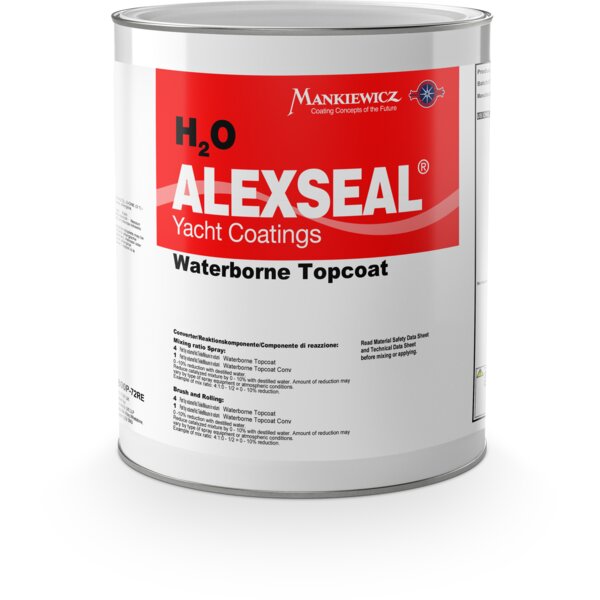
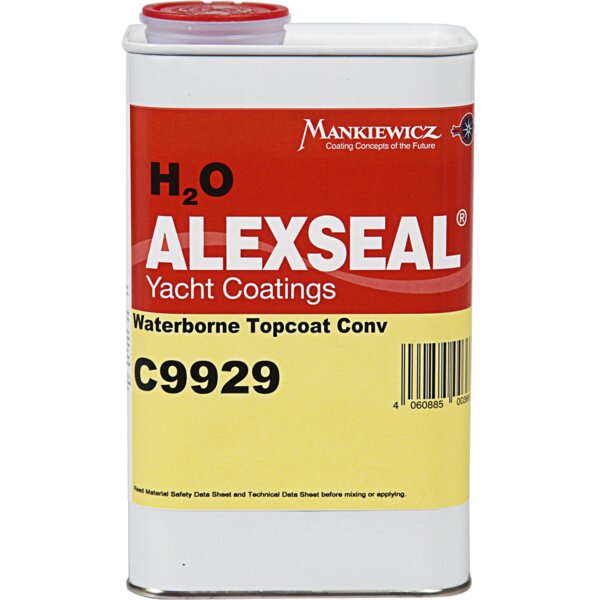
What is ALEXSEAL Waterborne Topcoat and why choose it
ALEXSEAL Waterborne Topcoat is a two-component, water-reducible polyurethane topcoat designed for professional marine and industrial environments. Once cured, it delivers high gloss retention and excellent colour stability, even under extreme climatic conditions. The cured film offers resistance to abrasion, scratching, solvents, chemicals, synthetic cooling agents and hydraulic oils.
The product is approved according to IMO Resolution MSC.307 (88) (FTP Code 2010) as a marine paint with low flame-spread characteristics, making it suitable for safety-relevant areas on board. Its waterborne formulation helps reduce solvent emissions while still achieving durable, high-performance protection.
Main features
- Two-component, water-reducible polyurethane topcoat.
- High gloss retention and durable colour resistance under extreme climatic conditions.
- Resistant to abrasion, scratching, solvents, chemicals, synthetic cooling agents and hydraulic oils.
- Approved as a marine coating with low flame-spread characteristics in accordance with IMO Resolution MSC.307 (88) (FTP Code 2010).
- Suitable for use in engine rooms, lockers and other areas where a water-based product is preferred.
- Can be applied directly to fibreglass thanks to very good adhesion properties.
- Available in factory-packaged standard colours (including white and Oyster White W9128, glossy).
- Designed exclusively for professional use.
Technical specifications
General product data
- Product type: Waterborne two-component polyurethane topcoat.
- Chemical nature: Mixture of synthetic resins, water and pigments.
- Appearance: Gloss finish (according to product name/colour).
- Flash point: > 120 °C (ISO 13736).
- Auto-ignition temperature: > 300 °C.
- Density: Approximately 1.2 g/cm³ (20 °C).
- pH: 7 – 9 (20 °C).
- VOC content: Approximately 14.86 %, 300 g/l (Directive 2010/75/EU).
Colour and packaging
- Colours: Factory-packaged standard colours.
- Base material: ALEXSEAL Waterborne Topcoat (Base Colour), 1 gal.
- Converter: C9929 ALEXSEAL Waterborne Topcoat Converter, 1 qt.
- Reducer: Distilled water.
Volume solids and coverage
- Volume solids (catalysed, without reduction): 46 %.
Coverage for 2-coat application (base + converter, without reducer):
- Theoretical, brush and roller: 12 m²/l; 45 m²/gal; 484 sq. ft./gal at 40–50 µm DFT.
- Practical, conventional air spray: 7.2 m²/l; 27.2 m²/gal; 293 sq. ft./gal at 40–50 µm DFT.
- Practical, HVLP spray: 8.4 m²/l; 31.7 m²/gal; 342 sq. ft./gal at 40–50 µm DFT.
Mixing ratios
Spray application
- 4 parts by volume ALEXSEAL Waterborne Topcoat (Base Colour).
- 1 part by volume C9929 ALEXSEAL Waterborne Topcoat Converter.
- 10 – 15 % by volume distilled water.
- Example: 4 : 1 : 1/2 to 3/4 (approx. 20 % reduction).
Brush and roller application
- 4 parts by volume ALEXSEAL Waterborne Topcoat (Base Colour).
- 1 part by volume C9929 ALEXSEAL Waterborne Topcoat Converter.
- 5 – 10 % by volume distilled water.
- Example: 4 : 1 : 1/4 up to 1/2 (approx. 5 – 10 % reduction).
The amount of distilled water required may vary depending on application conditions. Mixed material must be filtered before application. Mix base and converter with a high-speed mixer for approximately 2 minutes before adjusting viscosity with water.
Application parameters
- Application viscosity: Zahn #2 ≈ 37 – 50 s; DIN 4 cup 4 mm ≈ 30 – 40 s.
- Gravity gun nozzle: 1.0 – 1.4 mm (0.040 – 0.050 in), conventional and HVLP.
- Siphon cup nozzle: 1.2 – 1.6 mm (0.046 – 0.060 in), conventional and HVLP.
- Pressure pot fluid nozzle: 1.0 – 1.2 mm (0.040 – 0.042 in), conventional and HVLP.
- Atomizing pressure: 3.0 – 3.5 bar (42 – 50 psi), conventional and HVLP.
- Pot pressure: 0.7 – 1.5 bar (10 – 20 psi), conventional and HVLP.
Recommended film thickness and application method
Spray application
- Coats: 2 coats.
- Wet film thickness (WFT) per coat: 30 – 40 µm (approx. 1.1 – 1.6 mils).
- Flash-off time between coats: 60 minutes.
- Resulting dry film thickness (DFT) for 2 coats: 30 – 40 µm (approx. 1.2 – 1.6 mils).
- Maximum recommended total WFT: 60 – 80 µm (approx. 2.5 – 3 mils).
- Maximum recommended total DFT: 30 – 40 µm (approx. 1.2 – 1.6 mils).
Brush and roller application
- Coats: 2 coats.
- Wet film thickness (WFT) per coat: 30 – 40 µm.
- Dry to tape stage between coats: 12 – 24 h.
- Sanding between coats: Abrasive grain 320 – 400.
- Resulting dry film thickness (DFT) for 2 coats: 30 – 40 µm.
- Maximum recommended total WFT: 60 – 80 µm.
- Maximum recommended total DFT: 30 – 40 µm.
Substrate preparation
- Substrate must be clean, dry and free from dust and grease.
- May be applied directly to fibreglass due to good adhesion properties.
Environmental conditions, pot life and drying
- Optimal application environment: 15 °C (60 °F), 40 % RH to 30 °C (85 °F), 80 % RH.
- Minimum temperature during drying: 15 °C (60 °F).
- Ideal temperature: 25 °C (77 °F).
- Minimum application conditions: at least 3 °C (5.4 °F) above dew point.
Approximate times (depend on temperature, air flow, sunlight, reducer quantity and film thickness):
| Condition |
15 °C (60 °F) |
20 °C (68 °F) |
25 °C (77 °F) |
30 °C (85 °F) |
| Pot life |
2 – 3 h |
2 – 3 h |
2 h |
1.5 h |
| Dust free (approx. 60 % RH) |
4 h |
3 h |
2 h |
1 h |
| Tape dry |
26 h |
24 h |
18 h |
12 h |
| Fully cured |
21 days |
18 days |
14 days |
12 days |
| Recoat with ALEXSEAL Waterborne Topcoat (after tack free) |
90 min |
60 min |
60 min |
60 min |
| Overcoat with another product (sanding required) |
24 h |
24 h |
18 h |
12 h |
Health and safety classification (summary)
- Classification: Skin sensitisation, Category 1 (H317: May cause an allergic skin reaction).
- Additional EUH211: Warning that hazardous respirable droplets may be formed when sprayed; do not breathe spray or mist.
Applications and use cases
- Engine rooms on vessels where low flame-spread and chemical resistance are required.
- Lockers and enclosed technical spaces exposed to mechanical wear, oils and cleaning agents.
- Other interior or protected surfaces where a water-based, low-flame-spread marine coating is desired.
- Fibreglass substrates in marine or industrial environments, applied directly thanks to strong adhesion.
FAQ
1. Where is ALEXSEAL Waterborne Topcoat typically used?
It is used mainly in engine rooms, lockers and other surfaces where a water-based marine coating with low flame-spread properties is required.
2. Can it be applied directly on fibreglass?
Yes. Due to its good adhesion properties, ALEXSEAL Waterborne Topcoat can be applied directly to fibreglass substrates prepared to be clean, dry and free of dust and grease.
3. How many coats are recommended?
The technical data specifies a 2-coat system, applied either by spray or by brush/roller, reaching a total dry film thickness of approximately 30 – 40 µm.
4. What mixing ratio should I use for spraying?
For spray application, mix 4 parts base with 1 part converter and add 10 – 15 % distilled water by volume. Mixed material should be filtered before application.
5. What is the pot life of the mixed product?
Depending on temperature, the pot life is approximately 2 – 3 hours at 15 – 20 °C, 2 hours at 25 °C and 1.5 hours at 30 °C.
6. How long does the coating take to fully cure?
Full cure is reached after approximately 21 days at 15 °C, 18 days at 20 °C, 14 days at 25 °C and 12 days at 30 °C.
7. Is the product solvent-free?
No. The coating is water-reducible but contains organic components. The VOC content is approximately 14.86 %, equal to about 300 g/l.
8. Is ALEXSEAL Waterborne Topcoat classified as dangerous for transport?
No. According to the transport information, it is not regulated as a dangerous good for ADR, IMDG or IATA.
9. Does the product have any particular health classification?
Yes. It is classified as Skin Sensitiser Category 1 (H317: May cause an allergic skin reaction). Appropriate personal protection and handling procedures are required.
10. Can I overcoat this topcoat with another system?
Yes. Overcoating with another product is possible after the specified waiting times, but appropriate surface preparation including sanding is required.
Section 14 – Transport information
- UN number or ID number (ADR/IMDG/IATA): Not regulated as a dangerous good.
- UN proper shipping name (ADR/IMDG/IATA): Not regulated as a dangerous good.
- Transport hazard classes (ADR/IMDG/IATA): Not regulated as a dangerous good.
- Packing group (ADR/IMDG/IATA): Not regulated as a dangerous good.
- Environmental hazards: Not regulated as a dangerous good.
- Special precautions for user: If transported within the user’s premises, always transport in closed, upright and secure containers. Ensure that persons handling these containers are aware of procedures in case of incident or spillage.
- Maritime transport in bulk according to IMO instruments: Not applicable for the product as supplied.
Section 8 – Individual protection measures
General engineering controls
- Provide adequate ventilation. Where possible, use local exhaust ventilation and good general extraction.
- If ventilation does not maintain concentrations below applicable occupational exposure limits, suitable respiratory protection must be worn.
Eye and face protection
- Wear safety goggles to protect against splashes.
Hand protection
- Use chemical-resistant protective gloves tested in accordance with EN 374.
- Recommended glove materials for short-term contact (splash protection): nitrile rubber or neoprene.
- Minimum glove thickness: > 0.4 mm.
- Minimum breakthrough time: > 480 minutes.
- Gloves must be checked for specific suitability at the workplace and replaced immediately when damaged or worn.
- Preventive skin protection (skin protection cream) and immediate washing of contaminated skin are recommended.
Skin and body protection
- Wear appropriate protective clothing, adapted to the probability of occurrence of potentially explosive atmospheres and contact with the product.
Respiratory protection
- If exposure levels exceed occupational exposure limits, use appropriate certified respirators (for example a half mask with cartridge or air-fed system).
- Dry grinding, torch cutting or welding on coated surfaces can produce hazardous dust and/or vapours; where practicable, use wet methods and exhaust hoods. If exposure cannot be adequately controlled, wear suitable respiratory protection.
- When operators have to work inside spray booths and ventilation may not be sufficient, they should wear a compressed air-fed respirator during spraying until particulate and vapour concentrations are below exposure limits.
Additional protective measures
- Do not eat, drink or smoke during use.
- Avoid contact with skin, eyes and clothing.
- Contaminated work clothing should not be taken out of the workplace before proper cleaning.
*Contenido generado por IA