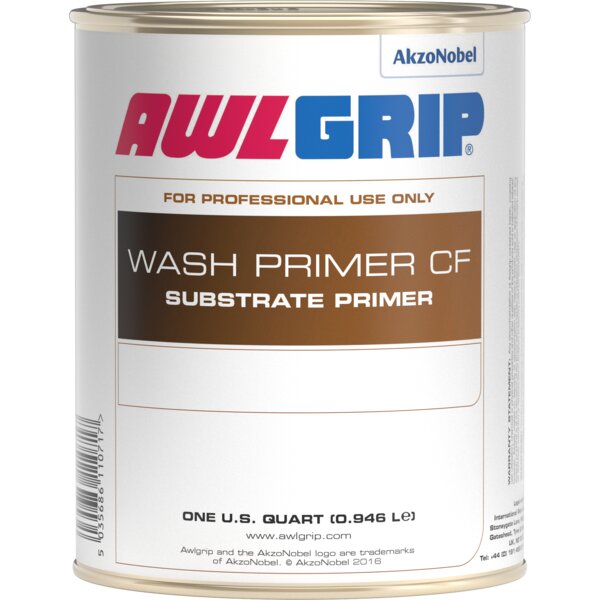
What Wash Primer CF is and why choose it
Wash Primer CF from Awlgrip is a chromate-free etch primer based on Controlled Fusion (CF) technology. This unique chemical system provides extended re-coat windows, eliminates the need for sanding before applying subsequent coats and delivers excellent adhesion to suitable metal substrates. By avoiding high-hazard chromates and ensuring a tightly fused intercoat layer, Wash Primer CF offers a modern, high-performance substrate pre-primer for professional and industrial exterior coating systems.
Main features
- Chromate-free etch primer: designed to promote adhesion on aluminium, anodised aluminium and stainless steel without using chromate pigments.
- Controlled Fusion (CF) technology: creates a chemically fused intercoat layer that improves adhesion between Wash Primer CF and the subsequent primer or topcoat.
- No sanding required before overcoating: extended re-coat times remove the need to sand prior to applying compatible primers or topcoats, when overcoated within the recommended window.
- Extended overcoating window: minimum 1 hour and maximum 6 months at 25 °C / 50 % RH before overcoating, without sanding, provided surfaces remain clean.
- Fast drying: at 25 °C / 50 % RH the film is dust free in approximately 30 minutes, touch dry in 60 minutes and hard dry in 2 hours.
- Excellent adhesion to metals: suitable for properly prepared aluminium, architectural anodised aluminium and stainless steel substrates.
- Versatile application: can be applied by conventional air-atomized spray; brush and roller use is possible on some substrates but spray is recommended directly on metal to avoid roller-fibre contamination.
- High theoretical coverage: approximately 10 m²/L at 13–14 µm dry film thickness (DFT), depending on application technique and conditions.
- Two-component system: Yellow Base D6600 and Converter D3300 mixed 1:1 by volume.
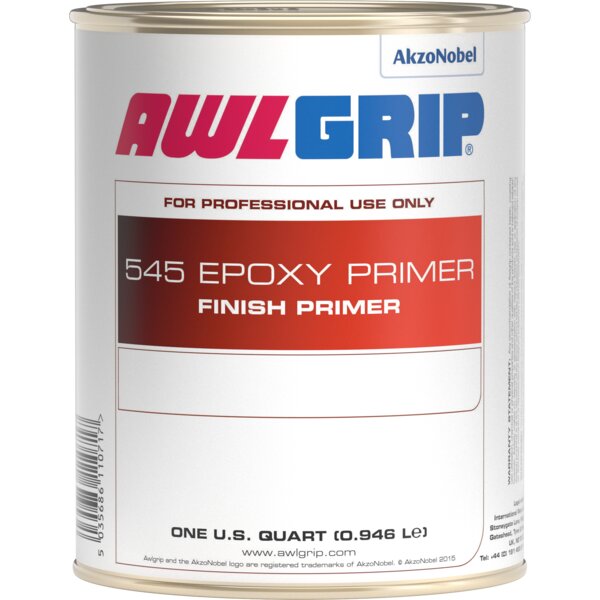
- Compatible systems: can be overcoated with Awlgrip 545 Epoxy Primer and Awlgrip, Awlgrip HS, Awlcraft 2000 and Awlcraft SE topcoats. Not suitable beneath Awlgrip Fairing Compounds.
Technical specifications
Product type and appearance
- Type: chromate-free etch primer (substrate pre-primer).
- Color (base): Yellow.
- Physical state: liquid.
Packaging and components
- Available packs: 0.946 L (1 US quart) Yellow Base (D6600) and 0.946 L (1 US quart) Converter (D3300).
- Mixing ratio (by volume): 1 part D6600 Yellow Base : 1 part D3300 Converter.
- Reducer: not required; material is supplied at maximum allowable VOC.
- Typical shelf life: 2 years.
- Equipment cleaning: T0006 or T0002 reducers, or M.E.K.
Film thickness and coverage
- Recommended wet film thickness (WFT): 50–100 µm per coat (approx. 2–4 mils) by conventional spray.
- Recommended dry film thickness (DFT): 6–13 µm (approx. 0.25–0.5 mil) per coat.
- Number of coats: one coat at 6–13 µm DFT; additional coats are not required once the coating is hard dry.
- Theoretical coverage: approx. 10 m²/L at 13 µm DFT (407.4 ft²/gal at 0.5 mil DFT), based on 100 % transfer efficiency. Actual coverage will vary with equipment, technique, part geometry and conditions.
Drying and curing at 25 °C (77 °F) / 50 % RH
- Dust free: 30 minutes.
- Touch dry: 60 minutes.
- Hard dry: 2 hours.
- Light service / handling: 3 days.
- Full cure (maximum hardness and adhesion): 7 days after topcoat application.
- Pot life (mixed product): 8 hours.
Overcoating intervals and compatibility
- Minimum overcoat time at 25 °C / 50 % RH: 1 hour with compatible primers and topcoats.
- Maximum overcoat time without sanding: 6 months, provided the surface remains clean; cleanliness should be inspected before recoating.
- Compatible primers: Awlgrip 545 Epoxy Primer, 321 HS Undercoat (in build systems).
- Compatible topcoats (spray): Awlgrip Topcoat, Awlgrip HS Topcoat, Awlcraft 2000, Awlcraft SE.
- Not suitable for use under: Awlgrip Fairing Compounds.
- Important: Wash Primer CF will soften when overcoated with solvent-based products; full hardness and adhesion develop 1 week after topcoat application. For build systems, no assembly, stacking, drilling or similar operations should take place before 2 weeks at 25 °C or 3 weeks at 13 °C.
VOC data
- VOC (product as supplied, mixed, no reducer): approx. 780 g/L (6.51 lb/gal).
- VOC (base D6600): 675 g/L.
- VOC (converter D3300): 908 g/L.
Recommended application equipment and settings
- Application methods: conventional air-atomized spray is recommended; brush or roller application is possible, but when coating metal directly, apply by spray only to avoid roller-fibre entrapment.
- Spray gun type: gravity-fed conventional gun.
- Tip size: 1.1–1.4 mm.
- Atomising pressure: 3–4 bar at source (depending on hose length).
- Application viscosity: approx. 14–18 s (DIN 4) for wet paint application (guidance).
Surface preparation
- Suitable substrates: aluminium, anodised aluminium (including architectural grades) and stainless steel.
- Unsuitable substrates: wood and plastic surfaces.
- Cleaning: thoroughly clean and degrease using commercial detergents, steam cleaners or pressure washers. Rinse completely to remove detergent residues. Perform a final wipe-down with Awlgrip Wipe Down Solvent (NA: Awlprep Plus T0115; EU: Surface Cleaner T0340).
- Stainless steel: abrade thoroughly with 80–120 grit abrasive to a coarse matte surface to optimise mechanical adhesion.
- Anodised aluminium: abrade with 180–220 grit to fully break the anodised layer; for architectural anodised aluminium, sand thoroughly with 40–80 grit until a clear profile is achieved, then clean and degrease again.
Environmental and application conditions
- Recommended substrate and ambient temperature: between 13 °C and 41 °C (55–105 °F).
- Dew point: do not apply to surfaces less than 3 °C (5 °F) above dew point.
- Maximum surface temperature: do not apply to surfaces warmer than 41 °C (105 °F).
Applications and use cases
- General topside systems: one-coat etch primer under Awlgrip or Awlcraft spray-applied topcoats on aluminium or stainless steel topsides and superstructures, where excellent adhesion and extended recoat time are required.
- Fast-drying topcoat systems: used as a thin CF layer (approx. 50 µm WFT / 6 µm DFT) prior to two or three coats of Awlgrip, Awlgrip HS or Awlcraft 2000 topcoats when a rapid through-dry schedule is needed.
- Build systems for defect-hiding: applied as an adhesion-promoting wash coat before 545 Epoxy Primer or 321 HS Undercoat and subsequent Awlgrip or Awlcraft topcoats, to increase overall system thickness and help hide surface imperfections.
- Architectural anodised aluminium: suitable as a pre-primer over properly sanded and cleaned architectural anodised aluminium where strong adhesion to subsequent epoxy primer and topcoat systems is required.
- Stainless steel components: provides an adhesion-promoting wash coat on abraded stainless fixtures, rails and fittings as part of a full Awlgrip system.
FAQ
1. On which substrates can I use Wash Primer CF?
Wash Primer CF is suitable for aluminium, anodised aluminium (including architectural grades) and stainless steel that have been properly cleaned and mechanically abraded. It is not suitable for wooden or plastic surfaces.
2. Do I need to sand Wash Primer CF before applying the next coat?
No sanding is required if compatible primers or topcoats are applied within the recommended overcoating window (minimum 1 hour, maximum 6 months at 25 °C / 50 % RH) and the surface remains clean.
3. What is the recommended mixing ratio?
Mix 1 part Yellow Base D6600 with 1 part Converter D3300 by volume. Reduction is not required.
4. How thick should I apply the primer?
Apply 1 coat by conventional spray at 50–100 µm wet film thickness to achieve 6–13 µm dry film thickness. Achieving the recommended film build is essential for a flat, even surface.
5. Which primers and topcoats can be applied over Wash Primer CF?
Wash Primer CF can be overcoated with Awlgrip 545 Epoxy Primer and with Awlgrip, Awlgrip HS, Awlcraft 2000 and Awlcraft SE topcoats applied by spray. It is not suitable under Awlgrip Fairing Compounds.
6. How long does the mixed product remain usable?
The pot life of the mixed material is approximately 8 hours at 25 °C / 50 % RH.
7. When can the coated parts be put into service?
The film is dust free in about 30 minutes and hard dry in 2 hours at 25 °C, but full hardness and adhesion develop 7 days after topcoat application. For build systems, assembly, stacking or drilling should not take place before 2 weeks at 25 °C or 3 weeks at 13 °C.
8. Can I apply Wash Primer CF below the waterline?
The application guidance specifies not to apply the system below the waterline.
9. What are the recommended environmental conditions during application?
Apply only when ambient temperature is between 13 °C and 41 °C, the surface temperature is at least 3 °C above the dew point and does not exceed 41 °C.
10. What is the theoretical coverage of Wash Primer CF?
At a recommended DFT of about 13–14 µm, the theoretical coverage is approximately 10 m²/L, depending on application efficiency and conditions.
Section 14 – Transport information
The following transport data apply to Wash Primer CF Yellow Base as supplied:
- UN number (ADR/RID, IMDG, IATA): UN1263.
- Proper shipping name: PAINT.
- Transport hazard class: Class 3 – Flammable liquid.
- Packing group: III.
- ADR/RID tunnel restriction code: (D/E).
- IMDG emergency schedules: F-E, S-E.
- Environmental hazards: classified as environmentally hazardous for ADR/RID; the environmentally hazardous substance mark is not required when transported in pack sizes of ≤5 L or ≤5 kg.
- Bulk transport according to IMO instruments: not applicable.
Section 8 – Individual protection measures
The following personal protective measures are indicated for handling and applying Wash Primer CF Yellow Base in professional and industrial environments:
General hygiene measures
- Use only with adequate ventilation and explosion-proof equipment where required.
- Avoid breathing vapors or spray mist and avoid contact with skin, eyes and clothing.
- Do not eat, drink or smoke in areas where the product is handled or applied.
- Wash hands, forearms and face thoroughly after handling and before eating, smoking or using the lavatory.
- Remove contaminated clothing and protective equipment before entering eating areas; wash contaminated clothing before reuse.
Eye and face protection
- Wear safety eyewear complying with an approved standard when there is a risk of exposure to liquid splashes, mists or spray.
- Chemical splash goggles are recommended when spraying or where splashes may occur.
Hand protection
- Wear chemical-resistant, impervious gloves complying with EN 374 or equivalent, whenever handling the mixed product.
- For prolonged or frequently repeated contact, gloves with protection class 6 (breakthrough time > 480 minutes according to EN 374) are recommended; suitable materials include Viton or nitrile with a thickness ≥ 0.38 mm.
- For brief contact, gloves with protection class 2 or higher (breakthrough time > 30 minutes according to EN 374) are acceptable; nitrile gloves with thickness ≥ 0.12 mm are recommended.
- Replace gloves regularly and immediately if damaged or if any sign of degradation is observed.
Skin and body protection
- Select protective clothing based on the specific task and associated risks.
- Where there is a risk of ignition from static electricity, use anti-static protective clothing that may include coveralls, boots and gloves with anti-static properties (see EN 1149 guidance).
- Use appropriate protective footwear and additional skin protection as required.
Respiratory protection
- Ensure good general ventilation; where ventilation is insufficient to maintain airborne concentrations below exposure limits, wear suitable respiratory protective equipment.
- A respirator conforming to EN 140 with type A/P2 filter (or better) is recommended during spraying and whenever vapors or mists may be present.
- Dry sanding, flame cutting or welding of the dry paint film can generate hazardous dusts and fumes; wet sanding is preferred. If exposure cannot be avoided, use appropriate respiratory protection.
Environmental exposure control
- Emissions from ventilation or process equipment should be checked to ensure compliance with relevant environmental legislation.
- Fume scrubbers, filters or engineering modifications may be required to reduce emissions to acceptable levels.
*Contenido generado por IA