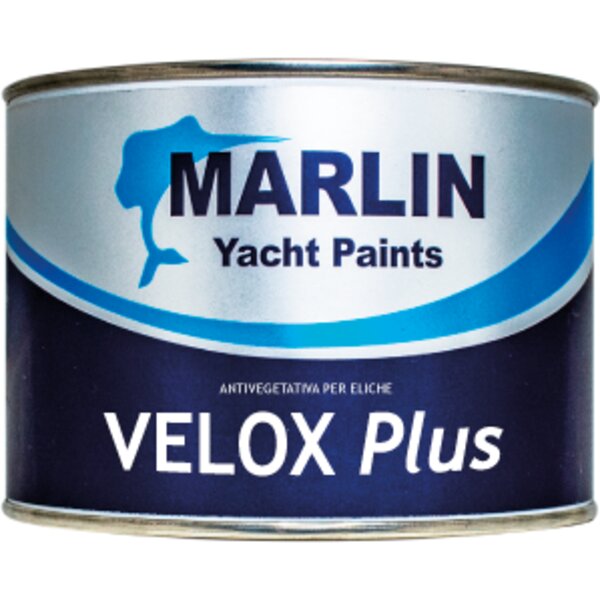
What is VELOX PLUS and why choose it
VELOX PLUS from Marlin Paints is a specialised antifouling paint designed for propellers, stern drives, shafts, fins, flaps and other propulsion system parts. Its unique combination of active ingredients with soluble and insoluble resins provides excellent adhesion and long-lasting antifouling efficiency, even under strong movement, galvanic currents and cavitation.
The coating forms an extremely thin film that does not reduce propeller performance and is applied exclusively over METAL PRIMER. When the surface is correctly prepared and the application instructions are followed, VELOX PLUS delivers reliable protection on all types of propellers and metal components.
Main features
- Antifouling paint specifically formulated for propellers and propulsion gear.
- Excellent adhesion thanks to its resin system and mandatory METAL PRIMER undercoat.
- Very thin film that does not affect hydrodynamic efficiency.
- Suitable for bronze, stainless steel, aluminium (with appropriate priming) and factory-coated parts.
- Resistant to movement, galvanic currents and cavitation.
- Easy application by brush, roller or airless spray when surface preparation instructions are respected.
- Available colours: white, grey, black.
- Intended for professional users only.
Technical specifications
General data
- Product type: Antifouling paint.
- Recommended substrate: Metals in propulsion systems, always primed with METAL PRIMER.
- Colours: White, grey, black.
- Specific gravity: 1.25–1.35.
- Solids by volume: 35–40.
- VOC content (product sheet): 580–600 g/L.
- VOC (Directive 2010/75/EU, SDS): 49 of product weight.
- Total solids at 250°C: 51.
- Packaging sizes: 0.25 L, 0.50 L, 2.5 L.
- Shelf life: 24 months (stored between 10°C and 40°C, protected from excessive humidity and direct sunlight).
Coverage and film thickness
- Theoretical coverage: 10–11 m²/L per coat.
- Recommended wet film thickness per coat: 90–100 µm.
- Recommended dry film thickness per coat: 35–40 µm.
Application methods
- Application tools: Brush, roller, airless spray.
- Thinner: Thinner No. 4.
- Brush or roller: Apply two coats with 3 hours interval at 20°C.
- Airless spray: Apply one coat at 180–200 µm wet film thickness; recommended tip 0.12–0.18, fan angle 20–30°, pressure 1400–1800 PSI.
- Compatibility: Do not apply over other antifoulings; apply only over METAL PRIMER, never directly on bare metal.
Drying and recoat times
Indicative times; they may vary depending on temperature, film thickness, ventilation and humidity. Surface must be dry and free from contamination before recoating.
| Temperature |
Dust dry |
Touch dry |
Recoat |
Minimum time before immersion |
| 10°C |
30 min |
3 h |
6 h |
24 h |
| 20°C |
20 min |
2 h |
3 h |
12 h |
| 30°C |
15 min |
1.5 h |
2 h |
8 h |
Maximum time before launching: 6 months after application.
Applications and use cases
Recommended substrates
- Propellers of any type.
- Shafts.
- Stern drives and outdrives.
- Fins, flaps and other metal parts of propulsion systems.
- Factory-coated aluminium parts (after light sanding and METAL PRIMER).
Surface preparation
Previously coated with VELOX PLUS in good condition
- Wash with fresh water at pressure and/or wet sand with medium-fine abrasive paper.
Previously coated with unknown or defective antifouling
- Remove all old antifouling or other coatings with 80-grit abrasive paper, by hand or with an orbital sander, taking care not to damage the propeller or metal parts.
Bare metal: propellers, shafts, stern drives and other parts (bronze, stainless steel, aluminium)
- Sand all metal surfaces thoroughly with 80-grit abrasive paper, renewing it often.
- For larger areas, use an orbital sander; for difficult points, sand by hand.
- Do not use coarser paper (risk of removing too much metal) or finer paper (surface will not be rough enough).
- Clean all sanded metal with a dry cloth to remove dust and residues.
- An additional pass may be made with a clean cloth lightly moistened with SOLVENT 102 ANTISILICONE or pure acetone.
- Do not use acids, other solvents or detergents and do not touch sanded surfaces with bare hands. Any contamination may drastically reduce METAL PRIMER adhesion.
Factory painted aluminium parts
- Do not remove factory coatings.
- Degrease, lightly sand with fine paper or abrasive felt, then prime with METAL PRIMER.
Uncoated bare aluminium without factory paint
- Treat with an anticorrosive epoxy system such as 2–3 coats of PRIMEPOX.
- Sand and then treat as factory-painted parts.
Application conditions and recommendations
- Apply VELOX PLUS only on surfaces primed with METAL PRIMER; never directly on bare metal.
- Do not apply over other antifouling paints.
- Do not use acids to descale or clean before METAL PRIMER.
- Do not wash sanded surfaces with detergents, dirty solvents or water; use only SOLVENT 102 or thoroughly dry wipe.
- Do not touch prepared surfaces with bare hands before METAL PRIMER.
- Mix very thoroughly before use, as heavy pigments can separate in the can.
- At the time of METAL PRIMER application, the metal must be very rough (the rougher, the better the adhesion) and perfectly clean, free of grease, dust, water or solvent residues, including fingerprints and sweat.
- Recommended wet sanding only.
- Application temperature range: do not apply below 5°C or above 38°C. If temperature is below 10°C, wait at least 48 hours after the last coat before launching.
FAQ
-
On which parts of the boat can I use VELOX PLUS?
VELOX PLUS is intended for propellers, shafts, stern drives, fins, flaps and other metal components of the propulsion system that have been correctly primed with METAL PRIMER.
-
Can VELOX PLUS be applied directly on bare bronze or stainless steel?
No. VELOX PLUS must always be applied over METAL PRIMER. Direct application on bare metal is not allowed.
-
How many coats are needed?
When using brush or roller, two coats are recommended with 3 hours between them at 20°C. With airless spray, one coat at 180–200 µm wet film thickness is indicated.
-
How soon after painting can the boat be launched?
At 20°C, immersion is possible after 12 hours. Launch must take place within 6 months from application.
-
Which thinner should be used?
Only THINNER No. 4 is specified for VELOX PLUS. The product is ready for use and thinning is generally not recommended, except as indicated for spray application.
-
Can I apply VELOX PLUS over an existing antifouling?
No. VELOX PLUS is not compatible with other antifoulings. Old coatings must be removed and the full METAL PRIMER system used.
-
What storage conditions are required?
Store closed cans between 10°C and 40°C, protected from excessive humidity and direct sunlight. Under these conditions the shelf life is 24 months.
-
Is VELOX PLUS suitable for consumers?
The product is reserved exclusively for professional users, according to the safety data sheet.
Section 14 – Transport information
- UN number: 1263.
- UN proper shipping name (ADR / RID, IMDG, IATA): PAINT or PAINT RELATED MATERIAL.
- Transport hazard class: Class 3 (flammable liquids); label 3.
- Packing group: III.
- Environmental hazards: ADR / RID: Dangerous for the Environment; IMDG: Marine Pollutant; IATA: not classified as environmentally hazardous for air transport purposes.
- ADR / RID additional data: Kemler code 30; tunnel restriction code (D/E); limited quantities 5 L.
- IMDG additional data: EMS F-E, S-E; limited quantities 5 L.
- IATA additional data: Cargo aircraft maximum quantity 220 L (packing instruction 366); passenger aircraft maximum quantity 60 L (packing instruction 355); special provisions A3, A72, A192.
Section 8 – Individual protection measures
The following personal protective equipment is indicated in the safety data sheet and should be selected and used in accordance with local regulations and workplace risk assessments.
- General measures: Ensure good ventilation with effective local exhaust. Provide eye-wash station and safety shower. Keep exposure levels as low as possible and manage PPE replacement to maintain protection.
- Hand protection: Work gloves of category III compliant with EN 374, selected considering compatibility, degradation, breakthrough time and permeability.
- Skin and body protection: Long-sleeved work clothing and professional protective footwear of category III (Regulation 2016/425 and EN ISO 20344). Consider antistatic clothing where explosion risk exists. Wash with water and soap after removing protective garments.
- Eye protection: Tight-fitting safety goggles compliant with EN 166. When there is risk of splashes or jets, protect mucous membranes (eyes, nose, mouth) to avoid accidental absorption.
- Respiratory protection: When exposure limits are exceeded, use a respirator with type A filter, class 1, 2 or 3 according to concentration limits (EN 14387). For mixed vapours or vapours with particles, use combined filters. In emergencies or where the substance is odourless or odour threshold is above exposure limit, use an open-circuit compressed-air breathing apparatus (EN 137) or an air-line respirator (EN 138).
- Environmental exposure controls: Emissions from ventilation and process equipment should be controlled to comply with environmental regulations. Do not discharge product residues into sewers or waterways.
*Contenido generado por IA