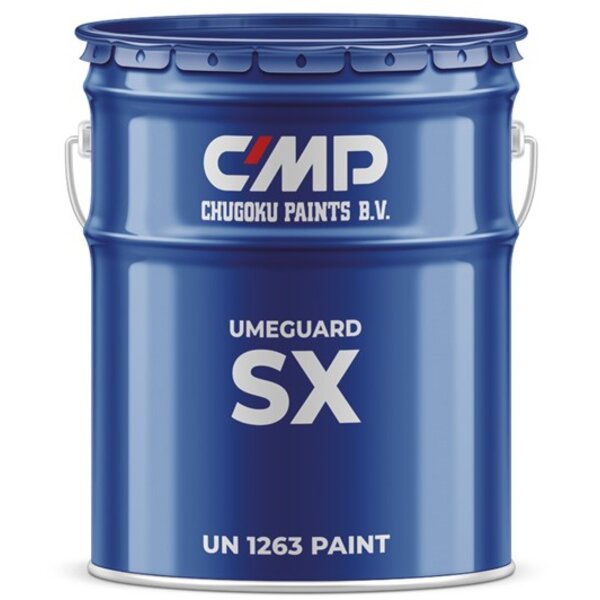
What is UMEGUARD SX PART A and why choose it?
UMEGUARD SX PART A is the base component of UMEGUARD SX, a two-pack, surface-tolerant epoxy multipurpose primer/finish from Chugoku. When mixed with the dedicated hardener (85:15 by volume), it forms a high performance coating that offers excellent adhesion, toughness and abrasion resistance, as well as resistance to water, seawater and crude oil. It is designed for maintenance and new work on steel and suitable concrete, especially where optimum surface preparation is difficult.
This coating can be used both as a primer and as a finish on areas where an ultra-decorative cosmetic appearance is not essential. It adheres well to a wide range of existing coatings and can be overcoated with many Chugoku finishing systems, making it a flexible choice for shipyards, repair yards and industrial applicators.
Main features
- Surface-tolerant epoxy system designed for steel in service, including slightly corroded areas where only limited surface preparation is possible.
- Multipurpose use on decks, holds, hatch covers, void spaces, cofferdams, accommodation spaces, engine rooms, pipelines and other steel structures. Also applicable on suitable concrete and galvanized steel after correct preparation.
- Primer and finish in one system, ideal where a separate high-build primer and finish are not required.
- Excellent adhesion and toughness with good abrasion resistance and resistance to water, salt water and crude oil.
- Good compatibility with existing coatings, including a wide range of Chugoku epoxy and acrylic finishes.
- On-board maintenance friendly: easy to clean between cargo shifts and can be overcoated with most marine finishes.
- FDA approval for carriage of grain when the full UMEGUARD SX system is correctly applied and cured.
- Two-pack epoxy with convenient 85:15 volume mixing ratio (Base: Hardener).
- Application flexibility: airless spray, brush or roller, with airless spray recommended to achieve specified dry film thickness in fewer coats.
Technical specifications
Chemistry and type
- Type: Surface-tolerant epoxy paint; multipurpose primer/finish.
- Components: Two-pack product (UMEGUARD SX PART A base + dedicated hardener).
Recommended use
- Inside and outside accommodation spaces.
- Void spaces and cofferdams.
- Engine rooms and related machinery spaces.
- Decks, holds and hatch covers.
- Pipelines and other steel structures.
- Submerged zones and pavements where specified in the technical documentation.
- Maintenance and repair of ships in service.
Surface preparation
- New steel (general guideline): abrasive blasting is recommended. Consultar ficha técnica del fabricante.
- Repair / maintenance (steel):
- Remove oil, grease and contaminants.
- Remove salt and other contamination by (high-pressure) fresh water cleaning and dry completely.
- Damaged areas: abrasive blast to Sa2 (ISO 8501-1:2007) minimum or power tool clean to St2 (ISO 8501-1:2007) minimum.
- Water jetting: Consultar ficha técnica del fabricante.
- Galvanized steel: degrease. For new galvanizing, create surface roughness by sweep blasting or sanding with inert abrasive.
- Concrete: remove grease, dirt and contamination. The surface must have sufficient porosity to allow sealing with UMEGUARD SX; thinning of the first coat is recommended for proper sealing.
Physical data (mixed product)
- Colour range: White, Black, Red brown, Grey, Green.
- Flash point (mix): 27°C.
- Volume solids: 57–58 % (±2) (ISO 3233).
- VOC (theoretical): approx. 437–470 g/l, depending on version/colour.
Application data
- Mixing ratio (by volume): Base (UMEGUARD SX PART A) 85 : Hardener 15.
- Thinner: EPOXY THINNER A.
- Minimum application temperature (substrate/ambient): 5°C.
- Maximum relative humidity: 85 % R.H.
- Surface temperature: at least 3°C above the dew point.
- Application methods: airless spray, brush, roller.
- Airless spray parameters (guideline):
- Tip size: Graco 419–623.
- Paint output pressure: approx. 14.7–17.7 MPa.
- Thinning: 0–15 % by volume with EPOXY THINNER A.
Film thickness and spreading rate (mixed product)
- Standard system (Spanish TDS):
- Wet film thickness: 125 µm.
- Dry film thickness: 75 µm.
- Theoretical spreading rate: 8.0 m²/l.
- Extended range (English/Japanese TDS):
- Wet film thickness: 132–351 µm.
- Dry film thickness: 75–200 µm.
- Theoretical spreading rate: 7.6–2.9 m²/l (depending on DFT).
- Note: When applied by brush or roller, additional coats may be required to reach the specified dry film thickness. Stripe coating of edges and welds is recommended.
Drying and overcoating (typical values at 200 µm DFT)
Values below refer to UMEGUARD SX overcoated with itself unless otherwise noted. Drying and overcoating times increase with higher film thickness.
- 5°C:
- Surface dry: approx. 4.5 hours.
- Hard dry: approx. 44 hours.
- Minimum overcoating: 44 hours.
- Maximum overcoating: Consultar ficha técnica del fabricante. (up to 180 days noted for self-overcoating in tables).
- 10°C:
- Surface dry: approx. 3.5 hours.
- Hard dry: approx. 27 hours.
- Minimum overcoating: 27 hours.
- Maximum overcoating: Consultar ficha técnica del fabricante. (up to 180 days for self-overcoating in tables).
- 20°C:
- Surface dry: approx. 2.5 hours.
- Hard dry: approx. 17 hours.
- Minimum overcoating: 17 hours.
- Maximum overcoating: Consultar ficha técnica del fabricante. (up to 180 days for self-overcoating in tables).
- 30°C:
- Surface dry: approx. 1.5 hours.
- Hard dry: approx. 12 hours.
- Minimum overcoating: 12 hours.
- Maximum overcoating: Consultar ficha técnica del fabricante. (up to 180 days for self-overcoating in tables).
Note: For cargo loading and immersion service, curing times and conditions should be confirmed with Chugoku before use.
Compatible systems
- Recommended preceding coats: WELBOND HM, CERABOND 2000, NZ PRIMER S, EPICON ZINC RICH PRIMER B-2 and a wide range of existing coatings.
- Recommended subsequent coats: UMEGUARD series, EPICON FINISH series, ACRI 700 FINISH, UNY MARINE / UNY MARINE HS M.
- Important: For detailed overcoat intervals with each specific product (e.g. UMEGUARD SX QD, EPICON FINISH series, ACRI 700 FINISH, UNY MARINE, RAVAX FINISH), follow the overcoatability tables in the technical documentation.
Applications and use cases
- Ship decks and walkways: High adhesion, abrasion resistance and surface tolerance make it a robust choice for exposed steel decks and walkways.
- Cargo holds and hatch covers: Easy cleaning between cargoes and FDA approval for grain carriage when fully cured.
- Ballast and void spaces: Suitable for void spaces and cofferdams where long-term corrosion protection is required.
- Engine room structures and pipelines: Resistant to water, seawater and crude oil, ideal for machinery spaces, pipe racks and pipe externals.
- Accommodation and internal spaces: Can be used inside accommodation and service spaces where a durable functional finish is required.
- Concrete and galvanized substrates: When correctly prepared, UMEGUARD SX can be used as a sealer/primer on concrete and as a coating on suitably roughened galvanized steel.
- On-board maintenance and repair: Designed as a maintenance-friendly system for vessels in service, with wide overcoating windows for on-board work.
FAQ
1. What is UMEGUARD SX PART A exactly?
UMEGUARD SX PART A is the base component of the UMEGUARD SX two-pack epoxy system. It must be mixed with the specified hardener (85:15 by volume) to form a surface-tolerant primer/finish for steel and suitable concrete.
2. On which areas of a vessel can I use this product?
It is recommended for decks, holds, hatch covers, accommodation areas (inside and outside), void spaces, cofferdams, engine rooms, pipelines and other steel structures, as well as specified submerged zones and pavements.
3. Can UMEGUARD SX be used as a finish coat?
Yes. It can be used as a finish coat on structures where excellent cosmetic appearance is not essential and where exposure to direct ultraviolet light is limited or where a dedicated topcoat will be applied later.
4. Is it suitable for slightly corroded steel?
Yes. UMEGUARD SX is surface tolerant and suitable for slightly corroded areas where optimum surface preparation (full blasting) is not practical, provided minimum standards such as Sa2 or St2 are met on damaged spots.
5. What thinning and application methods are recommended?
Use EPOXY THINNER A at 0–15 % by volume. Apply by airless spray for best film build; brush and roller can be used for spot repair and small areas, with additional coats as needed to achieve specified thickness.
6. Does the coating chalk under sunlight?
Yes. Like all epoxy coatings, UMEGUARD SX will chalk and may fade when exposed to UV light. For long-term cosmetic appearance, an appropriate topcoat such as UNY MARINE should be applied.
7. Which primers or previous coats are compatible?
It can be applied over WELBOND HM, CERABOND 2000, NZ PRIMER S, EPICON ZINC RICH PRIMER B-2 and a wide range of sound existing coatings, following proper surface preparation.
8. What about subsequent topcoats?
Recommended subsequent coats include the UMEGUARD series, EPICON FINISH series, ACRI 700 FINISH and UNY MARINE / UNY MARINE HS M. Overcoating intervals depend on temperature and location (exposed area, topside, etc.).
9. Is there any specific guidance for confined spaces?
Yes. In confined spaces such as tanks and void spaces, adequate ventilation is required during application and curing to remove vapours and to promote curing. Compressed air-fed respiratory protection may be needed where ventilation is insufficient.
10. Is UMEGUARD SX approved for carriage of grain?
UMEGUARD SX has FDA approval for grain carriage when correctly applied and fully cured in accordance with the manufacturer’s instructions.
Section 14 – Transport information
The following information is based on the Safety Data Sheet for UMEGUARD SX BASE (Part A):
- UN number: UN 1263.
- UN proper shipping name: PAINT.
- Transport hazard class: Class 3 (flammable liquid).
- Packing group: III.
- ADR / RID / ADN:
- Classification: UN 1263, PAINT, Class 3, Packing group III.
- Carriage in accordance with 2.2.3.1.5 for viscous substances up to 450 litre packs may apply.
- IMDG Code:
- UN 1263, PAINT, Class 3, Packing group III.
- Marine pollutant: No.
- Transport in accordance with 2.3.2.5 of the IMDG Code for viscous substances up to 30 litre packs may apply.
- Emergency Schedule (EmS): F-E, S-E.
- IATA:
- UN 1263, PAINT, Class 3, Packing group III.
- The viscosity exemption provision does not apply to air transport.
- Environmental hazards: Not classified as a marine pollutant.
- General transport advice: Always transport in closed, upright and secure containers. Ensure that personnel involved in transport know how to respond in case of accident or spillage.
Section 8 – Individual protection measures
The following personal protective equipment (PPE) recommendations are taken from the Safety Data Sheet for UMEGUARD SX BASE (Part A). Actual PPE selection must follow local risk assessment and regulations.
Engineering controls
- Provide adequate ventilation through local exhaust and general extraction to keep solvent vapour and particulates below occupational exposure limits.
- In spray booths or confined areas where ventilation alone is insufficient, use compressed air-fed respiratory protection during spraying and until vapour/particulate levels are below limits.
Respiratory protection
- Where concentrations may exceed exposure limits, use a respirator conforming to EN 140 fitted with a combined particulate and vapour filter to EN14387, with an assigned protection factor of at least 10 (for example A2P3).
- During dry sanding, flame cutting or welding on coated surfaces, wet methods or local exhaust should be used where possible; otherwise use suitable respiratory protection.
Hand protection
Use chemical-resistant gloves tested according to EN 374. The following materials are referenced in the SDS (minimum thickness and indicative breakthrough times):
- High protection, repeated/prolonged exposure (breakthrough time > 480 min):
- Polyethylene (PE) gloves, 0.062 mm.
- Polyvinyl alcohol (PVA) gloves, 0.2–0.3 mm.
- High protection, 240–480 min:
- Polyethylene (PE) gloves, 0.062 mm.
- PVA gloves, 0.2–0.3 mm.
- Medium protection, 120–240 min:
- Polyethylene (PE) gloves, 0.062 mm.
- PVA gloves, 0.2–0.3 mm.
- Butyl/Viton gloves, 0.70 mm.
- Medium protection, 60–120 min:
- Polyethylene (PE) gloves, 0.062 mm.
- PVA gloves, 0.2–0.3 mm.
- Butyl/Viton gloves, 0.70 mm.
- Short-term splash protection, 30–60 min:
- Polyethylene (PE) gloves, 0.062 mm.
- PVA gloves, 0.2–0.3 mm.
- Butyl/Viton gloves, 0.70 mm.
- Nitrile gloves, 0.31 mm.
- Short-term splash protection, 10–30 min:
- Polyethylene (PE) gloves, 0.062 mm.
- PVA gloves, 0.2–0.3 mm.
- Butyl/Viton gloves, 0.70 mm.
- Butyl gloves, 0.3 mm.
- Nitrile gloves, 0.175 mm.
- Not suitable (breakthrough < 10 min):
- Natural rubber gloves, 0.75 mm.
- Nitrile gloves, 0.75 mm.
- Neoprene gloves, 0.75 mm.
Nitrile gloves provide good protection for spray application, and Viton gloves offer good protection for intensive solvent contact. Always follow glove manufacturer instructions and replace gloves at the first sign of damage.
Eye and face protection
- Use safety eyewear tested to EN 16321 iso EN 166, designed to protect against liquid splashes (for example, chemical splash goggles or face shield).
Skin and body protection
- Wear anti-static clothing made of natural fibre or high temperature resistant synthetic fibre conforming to EN ISO 13688.
- Barrier creams may help protect exposed skin areas but must not be applied after exposure has occurred.
General hygiene measures
- Avoid contact with skin and eyes and avoid inhalation of vapours and spray mists.
- Do not eat, drink or smoke in the application area.
- Wash hands and face thoroughly after handling and before breaks.
*Contenido generado por IA .