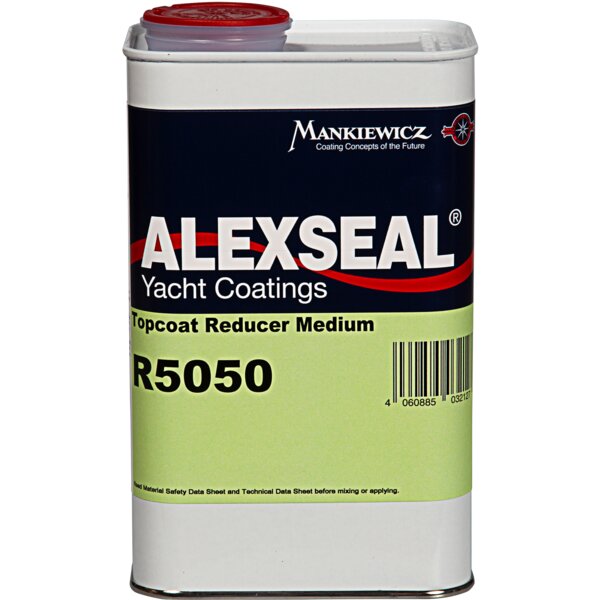
What is Alexseal Topcoat Reducer Slow R5030 and why choose it?
Alexseal Topcoat Reducer Slow R5030 is a halogen-free blend of organic solvents specifically formulated for industrial serial painting and for use with ALEXSEAL Premium Topcoat 501 and other compatible Alexseal polyurethane topcoats. As a slow reducer, it optimizes flow, leveling and gloss, particularly in warmer conditions or when larger yacht and boat surfaces are being sprayed. Used correctly, R5030 helps achieve a smooth, high-gloss finish with reduced orange peel and improved distinction of image.
This reducer is suitable for professional spray applications in the marine and industrial sectors, where controlled evaporation and consistent application properties are essential.
Main features of Alexseal R5030 Topcoat Reducer Slow
- Slow-evaporation reducer designed for use with ALEXSEAL Premium Topcoat 501 in spray applications.
- Halogen-free organic solvent blend, compatible with professional polyurethane coating systems.
- Supports extreme high-gloss finishes by improving flow-out and reducing application defects when correctly mixed and applied.
- Professional-grade product intended for industrial serial painting and yacht coating applications.
- Highly flammable liquid; requires strict handling, storage and PPE according to the Safety Data Sheet.
Technical specifications
- Product name: ALEXSEAL R5030-Topcoat Reducer Slow
- Use: Industrial serial painting; reducer for Alexseal topcoats (e.g. Premium Topcoat 501) in spray applications
- Chemical nature: Mixture of organic solvents, halogen-free
- Physical state: Liquid (20 – 25 °C, 1,013 hPa)
- Colour: According to product name
- Odour: Characteristic
- Boiling range: ca. 120 °C
- Flash point: 5 °C (ISO 13736)
- Auto-ignition temperature: > 400 °C
- Upper explosion limit: 10.0 % (v/v)
- Lower explosion limit: 1.0 % (v/v)
- Water solubility: Insoluble
- Miscibility with water: Immiscible
- Vapour pressure: ca. 100 hPa (50 °C)
- Density: 0.93 g/cm³ (20 °C)
- Viscosity (kinematic): > 6 mm²/s
- Main classified hazards (CLP): Flammable liquids, Category 2 (H225); Serious eye damage, Category 1 (H318); Reproductive toxicity, Category 2 (H361); STOT SE Category 3 – central nervous system (H336); EUH066 (repeated exposure may cause skin dryness or cracking).
Applications and use cases
- Yacht and boat finishing: Used as the slow reducer in Alexseal Premium Topcoat 501 spray applications on hulls, superstructures and other yacht surfaces.
- Industrial serial painting: Suitable for controlled spray application in professional paint shops where polyurethane topcoats are applied in series.
- Warm or high-build applications: The slow evaporation profile supports better flow and leveling where extended open time is beneficial.
FAQ – Alexseal R5030 Topcoat Reducer Slow
-
What is Alexseal Topcoat Reducer Slow R5030 used for?
It is used as a slow-evaporation reducer for Alexseal polyurethane topcoats, such as ALEXSEAL Premium Topcoat 501, in professional industrial and marine spray applications.
-
Is R5030 suitable for brush or roll application?
The technical data sheet for ALEXSEAL Premium Topcoat 501 specifies R5030 as a spray reducer. For brush and roll applications, R5015 ALEXSEAL Topcoat Reducer Brush is recommended.
-
Can I adjust the amount of reducer during application?
Yes. The technical data sheet for Premium Topcoat 501 states that additional reducer may be added to a previously mixed paint pot during application to improve flow-out consistency and results, within the recommended reduction range.
-
Is ALEXSEAL R5030 Topcoat Reducer Slow water-soluble?
No. The product is insoluble in water and immiscible with water.
-
How flammable is this reducer?
The product is classified as a highly flammable liquid (Flam. Liq. 2, H225) with a flash point of 5 °C. Keep away from heat, hot surfaces, sparks, open flames and all ignition sources.
-
Does the product have any health hazard classifications?
Yes. It is classified as causing serious eye damage (H318), suspected of damaging fertility or the unborn child if swallowed (H361), and may cause drowsiness or dizziness (H336). Repeated exposure may cause skin dryness or cracking (EUH066).
-
Can R5030 be released into drains or water courses?
No. The Safety Data Sheet states that the product should not be allowed to enter drains, rivers or water courses.
-
How should waste and empty packaging be handled?
Dispose of product and uncleanable packaging in accordance with local regulations. Contaminated packaging should be emptied as far as possible and, after appropriate cleaning, may be reused.
Section 14 – Transport information
- UN number / ID number: UN 1263
- UN proper shipping name (ADR / IMDG / IATA): PAINT RELATED MATERIAL
- Transport hazard class: Class 3 (flammable liquids)
- Packing group: II
- ADR classification code: F1
- ADR hazard identification number: 33
- ADR tunnel restriction code: (D/E)
- Labels (IMDG / IATA): Flammable Liquids (Class 3)
- EmS code (IMDG): F-E, S-E
- IATA packing instructions: 364 (cargo aircraft); 353 (passenger aircraft); Y341 (limited quantities)
- Environmental hazards: Not environmentally hazardous under ADR; not a marine pollutant under IMDG.
- Special note: For transport within the user’s premises, move only in closed, upright and secure containers. Ensure personnel handling the product know the procedures in case of incident or spillage.
Section 8 – Individual protection measures
Exposure controls
- Engineering controls: Provide adequate ventilation. Where possible, use local exhaust ventilation and good general extraction. If solvent vapour concentrations cannot be maintained below occupational exposure limits, suitable respiratory protection must be worn.
Personal protective equipment (PPE)
- Eye and face protection: Wear safety goggles to protect against solvent splashes.
- Hand protection:
- Use chemical-resistant protective gloves compliant with EN 374.
- Recommended for short-term contact (splash protection): nitrile rubber or neoprene, material thickness > 0.4 mm, breakthrough time > 480 minutes.
- Check glove suitability for the specific workplace (mechanical resistance, product compatibility, antistatic properties).
- Replace gloves immediately if damaged or at first signs of wear. Preventive skin protection cream and immediate washing of contaminated skin are recommended.
- Skin and body protection: Depending on the probability of dangerous explosive atmospheres, wear suitably adapted protective clothing. Anti-static clothing and footwear are recommended.
- Respiratory protection:
- If solvent concentrations exceed air limit values, use a breathing apparatus approved for this purpose.
- Use a half-mask model with cartridge or an air-fed respirator.
- When working inside spray booths, operators should wear a compressed air-fed respirator until particulate and solvent vapour concentrations fall below exposure limits.
- General protective measures:
- Do not eat, drink or smoke during use.
- Avoid contact with skin, eyes and clothing.
- Avoid inhalation of sanding dust, spray mist and solvent vapours.
*Contenido generado por IA