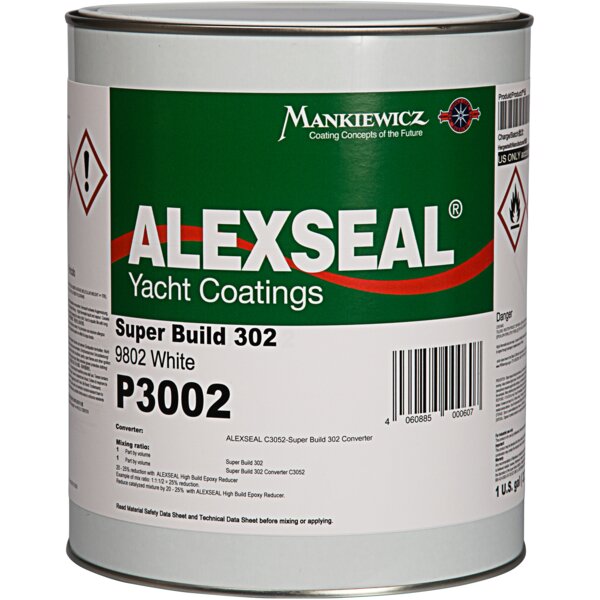
What is ALEXSEAL SUPER BUILD 302 and why choose it?
ALEXSEAL SUPER BUILD 302 is an epoxy-based high build primer / surfacer designed for professional use in demanding marine and industrial fairing systems. It cures to a smooth, easy-to-sand, water-resistant coating with excellent spray characteristics and fast drying, helping to maximise efficiency during fairing and priming work. The cured film provides very good mechanical resistance and acts as a non-porous surfacer before applying ALEXSEAL Finish Primer 442.
Main features
- Epoxy high build primer/surfacer: Provides substantial film build for fairing systems and surface levelling.
- Smooth, easy-to-sand finish: Cures into a fine, non-porous surface that sands easily for precise fairing.
- Water-resistant coating: Offers resistance to water penetration; below the waterline it must be overcoated with an additional water barrier primer before antifouling.
- Fast drying with excellent spray behaviour: Optimised for efficient application with conventional, HVLP and airless spray equipment.
- High mechanical resistance: The dry film delivers robust mechanical properties suitable for refit and repair applications.
- Compatible with ALEXSEAL fairing and primer systems: Used to seal ALEXSEAL Fairing Compound 202 and to prepare surfaces for ALEXSEAL Finish Primer 442.
- Adjustable drying times: Can be combined with ALEXSEAL Accelerator A4030 to reduce drying and tape times (with reduced pot life).
Key technical characteristics
Color
- Mixture color: Off white / light yellow (technical data sheet in English).
- Alternative data sheet: Off white / light yellow or off white / light yellow with grey/yellow converter depending on version.
- Base material: White.
- Converter: Yellow or grey/yellow (depending on converter used).
Chemistry and composition
- Binder type: Epoxy-based system.
- Chemical nature: Mixture of synthetic resins, organic solvents and pigments.
- Notable components: 4,4'-Isopropylidenediphenol epoxy resin reaction products; formaldehyde/epoxy phenolic oligomers; xylene; n-butyl acetate; ethylbenzene; quartz (SiO2).
Certain physical properties (mixed product)
- Physical state: Liquid (20–25 °C, 1,013 hPa).
- Boiling range: Approx. 120 °C.
- Flash point: 23.5 °C (ISO 13736).
- Auto-ignition temperature: > 400 °C.
- pH (10 % in water): 6–8 (20 °C).
- Kinematic viscosity: > 21 mm²/s.
- Flow time: 61–90 s (DIN 53211, 4 mm); approx. 41 s (ISO 2431, 6 mm).
- Density: 1.46 g/cm³ (20 °C).
- Water solubility: Insoluble; immiscible with water.
Coverage and recommended film thickness
Volume solids (catalysed, without reduction): 60 %.
- Theoretical coverage at 500 µm (20 mils) DFT:
- 2 m²/litre
- 7.6 m²/US gal
- 81 sq. ft./US gal
- Practical coverage (approximate at 500 µm / 20 mils DFT):
- Conventional air spray: 1.2 m²/l; 4.6 m²/gal; 50 sq. ft./gal
- HVLP air spray: 1.5 m²/l; 5.8 m²/gal; 63 sq. ft./gal
- Airless equipment: 2.0 m²/l; 7.6 m²/gal; 81 sq. ft./gal
- Brush / roller (Spanish sheet: 0.9 m²/l; 3.3 m²/gal; 36 sq. ft./gal)
Recommended film build and application thickness
- Spray application: 2–3 coats.
- Wet film thickness (WFT) per coat: 150–300 µm (6–12 mils).
- Resulting dry film thickness (DFT):
- 2 coats: 150–300 µm (6–12 mils).
- 3 coats: 225–450 µm (9–15 mils), using approx. 20–25 % reduction.
- Minimum DFT before sanding: 150 µm (6 mils).
- Maximum recommended total build by spray: 960 µm (36 mils) WFT or 500 µm (20 mils) DFT.
Trade names and packaging
- Base material: P3002 ALEXSEAL Super Build 302 – 1 QT & 1 Gal.
- Converters:
- C3012 ALEXSEAL Super Build 302 Converter Yellow – 1 QT & 1 Gal.
- C3052 ALEXSEAL Super Build 302 Converter Grey – 1 QT & 1 Gal.
- Reducer: R3040 ALEXSEAL High Build Epoxy Reducer – 1 QT & 1 Gal.
- Accelerator: A4030 ALEXSEAL Accelerator for Super Build 302 – 1 PT.
Mixing ratio and thinning
- Standard mix ratio (by volume):
- 1 part P3002 ALEXSEAL Super Build 302 base
- 1 part C3012 or C3052 ALEXSEAL Super Build 302 Converter
- Plus 10–25 % R3040 ALEXSEAL High Build Epoxy Reducer (by volume)
- Example for conventional spray: 1 : 1 : 1/2 (25 % reduction).
- Example for airless spray: 1 : 1 : 1/4 (12.5 % reduction, Spanish data sheet) or 20 % reduction (English data sheet).
- Reducer amount: Depends on specific application conditions.
Application parameters (spray)
- Viscosity:
- Zahn #2: approx. 24 s.
- DIN 4 cup, 4 mm: approx. 20–25 s (airless 25–30 s, conventional 20–25 s in Spanish data sheet).
- Gravity gun nozzle: 2.0 mm (0.079 in) – conventional and HVLP.
- Siphon / pressure pot nozzle: 1.2–1.6 mm (0.046–0.060 in) – conventional and HVLP.
- Airless tip size: 0.43 mm / 60° (0.017 in / 60°).
- Atomising pressure (conventional & HVLP): 2.0–4.0 bar (30–60 psi).
- Pressure pot pressure: 0.7–1.5 bar (10–22 psi).
- Airless atomising pressure: approx. 3–5 bar (44–70 psi) according to Spanish sheet.
Pot life and drying
Optimal application environment: 15–30 °C (60–85 °F), 40–80 % relative humidity. Minimum application temperature should be 3 °C (5.4 °F) above dew point. Minimum drying temperature: 15 °C (60 °F). Ideal temperature: 25 °C (77 °F).
| Temperature |
15 °C (60 °F) |
20 °C (68 °F) |
25 °C (77 °F) |
30 °C (85 °F) |
Max dry time |
| Pot life (approx.) |
8 h |
6 h |
6 h |
4 h |
12 h |
| Pot life with A4030 accelerator |
6 h |
4 h |
4 h |
3 h |
– |
| Fully cured |
21 days |
18 days |
14 days |
10 days |
– |
| Tape dry (without accelerator) |
30 h |
24 h |
18 h |
12 h |
– |
| Tape dry (with A4030 accelerator) |
24 h |
18 h |
12 h |
10 h |
– |
| Recoat with Super Build 302 |
4 h min |
2 h min |
1 h min |
1 h min |
24 h max |
| Overcoat with other products (e.g. 202, 212, 303, 328, 414, 442, 501/X) |
12 h min |
12 h min |
12 h min |
12 h min |
24 h max |
Accelerator use
- Product: A4030 ALEXSEAL Accelerator for Super Build 302.
- Function: Reduces drying time of ALEXSEAL Super Build 302 but also reduces pot life.
- Maximum addition: Up to 1 pint (16 oz) A4030 per 1 gallon of P3002 base.
- Note: Adding more than the specified amount further shortens pot life and is not recommended.
Substrate preparation and compatible systems
Surface preparation
- General condition: Substrate must be clean, dry and free of dust, grease, oil and other contamination.
- Over ALEXSEAL Fairing Compound 202:
- Sand fairing compound with P60–P150 grit.
- Clean and thoroughly remove dust prior to applying Super Build 302.
- Over gel coat and raw resin lay-up:
- Gel coat: sand with P80–P150 grit.
- Fiberglass resin: grind with P36–P60 and/or sandblast. Surface and profile bottoms should be dull, abraded and free from shiny spots.
- Refit and repair (old coatings):
- Existing coatings must have good adhesion and chemical resistance.
- Sand with P100–P150 grit.
- Perform a compatibility test if the condition of the old coating is questionable.
- Sealing before topcoat: ALEXSEAL Super Build 302 should be sealed with ALEXSEAL Finish Primer 442 prior to topcoating.
- Below waterline: An additional water barrier primer is required before applying antifouling.
Applications and use cases
- Marine fairing systems: High build surfacer for sealing ALEXSEAL Fairing Compound 202 and evening out residual imperfections before priming and topcoating.
- Yacht and boat refits: Suitable for refit and repair where old coatings (with verified adhesion) need to be levelled and re-primed.
- Gel coat restoration: High build isolating surfacer over sanded gel coat on composite hulls and superstructures.
- Fiberglass and raw laminate work: Applied over abraded fiberglass resin lay-up as part of a complete fairing system.
- Professional industrial serial painting: As indicated in the safety data sheet, for industrial serial coating processes where a high build epoxy surfacer is required.
FAQ – ALEXSEAL SUPER BUILD 302
1. What type of product is SUPER BUILD 302?
It is an epoxy-based high build primer / surfacer that cures to a smooth, easy-to-sand, water-resistant coating with high mechanical strength.
2. On which substrates can I apply SUPER BUILD 302?
According to the technical data, it can be applied over sanded ALEXSEAL Fairing Compound 202, over sanded gel coat, over ground/sandblasted fiberglass resin lay-up, and over properly sanded and sound existing coatings.
3. Do I need another primer before the topcoat?
Yes. ALEXSEAL Super Build 302 should be sealed with ALEXSEAL Finish Primer 442 before applying the final topcoat. Below the waterline an additional water barrier primer is also required before antifouling.
4. How many coats are recommended?
The data sheet recommends 2–3 spray coats with 150–300 µm wet film thickness per coat, staying within the maximum total build of 500 µm DFT.
5. Can it be applied by brush or roller?
Yes. Practical coverage values are given for brush/roller application, though spraying (conventional, HVLP or airless) is the primary method described.
6. What is the typical pot life?
Pot life is approximately 8 h at 15 °C, 6 h at 20–25 °C and 4 h at 30 °C. With A4030 accelerator these times decrease to approximately 6 h, 4 h and 3 h respectively.
7. When can I sand or tape the surface?
The product reaches tape dry between about 12 and 30 hours depending on temperature and whether accelerator is used. The minimum film thickness before sanding is 150 µm DFT.
8. Is SUPER BUILD 302 solvent-based?
Yes. It contains organic solvents such as xylene, n-butyl acetate and ethylbenzene, and is classified as a flammable liquid (Category 3).
9. Is this product suitable for DIY use?
No. Both the technical and safety data sheets specify “Professional Use Only”. It is intended for trained personnel in professional environments.
10. What is the VOC content?
The safety data sheet lists a VOC content of 15.38 %, corresponding to 225 g/l.
Section 14 – Transport information
The following transport data are taken directly from the safety data sheet for ALEXSEAL P3002-Super Build 302.
- UN number / ID number: UN 1263.
- Proper shipping name (ADR / IMDG / IATA): PAINT (includes 4,4'-isopropylidenediphenol epoxy reaction products and formaldehyde epoxy phenolic reaction products).
- Transport hazard class: Class 3 (flammable liquids).
- Packing group: III.
- Classification code (ADR): F1.
- Hazard identification number (ADR): 30.
- Labels: 3 (Flammable liquid).
- Tunnel restriction code: (D/E).
- IMDG EmS code: F-E, S-E.
- IATA packing instructions:
- Cargo aircraft: PI 366, Packing group III.
- Passenger aircraft: PI 355, Limited Quantities: Y344, Packing group III.
- Environmental hazards:
- ADR: Environmentally hazardous – yes.
- IMDG: Marine pollutant – yes.
- Special note for on-site transport: When transported within user premises, containers should be closed, upright and secure. Personnel should know how to act in case of incident or spillage.
Section 8 – Individual protective measures
The following personal protective equipment (PPE) and exposure control recommendations are extracted from the safety data sheet.
Engineering controls
- Provide good general ventilation and, where practicable, local exhaust ventilation to keep aerosol and solvent vapour concentrations below occupational exposure limits.
- If ventilation is insufficient to meet exposure limits, suitable respiratory protection must be used.
Eye and face protection
- Wear safety goggles or eye protection designed to protect against solvent splashes.
Hand protection
- Use chemical-resistant protective gloves compliant with EN 374.
- Recommended materials (short-term/splash contact):
- Nitrile rubber.
- Neoprene.
- Minimum material thickness: > 0.4 mm.
- Breakthrough time: > 480 minutes.
- Check glove suitability for the specific workplace (mechanical resistance, product compatibility, antistatic properties).
- Follow glove manufacturer’s instructions on use, storage, care and replacement; replace gloves immediately if damaged or worn.
- Use preventive skin protection (protective cream) and wash contaminated skin immediately.
- Organise work so that permanent, continuous glove use is not required where possible.
Skin and body protection
- Wear antistatic clothing made from natural fibres (e.g. cotton) or heat-resistant synthetic fibres.
- Depending on the likelihood of explosive atmospheres, use appropriately rated protective clothing.
Respiratory protection
- If solvent vapour concentrations exceed air limit values, wear respiratory equipment approved for organic vapours.
- Use a half-mask with suitable cartridge or an air-fed respirator.
- For operations such as dry grinding, torch cutting or welding that create hazardous dust or vapours, use wet methods where possible and/or install exhaust hoods. If exposure cannot be adequately controlled, wear appropriate respiratory protection.
- Inside spray booths, operators should wear compressed air-fed respirators during spraying until particulate and solvent vapour concentrations fall below exposure limits.
General protective measures and hygiene
- Do not eat, drink or smoke during work.
- Avoid contact with skin, eyes and clothing.
- Avoid inhalation of vapours, spray mist and dust from sanding.
*Contenido generado por IA