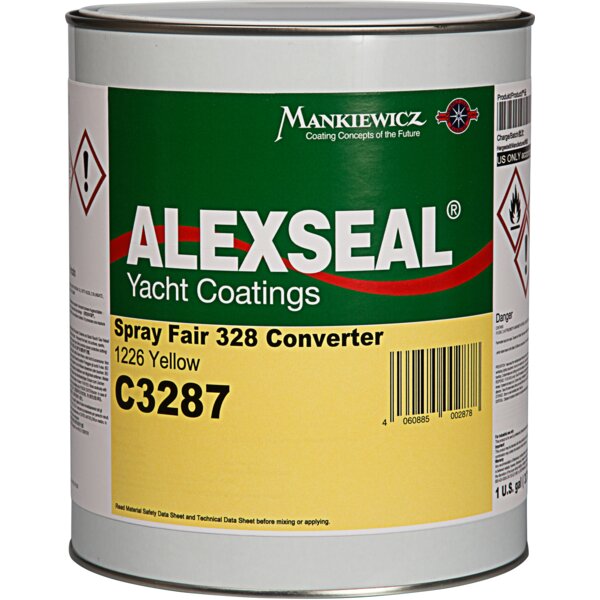
What is ALEXSEAL SPRAY FAIR 328 and why choose it?
ALEXSEAL Spray Fair 328 is a professional, epoxy-based, two-component sprayable filler designed specifically for yacht building and refit projects that require fairing and filling above the waterline. It combines excellent anti-sagging behavior with very good sanding properties, creating an ideal surface for subsequent ALEXSEAL primers and topcoats. The product is easy to mix and apply and offers high film build in spray application, helping to achieve fair, smooth hulls and superstructures with consistent results.
Main features
- Epoxy-based, 2-component sprayable filler for high-build fairing on yachts and other suitably prepared substrates.
- Designed for above-waterline use on primed and properly prepared surfaces.
- Excellent application properties with conventional, HVLP and airless spray equipment.
- Outstanding anti-sagging behavior for high wet film thickness per coat without runs.
- Very good sanding performance when block sanded with P80–P120 grit, helping to avoid sand-scratch print-through in the finishing system.
- High solids content (71 % by volume, catalyzed without reduction) for efficient film build.
- Visual mixing control thanks to differently colored base (tan) and converter (yellow), yielding a homogeneous tan mixture when properly mixed.
- Part of the ALEXSEAL fairing system, to be overcoated with ALEXSEAL Super Build 302 or High Build 357 and then finished with compatible primers and topcoats.
- Professional use only, suitable for industrial serial painting operations.
Technical specifications
Product identification
- Product name: ALEXSEAL Spray Fair 328
- Product code: P3280
- Type: Epoxy-based, two-component sprayable fairing compound / filler
- Intended use: Industrial serial painting; fairing of primed and appropriately prepared surfaces above the waterline
- Use restriction: Professional use only
Color
- Color of mixture: Tan (light brown)
- Base material: Tan
- Converter: Yellow
Composition (general)
Mixture of synthetic resins, organic solvents and pigments.
Coverage and solids
- Volume solids (catalyzed, without reduction): 71 %
Approximate coverage at 900 µm (36 mils) dry film thickness (DFT):
- Theoretical: 0.6 m²/l; 2.1 m²/gal; 23 sq. ft./gal
- Practical (Conventional air spray): 0.5 m²/l; 2.0 m²/gal; 22 sq. ft./gal
- Practical (HVLP air spray): 0.6 m²/l; 2.4 m²/gal; 26 sq. ft./gal
- Practical (Airless equipment): 0.7 m²/l; 2.8 m²/gal; 30 sq. ft./gal
Substrate preparation
- Substrate must be clean, dry and free from dust, grease, oil and other contamination.
- For optimum adhesion, substrate must be ground and/or blasted with P36–P60 grit before priming.
- Full fairing systems: require a heavily abraded substrate.
- Thin fairing systems (< 3 mm / approx. 1/8" – 0.012"): require a less aggressive profile.
- Priming is required on most substrates before applying Spray Fair 328.
- Metal substrates: prime with an ALEXSEAL Metal / Protective Primer 161.
- GRP substrates: use ALEXSEAL Finish Primer 442 or Super Build 302, then sand with P60–P80 grit after overnight drying before applying Spray Fair 328.
Trade names and packaging
- Base material: P3280 ALEXSEAL Spray Fair 328 – 1 Gal
- Converter: C3287 ALEXSEAL Spray Fair 328 Converter – 1 Gal
- Reducer: R3040 ALEXSEAL High Build Epoxy Reducer – 1 QT and 1 Gal
Mixing ratio
- Base (P3280): 1 part by volume
- Converter (C3287): 1 part by volume
- Reducer (R3040): 10–25 % by volume (based on total base + converter)
- Example: 1 : 1 : ¼ = 12.5 % reduction
- Example: 1 : 1 : ½ = 25 % reduction
- The exact amount of reducer depends on application conditions.
Application parameters
Spray equipment settings
- Fluid nozzle (pressure pot, conventional & HVLP): 2.2 – 2.8 mm (0.08 – 0.110 inch)
- Atomizing pressure (conventional & HVLP): 3.0 – 5.0 bar (44 – 73 PSI)
- Pot pressure (conventional & HVLP): 1 – 1.5 bar (15 – 22 PSI)
- Airless equipment tip: 0.50 mm / 60° to 0.60 mm / 60° (0.020 / 60° to 0.024 / 60°)
- Airless inlet pressure: 3 – 5 bar (44 – 70 PSI)
High viscosity may require the use of a large nozzle and pressure pot.
Recommended film thickness and number of coats
- Application method: Spray application.
- Number of coats: 3 coats per application cycle.
- Wet film thickness (WFT) per coat: 400 – 500 µm (16 – 20 mils).
- Resulting total DFT for 3 coats: approx. 700 – 900 µm (28 – 36 mils) with up to 25 % reduction.
- Maximum DFT per coat: 500 µm (20 mils).
- Maximum recommended per 3-coat application: 1500 µm (60 mils) WFT, or 900 µm (36 mils) DFT.
- Do not apply more than 3 coats without allowing to cure overnight and sanding the surface.
Sanding and finishing of fairing
- Block sand ALEXSEAL Spray Fair 328 with P80–P120 grit.
- Using P120 grit or finer will help minimize sand-scratch print-through in the final system.
- The product is porous and must be sealed with ALEXSEAL Super Build 302 or High Build 357 before the final primer or topcoat is applied.
Pot life and drying
Optimal application environment: 15 °C (60 °F) / 40 % RH to 30 °C (85 °F) / 80 % RH. Minimum application conditions should be 3 °C (5.4 °F) above dew point.
| Substrate temperature |
15 °C (60 °F) |
20 °C (68 °F) |
25 °C (77 °F) |
30 °C (85 °F) |
Max time |
| Pot life |
8 h |
8 h |
8 h |
8 h |
8 h |
| Dry to sand |
3–4 days |
2 days |
1 day |
1 day |
N/A |
| Fully cured |
2 weeks |
1 week |
5 days |
4 days |
N/A |
| Recoat after tack-up with additional Spray Fair 328 |
4 h |
2 h |
1 h |
1 h |
24 h |
Recoating within the recommended times is important to avoid solvent entrapment, which can cause blistering, cracking and extended sanding times. Maximum 3 coats in one application; sand after 24 hours before additional application.
Ideal drying temperature: 25 °C (77 °F). Minimum during drying: 15 °C (60 °F).
Physical properties (uncured product)
- Physical state: Liquid (20–25 °C, 1,013 hPa)
- Odour: Characteristic
- Boiling range: approx. 120 °C
- Flash point: 23 °C (ISO 13736)
- Upper explosion limit: 10 % (V)
- Lower explosion limit: 1 % (V)
- Auto-ignition temperature: > 400 °C
- pH (10 % solution, 20 °C): 6 – 8
- Viscosity (kinematic): > 21 mm²/s
- Flow time: approx. 151 s (DIN 53211, 4 mm); > 101 s (ISO 2431, 6 mm)
- Density: approx. 1.6 g/cm³ (20 °C)
- Water solubility: Insoluble; immiscible with water
Applications and use cases
- Yacht hull fairing above the waterline, providing a smooth, high-build base for ALEXSEAL primers and topcoats.
- Superstructure and deckhouse fairing on GRP or metal substrates primed with compatible ALEXSEAL primers.
- Repair fairing on previously coated and correctly prepared surfaces that require thickness build and surface levelling.
- Industrial marine applications where a sprayable epoxy filler is required within an ALEXSEAL coating system.
FAQ
1. On which areas of a yacht can ALEXSEAL Spray Fair 328 be used?
ALEXSEAL Spray Fair 328 is designed for fairing primed and properly prepared surfaces above the waterline only.
2. Do I need a primer before applying Spray Fair 328?
Yes. Priming is required on most substrates before applying Spray Fair 328. Use appropriate ALEXSEAL primers such as Protective Primer 161 for metals or Finish Primer 442 / Super Build 302 for GRP.
3. How many coats can I spray in one application?
Apply a maximum of 3 coats in one application, reaching up to 1500 µm WFT (about 900 µm DFT). After 3 coats, allow to cure overnight and sand before applying additional coats.
4. When can I sand the fairing compound?
Depending on temperature, the coating is dry to sand in approximately 1–4 days (from 30 °C down to 15 °C). At 25 °C, sanding is typically possible after about 1 day.
5. What sanding grit is recommended?
Block sand Spray Fair 328 with P80–P120 grit. Using P120 or finer helps reduce sand-scratch print-through in the final finish.
6. Is ALEXSEAL Spray Fair 328 porous?
Yes. Spray Fair 328 is porous and must be sealed with ALEXSEAL Super Build 302 or High Build 357 before applying the final primer or topcoat.
7. What is the pot life of the mixed product?
At 15–30 °C, the pot life is approximately 8 hours.
8. Can I overcoat Spray Fair 328 with itself without sanding?
Yes, but only within the specified recoat windows (for example 1–4 hours depending on temperature). After 24 hours, the surface should be sanded before additional application.
9. What happens if I apply too thick a film or overcoat too quickly?
Excessive film build or rapid overcoating, especially at low temperature or with slow drying, can lead to solvent entrapment, causing blistering, cracking and delayed sanding.
10. Is this product suitable for non-professional or DIY use?
No. The product is explicitly labeled for professional use only within industrial or professional painting environments.
Section 14 – Transport information
- UN number / ID number: UN 1263
- UN proper shipping name: PAINT
- Transport hazard class: Class 3 (Flammable liquids)
- Packing group: III
- ADR: Class 3, Packing group III, Classification code F1, Hazard Identification Number 30, Tunnel restriction code (D/E)
- IMDG: Class 3, Packing group III, EmS F-E, S-E, Marine pollutant: no
- IATA (cargo): Class 3, Packing instruction 366, Packing group III, Labels: Flammable Liquids
- IATA (passenger): Class 3, Packing instruction 355 (Y344 for limited quantities), Packing group III, Labels: Flammable Liquids
- When transported within the user’s premises, always move in closed, upright and secure containers. Personnel should be familiar with emergency and spillage procedures.
Section 8 – Personal protective measures
When handling ALEXSEAL Spray Fair 328, observe the following personal protective equipment (PPE) recommendations:
- Ventilation: Provide adequate local exhaust and general ventilation to keep aerosol and solvent vapour concentrations below applicable occupational exposure limits.
- Eye/face protection: Wear safety goggles suitable for protection against solvent splashes.
- Hand protection:
- Use chemical-resistant protective gloves tested according to EN 374.
- Recommended glove materials for splash contact: nitrile rubber or neoprene.
- Minimum material thickness: > 0.4 mm; breakthrough time > 480 minutes (as guideline).
- Inspect gloves before use and replace when damaged or worn.
- Skin and body protection: Wear suitable protective clothing, adapted to the potential for explosive atmospheres and solvent exposure.
- Respiratory protection:
- If solvent vapour concentrations exceed limit values, use an approved respirator (e.g. half-mask with appropriate cartridge or air-fed equipment).
- During spraying, particularly inside spray booths where ventilation may be insufficient, operators should use a compressed air-fed respirator until vapour and particulate levels are below exposure limits.
- General protective measures:
- Do not eat, drink or smoke while using the product.
- Avoid contact with skin, eyes and clothing.
- Avoid inhalation of sanding dust, particulates and spray mist.
- Wash contaminated skin immediately and use appropriate skin protection creams if necessary.
Contenido generado por IA