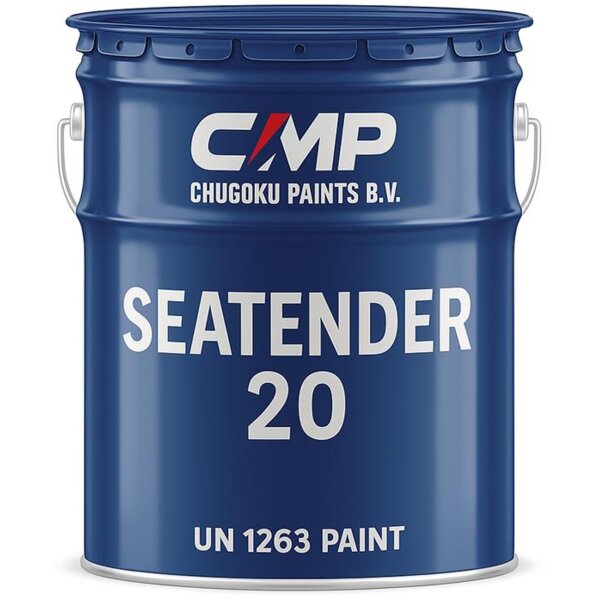
What SEATENDER 20 is and why choose it
SEATENDER 20 by Chugoku is a tin-free, self-polishing antifouling paint designed to provide long-lasting protection of coastal steel ship bottoms against marine fouling. Its specific polymer binder delivers a controlled, continuous polishing action in service, helping to maintain hull cleanliness over time. The product is compliant with the IMO Anti-fouling Systems Convention (AFS/CONF/26 & IMO MEP.331(76)) and is intended exclusively for professional application.
Main features
- Tin-free self-polishing antifouling: Long-term protection against marine organisms without organotin compounds acting as biocides.
- Designed for coastal steel vessels: Recommended as antifouling coating for the underwater hull (ship’s bottom) of coastal steel ships.
- Durable film with controlled polishing: The vehicle composition provides high durability and steady polishing, helping to keep fouling under control.
- Professional-only product: Formulated and classified for use by trained professional applicators, including spray, brush and roller application.
- Multi-colour range: Available in brown, light brown, black and blue.
- IMO AFS compliant: Meets the requirements of the International Convention on the Control of Harmful Anti-fouling Systems on Ships.
Main technical characteristics
General data
- Type: Tin free self polishing antifouling paint.
- Recommended use: Antifouling paint for coastal steel ship’s bottom / underwater hull of coastal vessels.
- Components: One pack product.
- Colours: Brown, Light brown, Black, Blue.
- Density: approx. 1.94–1.96 g/mL (20 °C).
- Volume solids (VS): 61 ± 2 % by volume.
- VOC (theoretical): 346–366 g/L (depending on data sheet and colour, without thinning).
- Flash point: 23.4 °C (technical data 2014) and 37 °C (European data sheet).
Film thickness and spreading rate
- Recommended wet film thickness: 123–246 µm.
- Recommended dry film thickness: 75–150 µm.
- Theoretical spreading rate: approx. 8.1–4.1 m²/L, depending on dry film thickness within the above range.
Application conditions
- Application methods: Airless spray, brush, roller (for brush/roller, additional coats are required to reach specified DFT).
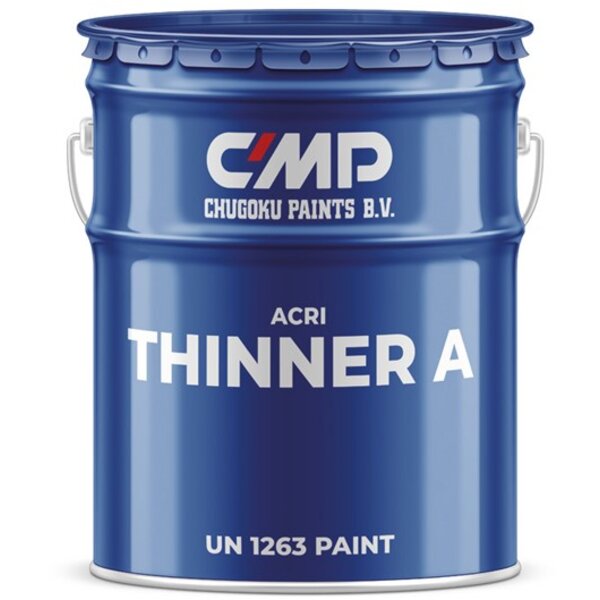
- Thinner: CR/ACRI THINNER A.
- Thinning range (airless spray): 0–7 % by volume.
- Minimum ambient/application temperature: -5 °C.
- Maximum relative humidity: 85 % RH.
- Surface temperature: At least 3 °C above the dew point.
Airless spray parameters
- Tip size: GRACO 621–735.
- Paint output pressure: 11.7–14.7 MPa.
- Indicative viscosity (for airless): approx. 90 s (Ford cup #4).
- Typical spray speed: 60–80 cm/s.
Drying and overcoating times (at 100 µm DFT)
The drying and overcoating intervals depend on temperature and film thickness. The values below are indicative for 100 µm DFT; higher thickness will increase times.
- -5 °C
- Surface dry: 8 h
- Hard dry: 22 h
- Minimum overcoating interval: 22 h (no maximum specified)
- Minimum time before launch: 48 h
- 0 °C
- Surface dry: 5 h
- Hard dry: 16 h
- Minimum overcoating interval: 16 h (no maximum specified)
- Minimum time before launch: 36 h
- 5 °C
- Surface dry: 3 h
- Hard dry: 12 h
- Minimum overcoating interval: 12 h (no maximum specified)
- Minimum time before launch: 24 h
- 10 °C
- Surface dry: 2 h
- Hard dry: 8 h
- Minimum overcoating interval: 8 h (no maximum specified)
- Minimum time before launch: 18 h
- 20 °C
- Surface dry: 1 h
- Hard dry: 5 h
- Minimum overcoating interval: 5 h (no maximum specified)
- Minimum time before launch: 12 h
- 30 °C
- Surface dry: 30 min
- Hard dry: 4 h
- Minimum overcoating interval: 4 h (no maximum specified)
- Minimum time before launch: 10 h
Before overcoating, the existing film must be checked to ensure it is completely dry through.
Surface preparation
- All contamination such as dirt, grease, oil and previous fouling residues must be thoroughly removed.
- High-pressure fresh-water washing up to 250 bar (3500 psi) is recommended to remove contamination and any leached layer from the existing antifouling.
- Apply over suitable existing antifoulings and primers. Compatibility should be checked with Chugoku / CMP.
Compatible preceding systems
- SILVAX SQ-K
- CMP AC / CMP AC-10
- BANNOH 1500 SZ
- BANNOH 500 N
- BANNOH 500 R
Applications and use cases
- Coastal steel ship hulls: Antifouling protection for the underwater hull of steel coastal vessels operating in waters with typical fouling and pollution levels.
- Maintenance of existing antifouling systems: Can be applied over compatible existing antifoulings and primer systems after proper surface cleaning and inspection.
- Docking and repair yards: Suitable for professional shipyard environments where controlled airless spray application is available.
- Static or low-activity conditions: Performance in static conditions depends on trading pattern and environmental parameters such as fouling intensity, water temperature and pollution level at the lay-up location.
FAQ – SEATENDER 20
- Is SEATENDER 20 a tin-free antifouling?
Yes, SEATENDER 20 is explicitly described as a tin-free self-polishing antifouling paint and complies with the IMO Anti-fouling Systems Convention.
- On which substrates can it be applied?
It is recommended as antifouling for coastal steel ship bottoms and must be applied over suitable primers or existing antifoulings specified by Chugoku.
- Can it be applied by brush or roller?
Yes, SEATENDER 20 can be applied by brush or roller, but additional coats will be necessary to achieve the specified dry film thickness.
- What thinner should be used?
The specified thinner is CR/ACRI THINNER A, typically at 0–7 % by volume for airless spray.
- Which colours are available?
Brown, light brown, black and blue.
- What is the recommended dry film thickness per coat?
The technical data specify 75–150 µm dry film thickness with corresponding 123–246 µm wet film thickness.
- How long before the vessel can be launched after application?
Depending on temperature and 100 µm DFT: from 48 h at -5 °C down to 10 h at 30 °C (see detailed drying table above).
- Does the colour change in service?
A slight colour change may occur after immersion or contact with water and climatic exposure.
- Is this product suitable for DIY or leisure users?
No, the documentation states that SEATENDER 20 is for professional use only.
- Where can I find additional detailed performance data (service life, speed loss, etc.)?
Consultar ficha técnica del fabricante.
Section 14 – Transport information
- UN number: UN 1263.
- UN proper shipping name: PAINT.
- Transport hazard class: Class 3 (flammable liquid).
- Packing group: II.
- ADR/RID/ADN: Class 3, Packing group II, Hazard identification number 33.
- IMDG: Class 3, Packing group II, Marine Pollutant: Yes.
- IATA: Class 3, Packing group II (not classified as marine pollutant under IATA).
- Marine pollutant substances: Cuprous(I) Oxide and the reaction mass of 3-methylphenyl di-4-methylphenyl phosphate, 4-methylphenyl di-3-methylphenyl phosphate and tris(3-methylphenyl) phosphate.
- Environmental hazard marking: Classified as hazardous to the aquatic environment (very toxic with long lasting effects).
- Special precautions for user: Transport only in closed, upright and secure containers. Ensure transport personnel know what to do in case of accident or spillage.
Section 8 – Individual protection measures
General exposure control
- Provide adequate ventilation using local exhaust and general extraction to keep solvent vapour and particulates below occupational exposure limits.
- Apply only in well-ventilated areas; for spray application, use spray booths, local exhaust ventilation or enhanced mechanical room ventilation as specified in the SUMI guidance.
- Avoid formation and inhalation of spray mist and sanding dust. Prefer wet sanding where possible.
Respiratory protection
- If exposure can exceed limits, use a respirator conforming to EN 140 with a combined particulate and vapour filter to EN14387 and an assigned protection factor of at least 10 (e.g. A2P3).
- For work inside spray booths where ventilation is insufficient, a compressed air-fed respirator should be used during spraying and until vapour/particulate levels fall below exposure limits.
Hand protection
There is no single glove material that provides unlimited resistance; gloves must comply with EN 374 and be selected based on exposure time.
- For repeated or prolonged contact (high protection, breakthrough > 240–480 min):
- Polyethylene (PE) gloves, minimum thickness 0.062 mm.
- Polyvinyl alcohol (PVA) gloves, thickness 0.2–0.3 mm.
- Butyl/Viton gloves, thickness 0.70 mm.
- For short-term exposure / splash protection (10–60 min):
- Nitrile gloves (e.g. 0.31 mm), PE gloves, PVA gloves, or Butyl/Viton gloves, according to the breakthrough time categories given in the safety data sheet.
- Gloves not suitable (breakthrough time < 10 min):
- Natural rubber gloves.
- Some neoprene or butyl gloves below the specified thickness ranges.
- Use PE under-gloves in difficult situations such as high exposure, unknown composition or unknown properties of chemicals.
- Replace gloves regularly and immediately if any damage is observed.
Eye and face protection
- Use safety eyewear tested according to EN 166 and designed to protect against liquid splashes.
Skin and body protection
- Wear anti-static clothing made from natural fibres or high-temperature-resistant synthetic fibres.
- Avoid skin contact; barrier creams may help protect exposed skin areas but must not be applied after exposure.
Additional safety recommendations
- Read and follow all precautionary statements on the container.
- Provide sufficient ventilation during application and drying.
- Avoid breathing vapours, spray mist and sanding dust.
- In case of skin contact, wash thoroughly with lukewarm water and soap or suitable cleaner; in case of eye contact, rinse immediately with water and seek medical advice.
- Keep away from heat, sparks, open flames and other ignition sources. Do not smoke nearby; the product contains flammable components.
*Contenido generado por IA