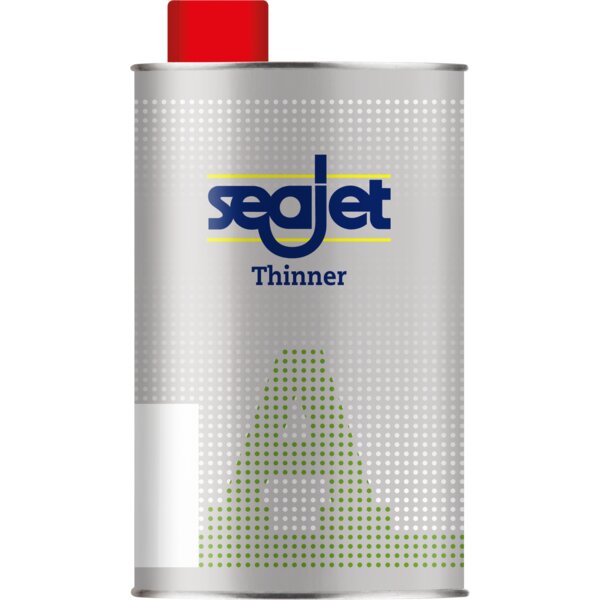
What SEAJET THINNER A is and why choose it
SEAJET THINNER A is a xylene-based thinner specifically formulated for use with antifouling coatings. It is designed for thinning Seajet Antifouling paints and Seajet 015 Underwater Primer, helping to adjust application viscosity while maintaining the performance of the original coating system.
Main features
- Xylene-based formulation suitable for antifouling systems.
- Recommended for Seajet Antifouling and Seajet 015 Underwater Primer to ensure product compatibility.
- Controlled dilution: usually not more than 5% thinner should be added to the paint.
- Colourless liquid with a typical aromatic solvent odour.
- Good storage stability: minimum shelf life of 3 years at 20°C under recommended conditions.
- Flammable liquid and vapour, classified as Flam. Liq. 3 according to Regulation (EC) No 1272/2008 (CLP).
Technical specifications
- Type: Thinner for antifouling paints.
- Base: Xylene-based thinner (reaction mass of ethylbenzene and xylene).
- Recommended use: Seajet Antifouling; Seajet 015 Underwater Primer.
- Typical dilution level: usually not more than 5% of thinner added to Seajet Antifoulings and Seajet 015.
- Physical state: Liquid.
- Colour: Colourless.
- Odour: Typical aromatic / solvent odour.
- Flash point: approx. 25–28°C (ISO 13736).
- VOC (theoretical): 870 g/l.
- Relative density: approx. 0.87 at 20°C (ASTM D1475-98).
- Boiling range: lowest boiling point about 135°C (reaction mass of ethylbenzene and xylene).
- Auto-ignition temperature (component): approx. 488°C (reaction mass of ethylbenzene and xylene).
- Kinematic viscosity: 0.0056 mm²/s at 40°C (ISO 3219), non-Newtonian, thixotropic behaviour.
- Solubility in water: Not soluble.
- Pack sizes: 1 litre, 5 litres.
- Shelf life: Minimum 3 years at 20°C in unopened, correctly stored containers.
- Product code: 908TR.
Applications and use cases
Intended use
- Thinning Seajet Antifouling paints for application.
- Thinning Seajet 015 Underwater Primer.
Application guidelines
- Use SEAJET THINNER A only for paint thinning as indicated by the paint’s technical documentation.
- As a rule, do not add more than 5% thinner to Seajet Antifoulings and Seajet 015.
- Ensure good ventilation and elimination of all sources of ignition during mixing and application.
- Store and handle only in containers of the same type as the original packaging.
FAQ
1. What is SEAJET THINNER A used for?
It is used to thin antifouling paints, specifically Seajet Antifouling products and Seajet 015 Underwater Primer.
2. How much thinner should I add to the paint?
Usually not more than 5% of SEAJET THINNER A should be added to Seajet Antifoulings and Seajet 015 Underwater Primer.
3. What type of solvent is it based on?
SEAJET THINNER A is a xylene-based thinner, consisting of a reaction mass of ethylbenzene and xylene.
4. In what pack sizes is it available?
The product is supplied in 1 litre and 5 litre containers.
5. How should SEAJET THINNER A be stored?
Store between 0°C and 40°C in a dry, well ventilated place, away from heat sources and direct sunlight. Keep containers tightly closed and upright, and prevent unauthorised access.
6. What is the shelf life?
When stored correctly at 20°C in unopened containers, the minimum shelf life is 3 years.
7. Is SEAJET THINNER A flammable?
Yes. It is classified as a flammable liquid and vapour (Flam. Liq. 3) and has a flash point of approximately 25–28°C.
8. Can I discharge leftover thinner into drains?
No. Do not allow the product to enter drains or watercourses. Dispose of contents and container at a hazardous or special waste collection point.
9. What should I do in case of ingestion?
If swallowed, do not induce vomiting. Rinse the mouth if the person is conscious and seek immediate medical attention, contacting a poison centre or doctor.
10. What should I do if the product contacts my skin or eyes?
For skin contact, remove contaminated clothing and wash thoroughly with soap and water or a recognised skin cleanser. For eye contact, rinse immediately with plenty of clean water for at least 10 minutes, keeping eyelids open, and seek medical advice.
Section 14 – Transport information
- UN number / ID number: UN 1263.
- UN proper shipping name: Paint related material.
- Transport hazard class: Class 3 (flammable liquid).
- Packing group: III.
- Transport regulations: ADR / RID / ADN, IMDG Code, IATA.
- Marine pollutant: No.
- Hazard Identification Number (ADR): 30.
- Emergency Schedule (EmS) code (IMDG): F-E, S-E.
- General transport advice: Always transport in closed containers that are upright and secure, and ensure that persons transporting the product know what to do in the event of an accident or spillage.
Section 8 – Personal protective measures
The following information summarises key individual protection measures indicated in Section 8 of the Safety Data Sheet.
Engineering controls
- Provide adequate ventilation through local exhaust and general extraction.
- If ventilation does not keep vapour and particulate concentrations below occupational exposure limits, suitable respiratory protection must be worn.
Respiratory protection
- If workers may be exposed above exposure limits, use a respirator conforming to EN 140, fitted with a combined particulate and vapour filter to EN 14387 with an assigned protection factor of at least 10 (for example A2P3).
- During spray application in spray booths where ventilation is insufficient, a compressed air-fed respirator should be used until vapour and particulate concentrations fall below exposure limits.
Hand protection
- Use chemical protective gloves tested according to EN 374 for repeated or prolonged contact.
- Nitrile gloves offer good protection during spray application.
- Viton (butyl/Viton) gloves provide high protection for intense solvent contact, such as complete immersion.
- Example glove materials and typical minimum thicknesses indicated:
- Polyethylene (PE) gloves: around 0.062 mm.
- PVA gloves: around 0.2–0.3 mm.
- Butyl/Viton gloves: around 0.70 mm.
- Nitrile gloves: around 0.31 mm (for splash protection).
- Gloves should be checked for defects, used and stored correctly, and replaced regularly or at the first sign of damage.
- Barrier creams may assist in protecting exposed skin areas but should not be applied after exposure has occurred.
Eye and face protection
- Wear safety eyewear complying with EN 166, designed to protect against liquid splashes.
Skin and body protection
- Wear anti-static clothing made from natural fibres or high temperature resistant synthetic fibres.
Environmental exposure controls
- Do not allow the product to enter drains or watercourses.
*Contenido generado por IA