What it is and why choose it
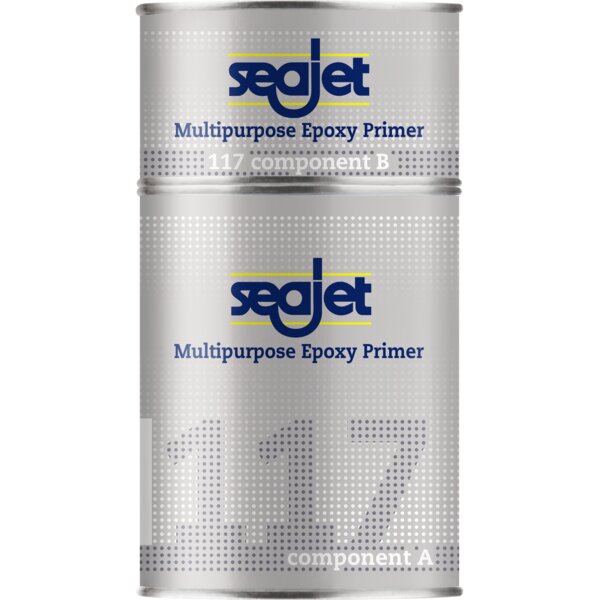
Seajet 117 Multipurpose Epoxy Primer Part B is the hardener component of the two-pack Seajet 117 epoxy primer system. When mixed with Part A (base), it forms a high performance, durable primer designed to protect GRP, aluminium, steel and wood boat hulls. Applied in multiple coats, the system offers effective protection against osmosis and provides an excellent base for Seajet antifoulings and two-component topcoats.
Main features
- Two-pack epoxy hardener to be mixed with Seajet 117 base component.
- Suitable for GRP, wood, steel, aluminium and alloy substrates.
- Designed to protect against osmosis when applied in 4–5 roller coats as part of the full system.
- Compatible with all Seajet antifouling products as subsequent coatings.
- Can be used under two-component topcoats.
- Silver grey and off white colour options in the mixed system (silver grey preferably underwater, off white above water).
- Airless spray, conventional spray, brush or roller application.
- Controlled drying and overcoating intervals from 5 °C to 30 °C.
Technical specifications
- Product type: Two pack epoxy primer system (Part B hardener).
- Mixing ratio (by volume): Base 67 : Hardener 33.
- Mixing ratio (by weight): Base 73 : Hardener 27.
- Colour (mixed system): Silver grey (preferable underwater) and off white (preferable above water).
- Flash point: 32 °C.
- Volume solids: 45 ±2 %.
- VOC (theoretical): 443 g/l.
- Recommended film thickness per coat: 100 µm wet / 45 µm dry.
- Theoretical spreading rate: 10.0 m²/l (at 45 µm DFT).
- Pack sizes (set with base + hardener): 1 l, 2.5 l, 5 l, 20 l.
- Thinner / cleaner: SEAJET THINNER E.
- Application methods: Airless spray, spray, brush, roller.
- Ambient temperature for application: min. 5 °C – max. 35 °C.
- Product temperature during application: min. 5 °C – max. 35 °C.
- Substrate temperature: min. 7 °C – max. 35 °C.
- Maximum relative humidity: 85% R.H.
- Spray nozzle tips (airless): Graco 719, 619, 617, 519.
- Paint output pressure (airless): 15.0 – 18.0 MPa.
- Thinning: 0 – 5% by volume with SEAJET THINNER E.
- Pot life (mixed product at 50 µm DFT reference): 24 h at 5 °C; 18 h at 10 °C; 10 h at 20 °C; 8 h at 30 °C.
- Drying time at 5 °C (50 µm DFT): Surface dry 1 h; hard dry 12.5 h.
- Overcoating interval at 5 °C (50 µm DFT): Min. 10 h; max. none.
- Drying time at 10 °C (50 µm DFT): Surface dry 30 min; hard dry 8 h.
- Overcoating interval at 10 °C (50 µm DFT): Min. 5 h; max. none.
- Drying time at 20 °C (50 µm DFT): Surface dry 25 min; hard dry 5 h.
- Overcoating interval at 20 °C (50 µm DFT): Min. 2 h; max. none.
- Drying time at 30 °C (50 µm DFT): Surface dry 20 min; hard dry 1.5 h.
- Overcoating interval at 30 °C (50 µm DFT): Min. 1 h; max. none.
- Maximum overcoat interval for Seajet antifouling: 28 days (at all listed temperatures).
- Maximum overcoat interval of Seajet 117 over itself: Free (no maximum).
- Shelf life (unopened): Minimum 3 years at 20 °C.
Applications and use cases
Suitable substrates
- GRP (glass reinforced plastic) hulls.
- Wooden hulls and structures.
- Steel hulls.
- Aluminium hulls and alloy components.
Typical use as part of the Seajet 117 system
- Osmosis protection on GRP: Apply 4–5 roller coats of the mixed system after proper surface preparation to build up the recommended dry film thickness.
- General priming on GRP: 2–3 coats of the mixed system to reach a minimum of 150 microns DFT.
- Aluminium and alloys: 3–4 coats of the mixed system for a minimum of 200 microns DFT.
- Steel hulls and metal keels: 4–5 coats of the mixed system to obtain at least 250 microns DFT.
- Undercoat for antifouling: All Seajet antifoulings can be applied directly over the cured Seajet 117 system within the specified overcoating intervals.
Surface preparation (summary)
- General: Degrease and clean using SEAJET THINNER E wiping to remove all contamination.
- Bare GRP: Abrade with P80 abrasive paper, then clean and apply the specified number of coats.
- Bare aluminium and alloys: Abrade with P80 abrasive paper followed by final cleaning before coating.
- Steel hulls and metal keels: Sand blast to SA 2½ or mechanically abrade bare areas before applying coats.
Drying times and overcoating intervals will increase if higher film thicknesses are applied.
FAQ
-
1. What is Seajet 117 Multipurpose Epoxy Primer Part B?
Part B is the hardener component of the two-pack Seajet 117 Multipurpose Epoxy Primer. It must be mixed with the base component before application.
-
2. How do I mix Part A and Part B?
Add the hardener (Part B) to the base (Part A) while mixing and stir well before use. The mixing ratio is 67 parts base to 33 parts hardener by volume (73:27 by weight).
-
3. Which thinner should I use?
Use SEAJET THINNER E for thinning (0–5% by volume) and for cleaning tools and surfaces.
-
4. On which substrates can the Seajet 117 system be used?
The system is suitable for GRP, wood, steel, aluminium and alloy substrates, provided they are correctly prepared.
-
5. How many coats are needed for osmosis protection on GRP?
For osmosis protection on GRP, apply 4–5 coats of the mixed Seajet 117 system.
-
6. What is the minimum overcoating time with antifouling at 20 °C?
At 20 °C and 50 µm DFT, the minimum overcoating interval is 2 hours; the maximum interval for Seajet antifouling is 28 days.
-
7. How should unused product be disposed of?
Do not empty into drains. Dispose of this material and its container at a hazardous or special waste collection point.
-
8. What is the shelf life of Seajet 117 components?
Both components have a minimum shelf life of 3 years at 20 °C when stored in unopened containers.
-
9. Can I sandblast steel before applying the primer?
Yes. Steel hulls and metal keels should be sand blasted to SA 2½ or mechanically abraded on bare areas before coating.
-
10. Where can I find missing technical data?
Consultar ficha técnica del fabricante.
Section 14 – Transport information
- The product should stay in a securely closed container during transport.
Section 8 – Individual protection measures
- Observe the precautionary notices displayed on the container.
- Provide adequate ventilation during mixing and application.
- Avoid skin contact and inhalation of spray mist and vapours.
- If the product comes into contact with the skin, wash thoroughly with lukewarm water and soap or a suitable cleaner.
- If the eyes are contaminated, irrigate with water and seek medical advice immediately.
- Because the product contains flammable materials, keep away from sparks and open flames; do not smoke in the area.
*Contenido generado por IA