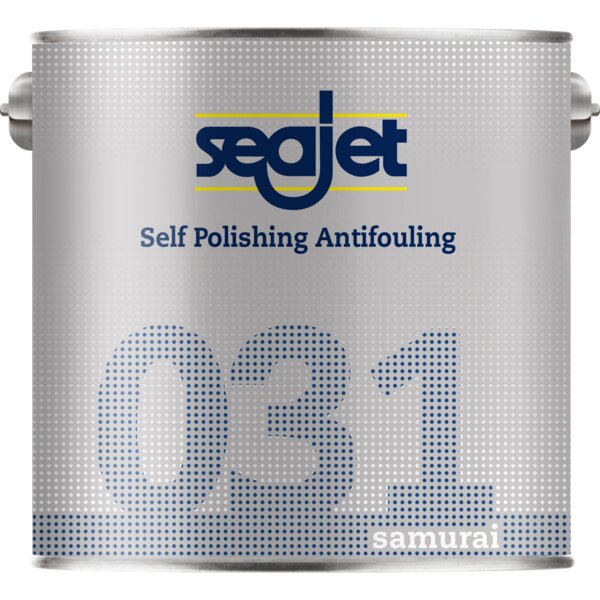
What SEAJET 031 SAMURAI is and why choose it
SEAJET 031 SAMURAI is a slow/self-polishing, tin-free antifouling paint designed for leisure sailing and motor boats. It delivers season-long protection in moderate fouling areas and offers a high coverage rate per litre, giving strong performance with controlled paint consumption. The product is suitable for suitably primed GRP (polyester), wood and steel hulls and is not suitable for aluminium surfaces.
Main features
- Slow/self-polishing antifouling for season-long performance.
- Tin-free “cruising” formulation suitable for sailing and motor boats up to 40 knots (according to Spanish data sheet).
- High coverage with a recommended theoretical spreading rate of approx. 10.0 m²/l per coat (at 46 µm DFT).
- For moderate fouling areas, on suitably primed GRP, wood and steel hulls.
- Wide colour range: shark grey / greyish white, blue, mid blue, green, red and black (black, red, blue, mid blue and shark grey listed in English data; additional colours listed in Spanish data).
- One-pack product for convenient mixing and application.
- Brush, roller or professional spray application with airless equipment.
- Maximum immersion window of 6 months after application.
- High solids content of approx. 46% ±2 by volume.
- VOC (theoretical) 498 g/l.
Technical specifications
Product data
- Type: Tin-free self-polishing / slow polishing antifouling.
- Use: Antifouling paint for leisure sailing and motor boats.
- Substrates: For use over suitably primed GRP (polyester), wood and steel.
- Not suitable for: Aluminium surfaces.
- Colour options: Shark grey / greyish white, blue, mid blue, green, red, black.
- Mixing ratio: One-pack product (no mixing of components required).
- Volume solids: 46% ±2 (by volume).
- Flash point: 35°C.
- VOC (theoretical): 498 g/l.
- Pack sizes: 0.75 L, 2.5 L, 5 L, 20 L.
Application data
- Application methods: Brush, roller, spray (airless spray for professional use only).
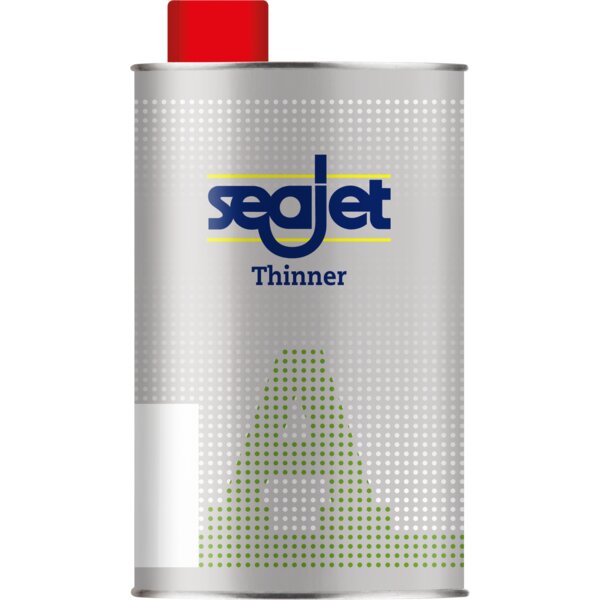
- Recommended thinner: SEAJET THINNER A.
- Thinning (spray): 0–5% by volume.
- Spray equipment: Graco 619 or 721 tip, 12.0–15.0 MPa paint output pressure.
- Recommended film thickness per coat:
- Wet: 100 µm (typical, English TDS).
- Dry: 46 µm (typical, English TDS) / 50–125 µm (range given in Spanish data sheet).
- Theoretical spreading rate: Approx. 10.0 m²/l at 46 µm DFT (or 9.2–3.7 m²/l for 50–125 µm DFT range in Spanish data sheet).
- Ambient temperature during application: min. 5°C – max. 35°C.
- Substrate temperature: min. 7°C – max. 35°C.
- Product temperature: min. 5°C – max. 35°C.
- Maximum relative humidity: 85% RH.
- Surface preparation (existing antifouling):
- High pressure fresh water wash (approx. 200 bar) to remove fouling and salts.
- Remove any poorly adhering or unstable antifouling.
- If the existing antifouling is in good condition and compatible, apply directly after cleaning.
- If compatibility is unknown or not compatible, apply a barrier coat of SEAJET 015 UNDERWATER PRIMER.
- Old antifouling should only be wet-sanded or chemically stripped. Never burn off or dry sand old antifouling.
- Surface preparation (new builds or bare substrates):
- GRP/Steel: Sand with P100 abrasive, clean thoroughly and apply SEAJET 117 MULTIPURPOSE EPOXY PRIMER (or SEAJET 015 according to Spanish sheet).
- Wood: Sand with P100 abrasive, clean thoroughly and apply SEAJET 015 UNDERWATER PRIMER.
- Aluminium: Do not use SEAJET 031 SAMURAI.
- Number of coats: Apply two coats; apply an extra coat on leading edges, waterline, rudders and stern gear.
- Mixing: Stir thoroughly before use until fully homogeneous.
- Maximum immersion time after application: 6 months before launching.
- Colour behaviour: After immersion, slight colour change may occur. Colour differences between batches are possible; mix batches together before use.
Drying and overcoating times (at 46–50 µm DFT)
Approximate drying and overcoating data, depending on film thickness, ventilation and humidity:
- 5°C:
- Surface dry: 3 hours.
- Hard dry: 12 hours.
- Minimum overcoating interval: 12 hours. No maximum.
- Minimum time before launch: 24 hours.
- 10°C:
- Surface dry: 2 hours.
- Hard dry: 7 hours.
- Minimum overcoating interval: 7 hours. No maximum.
- Minimum time before launch: 16 hours.
- 20°C:
- Surface dry: 1 hour.
- Hard dry: 5 hours.
- Minimum overcoating interval: 5 hours. No maximum.
- Minimum time before launch: 12 hours.
- 30°C:
- Surface dry: 30 minutes.
- Hard dry: 4 hours.
- Minimum overcoating interval: 4 hours. No maximum.
- Minimum time before launch: 10 hours.
Drying and overcoating times increase with higher film thickness.
Storage, shelf life and disposal
- Storage: Store containers tightly closed in a dry, cool, well-ventilated place, away from direct sunlight and sources of heat and ignition. Recommended storage temperature: 0–40°C.
- Shelf life: Minimum 2 years at 20°C.
- Disposal: Do not empty into drains. Dispose of product and container at a hazardous or special waste collection point according to local regulations. Waste code guidance (EU): 07 04 99 (wastes not otherwise specified).
Applications and use cases
- Leisure sailing yachts requiring season-long antifouling protection in moderate fouling waters.
- Motor boats up to 40 knots (according to Spanish technical data sheet) seeking a cruising antifouling with good value for money.
- GRP/Polyester hulls that are new or previously coated, after appropriate priming with SEAJET 117 or SEAJET 015.
- Wooden boats primed with SEAJET 015 UNDERWATER PRIMER.
- Steel hulls correctly primed with SEAJET 117 MULTIPURPOSE EPOXY PRIMER.
- Refit projects where existing compatible antifouling needs renewal after cleaning and inspection.
FAQ
1. On which substrates can I use SEAJET 031 SAMURAI?
It is suitable for correctly primed GRP (polyester), wood and steel hulls. It must not be used on aluminium.
2. How many coats should I apply?
The manufacturer recommends applying two full coats, plus an additional coat on leading edges, waterline, rudders and stern gear.
3. Can I apply it over existing antifouling?
Yes, provided the existing antifouling is in good condition and compatible. Clean thoroughly with high-pressure fresh water and remove any loose areas. If compatibility is unknown or not compatible, first apply a barrier coat of SEAJET 015 UNDERWATER PRIMER.
4. Is SEAJET 031 SAMURAI suitable for aluminium boats?
No. The product must not be used on aluminium surfaces.
5. What is the recommended thinner?
Use SEAJET THINNER A. For spray application, thinning is typically 0–5% by volume.
6. How long can I wait before launching after painting?
Depending on temperature, minimum time before launch ranges from about 24 hours at 5°C to 10 hours at 30°C. The maximum immersion time after application is 6 months.
7. Does the colour change in the water?
After immersion, SEAJET 031 SAMURAI may show a slight colour change. Colour differences between batches are also possible; mix batches together before application.
8. Is the product flammable?
Yes. It is classified as a flammable liquid (Flam. Liq. 3, H226) with a flash point of 35°C. Keep away from heat, sparks and open flame and do not smoke during use.
9. How should I prepare bare GRP or steel surfaces?
Sand with P100 abrasive, remove all dust and apply the appropriate primer (SEAJET 117 Multipurpose Epoxy Primer or SEAJET 015 as specified). Ensure the surface is clean, dry and free from salts, grease and oil.
10. Can I dry sand old antifouling when preparing the hull?
No. Old antifouling should only be wet-sanded or removed chemically. Do not burn off or dry sand old antifouling.
Section 14 – Transport information
Key transport data for SEAJET 031 SAMURAI according to the Safety Data Sheet:
- UN number / ID number: UN 1263.
- Proper shipping name: PAINT.
- Transport hazard class: Class 3 (flammable liquids).
- Packing group: III.
- Environmental hazards:
- ADR/RID/ADN: Dangerous for the aquatic environment.
- IMDG: Marine pollutant (contains cuprous(I) oxide and zinc oxide).
- Hazard identification number (ADR): 30.
- EmS (IMDG): F-E, S-E.
- Transport within user’s premises: Always transport in closed, upright and secure containers. Ensure that persons transporting the product know what to do in case of accident or spillage.
Section 8 – Personal protective measures
The following information is summarised from the Safety Data Sheet and describes minimum individual protection measures when handling SEAJET 031 SAMURAI. Always follow the full Safety Data Sheet for comprehensive safety guidance.
Exposure control and ventilation
- Provide adequate ventilation, preferably by local exhaust and general extraction, to keep solvent vapour and particulates below occupational exposure limits.
- When working inside a spray booth where ventilation may be insufficient, operators should wear a compressed air-fed respirator during spraying and until vapour and particulate levels are below exposure limits.
- Dry sanding, flame cutting or welding on the dry paint film may generate hazardous dust and fumes; use wet sanding where possible and suitable respiratory protection if exposure cannot be avoided.
Respiratory protection
- If workers could be exposed to concentrations above the exposure limit, use a respirator compliant with EN 140 fitted with a combined particulate and vapour filter to EN 14387 with an assigned protection factor of at least 10 (e.g. A2P3).
Hand protection
- For repeated or prolonged contact, use chemical-resistant gloves tested to EN 374.
- Recommended glove materials for high or medium protection (depending on exposure time):
- Polyethylene (PE) gloves (approx. 0.062 mm thickness).
- Butyl/Viton gloves (approx. 0.70 mm thickness).
- PVA (polyvinyl alcohol) gloves (approx. 0.2–0.3 mm thickness) for certain exposure durations.
- Nitrile gloves (approx. 0.31 mm thickness) provide good protection during spray application.
- Gloves should be replaced regularly and immediately if damaged. Follow glove manufacturer instructions regarding use, storage, maintenance and replacement.
- Barrier creams may help protect exposed skin but should not be applied after exposure has occurred.
Eye and face protection
- Wear safety goggles or face protection tested to EN 166, designed to protect against liquid splashes.
Skin and body protection
- Wear antistatic protective clothing made of natural fibres or high temperature-resistant synthetic fibres.
Environmental protection
- Do not allow product, overspray or cleaning waste to enter drains or watercourses.
- Application, maintenance and repair should be carried out on impermeable, contained surfaces so that spills and residues can be collected for reuse or disposal.
Contenido generado por IA