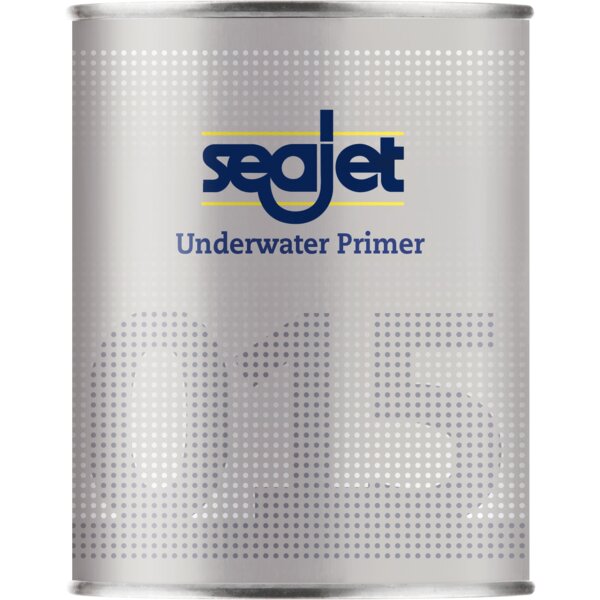
What is Seajet 015 Underwater Primer and why choose it?
Seajet 015 Underwater Primer is a one-pack acrylic primer designed as a sealer and barrier coat for underwater areas. It is especially formulated to isolate unknown, incompatible or Teflon-based antifoulings and to provide excellent adhesion for subsequent Seajet antifouling coatings. The product is quick drying, easy to apply by airless spray, brush or roller and suitable for GRP (fibreglass) and wooden hulls.
Main features
- Excellent sealer/barrier coat over existing, unknown or incompatible antifouling, including Teflon-based products.
- Quick drying with short surface and hard-dry times, helping to reduce turnaround time.
- Very good adhesion to subsequent Seajet antifouling systems.
- Versatile substrate use: suitable for GRP and wood.
- One-pack acrylic formulation for straightforward mixing and application.
- Silver colour for easy visual control during application.
- High solids content of 30 ±2% volume solids.
- Theoretical coverage of 10.0 m²/l per coat at 30 μm dry film thickness (roller application basis).
- Available pack sizes: 0.75 L, 2.5 L, 5 L and 20 L.
Technical specifications
- Product type: One-pack acrylic underwater primer.
- Colour: Silver.
- Substrates: GRP (fibreglass) and wood.
- Subsequent coating: All Seajet Antifouling products.
- Volume solids: 30 ±2%.
- VOC (theoretical): 614 g/l.
- Flash point: 26°C.
- Recommended film thickness per coat: 100 μm wet / 30 μm dry.
- Theoretical spreading rate: 10.0 m²/l at 30 μm DFT (roller application).
- Application methods: Airless spray, brush, roller.
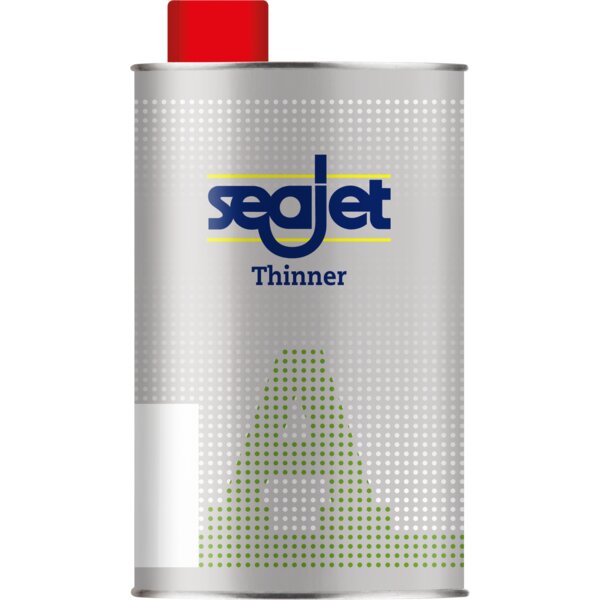
- Thinner: SEAJET THINNER A.
- Thinning (airless spray): 15–25% by volume.
- Spray equipment: Graco 721, 723 nozzles; paint output pressure 15.0–18.0 MPa.
- Application conditions:
- Ambient temperature: min. 5°C – max. 35°C.
- Product temperature: min. 5°C – max. 35°C.
- Substrate temperature: min. 7°C – max. 35°C.
- Maximum relative humidity: 85% RH.
- Drying time at 30 μm DFT:
- 5°C: Surface dry 40 min; hard dry 4 h.
- 10°C: Surface dry 30 min; hard dry 3 h.
- 20°C: Surface dry 20 min; hard dry 2 h.
- 30°C: Surface dry 15 min; hard dry 1.5 h.
- Overcoating interval at 30 μm DFT (with antifouling):
- 5°C: Min. 5 h – Max. none; dry to launch max. 7 days*
- 10°C: Min. 4 h – Max. none; dry to launch max. 7 days*
- 20°C: Min. 3 h – Max. none; dry to launch max. 7 days*
- 30°C: Min. 2 h – Max. none; dry to launch max. 5 days*
- Shelf life: Minimum 3 years at 20°C (unopened containers).
- Storage conditions: Store in a dry, cool, well-ventilated place, away from direct sunlight and sources of ignition. Keep containers tightly closed and upright.
- Mixing: Stir thoroughly before use until a uniform consistency is obtained.
- Flammability: Flammable liquid and vapour (Flash point 38°C as per SDS; product is classified as Flam. Liq. 3).
*Maximum times given when overcoated with antifouling. Drying times and overcoating intervals increase with higher film thickness.
Applications and recommended use
Typical applications
- Barrier coat over existing antifouling of unknown type or compatibility.
- Primer system for GRP hulls below the waterline prior to Seajet antifouling.
- Primer system for wooden hulls below the waterline prior to Seajet antifouling.
Surface preparation guidelines
Over existing clean antifouling
- Roughen the surface with P100–120 abrasive paper (wet sanding recommended).
- Ensure the surface is clean, dry and free from contamination.
- Apply 1 coat of Seajet 015 Underwater Primer to ensure good adhesion to the subsequent Seajet antifouling.
Bare fibreglass (GRP)
- Degrease the surface.
- Abrade with P100–120 abrasive paper.
- Wipe down with THINNER E to remove all contamination.
- Apply 3 coats of Seajet 015 Underwater Primer, followed by Seajet antifouling.
Wood
- Degrease if required.
- Abrade the surface and carry out final cleaning to remove all contamination.
- Apply 3–4 coats of Seajet 015 Underwater Primer, followed by Seajet antifouling.
Important application notes
- Apply only to dry, damp-free surfaces.
- Film thickness and spreading rate depend on application method; stated values are based on roller application.
- Before overcoating, always ensure the existing paint film is thoroughly dry.
FAQ – Seajet 015 Underwater Primer
-
1. What type of resin is Seajet 015 Underwater Primer based on?
Seajet 015 Underwater Primer is based on a special acrylic resin designed to act as a sealer and barrier coat.
-
2. On which substrates can I use this primer?
The primer is suitable for GRP (fibreglass) and wooden substrates below the waterline.
-
3. Can I apply Seajet 015 directly over old antifouling?
Yes. Over existing clean antifouling, roughen with P100–120 abrasive paper, then apply 1 coat of Seajet 015 Underwater Primer before applying Seajet antifouling.
-
4. How many coats are needed on bare fibreglass or wood?
On bare fibreglass, apply 3 coats of primer. On wood, apply 3–4 coats before antifouling.
-
5. What is the recommended dry film thickness per coat?
The recommended dry film thickness per coat is 30 μm (approximately 100 μm wet).
-
6. How long must I wait before overcoating with antifouling?
At 20°C and 30 μm DFT, the minimum overcoating interval is 3 hours with no maximum, provided the surface remains clean and dry. At lower temperatures, the minimum interval is longer (up to 5 hours at 5°C).
-
7. What thinner should I use?
Use SEAJET THINNER A. For airless spray, thinning is typically 15–25% by volume.
-
8. What is the shelf life of the product?
In unopened containers stored at 20°C, the shelf life is at least 3 years.
-
9. Is the product flammable?
Yes. It is classified as a flammable liquid and vapour (Flam. Liq. 3) with a flash point of 26–38°C depending on the reference document. Keep away from heat, sparks, open flames and other ignition sources. No smoking.
-
10. How should leftover paint and empty containers be disposed of?
Do not empty into drains. Dispose of the material and its container at a hazardous or special waste collection point, in accordance with local regulations. Waste code: 08 01 11* (waste paint and varnish containing organic solvents or other hazardous substances).
Section 14 – Transport information
Seajet 015 Underwater Primer is classified as dangerous goods for transport.
- UN number / ID: UN 1263.
- Proper shipping name: PAINT.
- Transport hazard class: Class 3 (flammable liquid).
- Packing group: III.
- Environmental hazards: Not classified as a marine pollutant.
- ADR/RID/ADN: Carriage in accordance with 2.2.3.1.5 – viscous substances up to 450 litre packs.
- IMDG: Transport in accordance with 2.3.2.5 of the IMDG Code – viscous substances up to 30 litre packs. Emergency Schedule (EmS): F-E, S-E.
- IATA: Class 3, Packing Group III; the viscosity exemption provision does not apply to air transport.
- General transport advice: Always transport in securely closed containers in an upright and secure position. Ensure that persons transporting the product know what to do in case of accident or spillage. The product should stay in a securely closed container during transport.
Section 8 – Personal protective measures
The following information summarises the minimum recommended personal protective equipment when handling Seajet 015 Underwater Primer, based on the Safety Data Sheet. Always follow local regulations and workplace risk assessments.
Engineering controls
- Provide adequate ventilation using local exhaust and good general extraction.
- If ventilation is insufficient to keep solvent vapour and particulates below occupational exposure limits, suitable respiratory protection must be worn.
- During spraying in spray booths, operators should wear compressed air-fed respirators until solvent vapour and particulate levels are below exposure limits.
Respiratory protection
- Use a respirator compliant with EN 140 fitted with a combined filter for particulates and organic vapours to EN14387 (e.g. A2P3) with an assigned protection factor of at least 10, when exposures may exceed limits.
- During dry sanding, flame cutting or welding of dry paint films, use suitable respiratory protection if effective local exhaust ventilation is not possible; wet sanding is preferred.
Hand protection
- Use chemical-resistant gloves tested to EN 374.
- For spray application and general handling: nitrile gloves offer good protection.
- For intense or prolonged solvent contact (e.g. immersion): Viton gloves provide good protection.
- Polyethylene (PE) gloves (minimum thickness 0.062 mm) are recommended as under-gloves, especially in high-exposure or unknown-chemical situations.
- Replace gloves regularly and immediately if damaged. Follow glove manufacturer instructions for use, storage and maintenance.
Eye and face protection
- Wear safety eyewear tested to EN 166, designed to protect against liquid splashes (goggles or face shield as appropriate).
Skin and body protection
- Wear anti-static clothing made from natural fibre or high-temperature-resistant synthetic fibres.
- Avoid skin contact. Remove contaminated clothing and wash before reuse.
General safety and hygiene measures
- Observe all precautionary notices on the container.
- Provide adequate ventilation; avoid inhalation of vapours, spray mist and sanding dust.
- Avoid contact with skin and eyes; if skin contact occurs, wash thoroughly with lukewarm water and soap or suitable cleaner. If in eyes, rinse with water and seek medical advice immediately.
- Since the product contains flammable materials, keep away from heat, hot surfaces, sparks and open flames. No smoking.
*Contenido generado por IA