What it is and why choose it
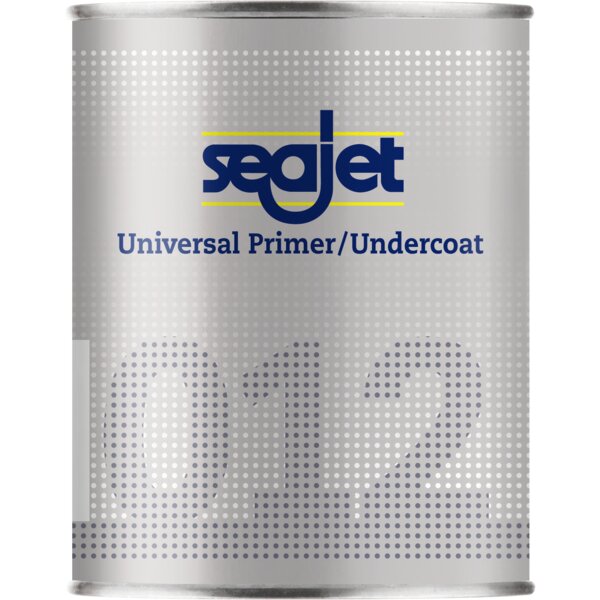
Seajet 012 Universal Primer / Undercoat is a one-pack primer and undercoat designed for use with one-component topcoats above the waterline. It is quick drying and formulated to provide excellent adhesion to a wide range of substrates and to subsequent coats, making it suitable for GRP, wood and steel, as well as for correctly primed aluminium and aged coatings.
Main features
- Universal one-pack primer/undercoat: specifically developed for one-component topcoats.
- Above-waterline use: for topsides and superstructures, not for underwater areas.
- Wide substrate compatibility: suitable for suitably prepared GRP, bare wood, steel and, over appropriate primers, aluminium and aged coatings.
- Quick drying: short surface-dry and hard-dry times depending on temperature, enabling efficient recoating schedules.
- Excellent adhesion: formulated to adhere strongly to prepared substrates and to subsequent finishes.
- White colour: provides a bright undercoat for final colours and helps with coverage control.
- Airless spray, brush or roller application: flexible application methods for professional and maintenance work.
- Solventborne system: theoretical VOC content 396 g/l, volume solids 50 ±2%.
Technical characteristics
- Product type: One-pack primer / undercoat for one-component topcoats.
- Colour: White.
- Volume solids: 50 ±2%.
- VOC (theoretical): 396 g/l.
- Flash point: 37°C.
- Recommended film thickness per coat: 100 µm wet / 50 µm dry (values based on roller application).
- Theoretical spreading rate: 10.0 m²/l at 50 µm dry film thickness.
- Application methods: Airless spray, brush, roller.
- Thinner: SEAJET THINNER U.
- Thinning range: 0–7% by volume.
- Pack sizes: 0.75 l, 2.5 l.
Application and curing conditions
- Ambient temperature during application: min. 5°C – max. 35°C.
- Maximum relative humidity: 85% R.H.
- Product temperature: min. 5°C – max. 35°C.
- Substrate temperature: min. 7°C – max. 35°C.
Drying times at 50 µm DFT
- 5°C: Surface dry 6 h; Hard dry 24 h.
- 10°C: Surface dry 3 h; Hard dry 14 h.
- 20°C: Surface dry 1.5 h; Hard dry 7 h.
- 30°C: Surface dry 45 min; Hard dry 4 h.
Drying times and overcoating intervals increase with higher film thicknesses. Before recoating, always ensure the existing paint film is through-dry.
Overcoating intervals at 50 µm DFT
- 5°C: Min. 48 h – Max. 120 days.
- 10°C: Min. 30 h – Max. 100 days.
- 20°C: Min. 20 h – Max. 90 days.
- 30°C: Min. 16 h – Max. 60 days.
Substrates, surface preparation and system build-up
All surfaces must be degreased and clean before painting.
General preparation
- Degreasing: Degrease and clean the surface. Degrease bare wood using thinner wiping.
- Abrasion for existing coatings: For paint in good condition, abrade with P100–P120 grade abrasive paper first.
Substrate-specific preparation
- Bare fibreglass (GRP): Abrade using P100–P120 abrasive paper followed by final cleaning. Apply a single coat of Seajet 012 Universal Primer / Undercoat.
- Steel hulls: Sand blast to SA 2½ or hand sand with P100–P120. Apply 2 coats of SEAJET 117, followed by 2 coats of Seajet 012 Universal Primer / Undercoat.
- Aluminium: Apply one coat of SEAJET 017, followed by 2 coats of Seajet 012 Universal Primer / Undercoat, then apply the topcoat.
- Bare wood: Sand with P100–P120 grade abrasive paper at 45° to the grain, degrease using thinner wiping, then apply 3–4 coats of Seajet 012 Universal Primer / Undercoat.
- Aged coatings: Can be applied over aged coatings after sanding.
Subsequent coatings
- Recommended topcoat: SEAJET 122 BRILLIANCE TOPCOAT.
Applications and use cases
- Professional topside refinishing: Use as a high-adhesion undercoat beneath SEAJET 122 Brilliance Topcoat on GRP, steel or wood above the waterline.
- Refurbishment of aged paint systems: After sanding sound, existing coatings, Seajet 012 provides a uniform base layer before overcoating.
- Multisurface primer on yachts and boats: Suitable for decks, superstructures and topsides constructed of wood, GRP or steel, and for aluminium when used over SEAJET 017.
- Fairing and smoothing prior to topcoat: White undercoat helps highlight imperfections and supports even coverage of the final finish.
Section 8 – Individual protection measures
The product is a flammable solventborne coating and appropriate personal protective equipment (PPE) is required during preparation, application and sanding.
Engineering controls
- Provide adequate ventilation using local exhaust and good general extraction to keep vapour and particulate concentrations below occupational exposure limits.
- During spraying in a booth where ventilation may be insufficient, operators should wear a compressed air-fed respirator until solvent vapour and particulates are below exposure limits.
- Dry sanding, flame cutting or welding of the dry film can generate hazardous dust and fumes; wet sanding should be used wherever possible.
Respiratory protection
- If workers may be exposed above the exposure limit, use a respirator conforming to EN 140 fitted with a combined particulate and vapour filter to EN 14387 with an assigned protection factor of at least 10 (e.g. A2P3).
Hand protection
- Use chemical-resistant gloves tested according to EN 374.
- Nitrile gloves offer good protection during spray application.
- For repeated or prolonged exposure, high-protection gloves such as Butyl/Viton or polyethylene (PE) gloves with appropriate minimum thickness (for example 0.70 mm for Butyl Viton, 0.062 mm for PE) are recommended according to the specified permeation breakthrough times.
- Replace gloves regularly and immediately if damaged. Use PE gloves as under-gloves in situations of high or uncertain exposure.
Eye and face protection
- Use safety eyewear tested according to EN 166, designed to protect against liquid splashes.
Skin and body protection
- Wear anti-static clothing made of natural fibre or high temperature resistant synthetic fibre.
Environmental exposure control
- Do not allow the product to enter drains or watercourses.
Section 14 – Transport information
- UN number / ID number: UN 1263.
- Proper shipping name (ADR / RID / ADN / IMDG / IATA): PAINT.
- Transport hazard class: Class 3 (flammable liquid).
- Packing group: III.
- Environmental hazards: Classified as environmentally hazardous for ADR / RID / ADN and IMDG; Marine Pollutant for IMDG (marine pollutant substance: Zinc Oxide). Not classified as environmentally hazardous for IATA.
- ADR hazard identification number: 30.
- EmS (IMDG): F-E, S-E.
- Special precautions for user: Always transport in closed containers that are upright and secure. Ensure persons transporting the product know what to do in case of accident or spillage.
- Maritime transport in bulk according to IMO instruments: Not applicable.
Storage, transport and disposal information
- Storage conditions: Store containers in a dry, cool and well-ventilated space away from direct sunlight and sources of heat. Keep container tightly closed. Prevent unauthorised access. Handle with care.
- Recommended storage temperature: 0–40°C.
- Shelf life: Minimum 3 years at 20°C.
- Transportation: During transport, keep the product in a securely closed container.
- Disposal of product and container: Do not empty into drains. Dispose of material and container at a hazardous or special waste collection point. European Waste Catalogue (LoW) code: 08 01 11* Waste paint and varnish containing organic solvents or other hazardous substances.
Health and safety information (summary)
- Classification (Regulation (EC) No 1272/2008): Flam. Liq. 3 (H226) Flammable liquid and vapour; STOT SE 3 (H336) May cause drowsiness or dizziness; Aquatic Chronic 2 (H411) Toxic to aquatic life with long lasting effects.
- EU supplemental statements: EUH066 Repeated exposure may cause skin dryness or cracking; EUH211 Warning: Hazardous respirable droplets may be formed when sprayed. Do not breathe spray or mist.
FAQ
1. Is Seajet 012 Universal Primer / Undercoat suitable for underwater areas?
No. It is specified as suitable for use above the waterline only.
2. Which substrates can I use this primer on?
It can be used on suitably prepared GRP, wood and steel, and on aluminium when applied over SEAJET 017. It can also be applied over aged coatings after sanding.
3. What is the recommended dry film thickness per coat?
The recommended dry film thickness is 50 µm per coat (100 µm wet), based on roller application.
4. What thinner should I use and how much can I add?
Use SEAJET THINNER U, with a thinning range of 0–7% by volume.
5. How long should I wait before overcoating at 20°C?
At 20°C and 50 µm DFT, the minimum overcoating interval is 20 hours and the maximum is 90 days.
6. Which topcoat is recommended over Seajet 012?
The subsequent coating indicated is SEAJET 122 BRILLIANCE TOPCOAT.
7. What personal protection is required during application?
Use suitable gloves tested to EN 374, eye protection to EN 166, appropriate respiratory protection (EN 140 with suitable filter) where exposure might exceed limits, and anti-static clothing.
8. How should I prepare bare wood before applying this product?
Sand bare wood with P100–P120 abrasive paper at 45° to the grain, degrease using thinner wiping and then apply 3–4 coats of Seajet 012 Universal Primer / Undercoat.
9. What are the key storage recommendations?
Store tightly closed containers in a dry, cool, well-ventilated area between 0°C and 40°C, away from heat sources and direct sunlight.
10. How should waste paint and empty containers be disposed of?
Do not discharge into drains. Dispose of paint and containers at a hazardous or special waste collection point under the European Waste Catalogue code 08 01 11*.
Contenido generado por IA