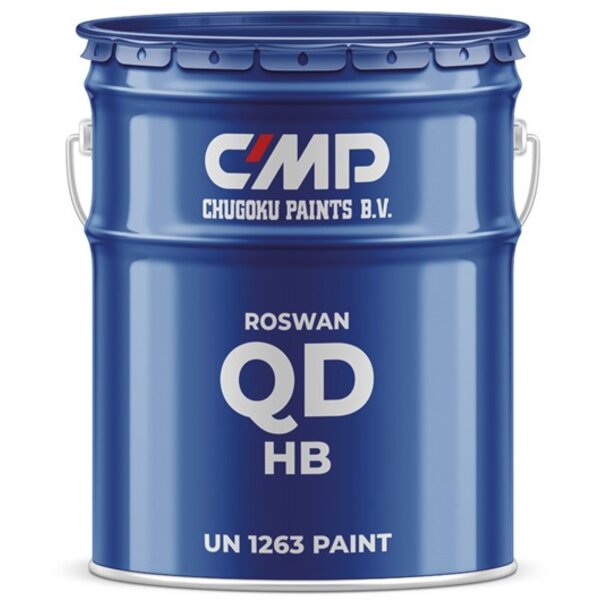
What ROSWAN QD HB is and why choose it
ROSWAN QD HB by Chugoku is a single-pack, high-build alkyd resin primer designed for rust prevention and easy maintenance. Suitable for use inside most areas of a ship, it offers excellent adhesion to alkyd finish coats and is especially recommended as an anticorrosive primer or undercoat for white and other light-coloured topcoats. Its high solids content and robust film build make it ideal for protecting steel structures in demanding marine environments.
Main features
- Special high-build alkyd primer: formulated to achieve 30–70 µm dry film thickness in fewer coats.
- Single-pack product: one-component system for easier mixing, handling and maintenance.
- Rust-preventing performance: developed as a rust-preventing primer for steel, including superstructures and decks.
- Excellent adhesion to alkyd finishes: optimised as an undercoat for EVAMARINE and other alkyd resin based paints.
- Versatile application methods: suitable for airless spray, brush and roller application.
- Usable in low temperatures: application possible from surface temperatures down to -5 °C with appropriate conditions.
- Available colours: White, Grey and Red brown for flexible system design and spot repair visibility.
- Marine-ready formulation: recommended for use inside superstructures, decks, holds and other internal steel areas of ships.
Technical specifications
- Product type: Special high build alkyd resin primer, single pack.
- Recommended use:
- Anticorrosive primer for internal superstructures, decks, holds and other steel structures.
- Undercoat for EVAMARINE and other alkyd resin based finish coats, especially white and light colours.
- Colours: White, Grey, Red brown.
- Flash point: 37 °C (TDS 2024) / 36–47 °C (other regional data).
- Density: Approx. 1.35–1.37 g/mL (20 °C).
- Volume solids:
- Approx. 49–50 ±2% (ISO 3233).
- VOC (theoretical): approx. 346–426 g/L (depending on version).
- Application methods: Airless spray, brush, roller.
- Thinner: MARINE Thinner.
- Thinning ratio:
- 0–10% by volume (latest TDS).
- Some versions specify 0–7% by volume.
- Application conditions:
- Minimum steel temperature: -5 °C.
- Surface temperature: at least 3 °C above dew point.
- Maximum relative humidity: 85% RH.
- Recommended film thickness and spreading rate (latest TDS):
- Wet film thickness: 60–140 µm.
- Dry film thickness: 30–70 µm.
- Theoretical spreading rate: 16.7–7.1 m²/L (depending on DFT).
- Alternative specification (other regional TDS):
- Wet film thickness: 61–143 µm.
- Dry film thickness: 30–70 µm.
- Theoretical coverage: 0.061–0.143 L/m².
- Airless spray equipment:
- Tip no.: Graco 515–617 (latest TDS) or Graco 719 (other regional data).
- Paint output pressure: 14.7–17.7 MPa.
- System compatibility:
- Preferable preceding coats: NZ PRIMER S, CERABOND 2000, etc.
- Preferable subsequent coats: EVAMARINE and other alkyd resin based paints.
- Components: One pack product.
- Drying times at 70 µm DFT (indicative):
- -5 °C: Surface dry 14 h; hard dry 48 h.
- 0 °C: Surface dry 10 h; hard dry 36 h.
- 5 °C: Surface dry 6 h; hard dry 24 h.
- 10 °C: Surface dry 3 h; hard dry 14 h.
- 20 °C: Surface dry 1.5 h; hard dry 7 h.
- 30 °C: Surface dry 45 min; hard dry 4 h.
- Overcoating intervals at 70 µm DFT (indicative):
- -5 °C: Minimum 48–110 h / maximum up to 120 days (depending on version).
- 0 °C: Minimum 36–70 h / maximum up to 120 days.
- 5 °C: Minimum 24–48 h / maximum 120 days.
- 10 °C: Minimum 14–30 h / maximum 100 days.
- 20 °C: Minimum 7–20 h / maximum 90 days.
- 30 °C: Minimum 4–16 h / maximum 60 days.
- Some documents specify that for interior service there is effectively no maximum overcoating limit.
Applications and use cases
- Marine internal areas: Primer for steel inside superstructures, decks, holds and other internal structures where a durable, anticorrosive coating is needed.
- Undercoat for light-coloured finishes: Designed to support white and light topcoats, helping achieve better hiding and long-term performance.
- Maintenance and repair:
- Maintenance surfaces must be clean, dry and free from contamination.
- Damaged areas should be prepared by power tooling to at least St2 (ISO 8501-1:2007) or applied over suitably sweep-blasted surfaces.
- Stripe coating of edges and welds is recommended.
- Newbuilding steel: Surface preparation for new steel is dependent on yard procedures and should be confirmed with the CMP representative.
- Low-temperature projects: Suitable where application down to -5 °C is required, provided dew point and humidity conditions are controlled.
FAQ
1. Is ROSWAN QD HB a single-pack or two-pack primer?
ROSWAN QD HB is a single-pack (one component) alkyd resin based primer.
2. On what substrates can I use ROSWAN QD HB?
It is intended for steel structures inside ships such as superstructures, decks, holds and other internal steel areas.
3. Which topcoats are compatible?
It is especially recommended as an undercoat for EVAMARINE and other alkyd resin based paints, including white and light-coloured finishes.
4. What surface preparation is required for maintenance?
The entire surface must be clean, dry and free from contaminants. Damaged areas should be power tooled to at least St2 (ISO 8501-1:2007) or prepared as a sweep-blasted surface.
5. Can ROSWAN QD HB be applied by brush or roller?
Yes. It can be applied by airless spray, brush or roller. When using brush or roller, additional coats may be required to achieve the specified dry film thickness.
6. What are the recommended film thickness and theoretical coverage?
Typical dry film thickness is 30–70 µm per coat, corresponding to a wet film of about 60–140 µm and a theoretical spreading rate of approximately 16.7–7.1 m²/L, depending on the selected DFT.
7. What thinner should be used?
Use MARINE Thinner, typically at 0–10% by volume (some regional data specify 0–7%).
8. Can it be used at low temperatures?
Yes. Application is permitted on steel surfaces down to -5 °C, as long as the surface is at least 3 °C above the dew point and the relative humidity does not exceed 85% RH.
9. Is the product classified as flammable?
Yes. It is classified as a flammable liquid, Category 3 (Flam. Liq. 3, H226) with a flash point of about 30–37 °C. Keep away from heat, sparks, open flames and hot surfaces.
10. Is ROSWAN QD HB hazardous to the environment?
The mixture is classified as toxic to aquatic life with long lasting effects (Aquatic Chronic 2, H411). Avoid release to the environment and collect any spillage.
Section 14 – Transport information
According to the Safety Data Sheet, ROSWAN QD HB is classified as dangerous goods for transport:
- UN number / ID number: UN 1263.
- Proper shipping name: PAINT.
- Transport hazard class: 3 (flammable liquid).
- Packing group: III.
- Environmental hazards:
- ADR/RID/ADN: Environmental hazardous substances (aquatic environment) – yes.
- IMDG: Marine Pollutant – yes (marine pollutant substance: Zinc Oxide).
- IATA: Not classified as environmentally hazardous under IATA.
- Hazard identification number (ADR): 30.
- EmS (IMDG): F-E, S-E.
- General transport precautions:
- Always transport in tightly closed containers that are upright and securely fastened.
- Ensure personnel involved in transport know what to do in case of accident or spillage.
- Containers that are not properly cleaned may contain highly flammable or explosive vapours.
Section 8 – Personal protective measures
The Safety Data Sheet provides detailed guidance on individual protection when handling ROSWAN QD HB:
Engineering controls
- Provide adequate mechanical ventilation with local exhaust and general extraction to keep solvent vapour and overspray below occupational exposure limits.
- During spray application in booths or enclosed areas, compressed air-fed respirators may be necessary until vapour and particulate levels are safe.
Respiratory protection
- If airborne concentrations can exceed exposure limits, use a respirator conforming to EN 140, fitted with a combined particulate and vapour filter meeting EN 14387, with an assigned protection factor of at least 10 (e.g. A2P3).
- Dry sanding, flame cutting or welding on the dry film can generate hazardous dust and fumes; use wet sanding where possible or suitable respiratory protection.
Hand protection
- There is no single glove material that provides unlimited resistance; for repeated or prolonged contact use gloves tested to EN 374.
- High protection (repeated/prolonged exposure):
- Polyethylene (PE) gloves, minimum thickness approx. 0.062 mm.
- Butyl/Viton gloves, minimum thickness approx. 0.70 mm.
- Medium protection (shorter breakthrough times): PE gloves, butyl/Viton, neoprene or nitrile gloves in the thickness ranges specified in the SDS.
- Replace gloves regularly and immediately if damaged; follow glove manufacturer’s instructions for use and storage.
- Barrier creams may help protect exposed skin areas but should not be applied after exposure.
Eye and face protection
- Use safety eyewear to EN 16321 / EN 166 designed to protect against liquid splashes.
Skin and body protection
- Wear anti-static protective clothing made of natural fibre or high temperature resistant synthetic fibre (EN ISO 13688).
- Contaminated rags, wipes and clothing may self-ignite; store in suitable closed metal containers or lay out in a single layer to dry and remove from the workplace daily.
General hygiene and safety measures
- Avoid skin and eye contact and inhalation of vapours or spray mist.
- Smoking, eating and drinking should be prohibited in application areas.
- Wash hands and face thoroughly after handling and before breaks.
- Prevent product from entering drains or watercourses.
*Contenido generado por IA